

Active vs Passive Components: Key Differences Explained
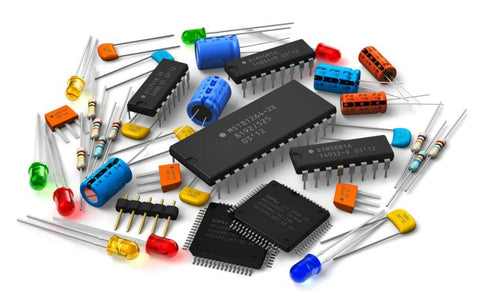
If you look at any assembled circuit board, you'll see dozens of tiny components on its surface. These are the building blocks of electronics. Each one has a different role, but they all fall into one of two categories: active or passive. Understanding the difference is essential before you start building your first circuit.
What Are Electronic Components?
Electronic components are basic devices that affect electrons and their associated fields to make a circuit function. They have electrical terminals (leads) used to connect to other components, usually by soldering onto a PCB (printed circuit board). The circuit then directs and controls electric current to perform various functions.
Active vs Passive Components: Quick Comparison
| Feature | Active Components | Passive Components |
|---|---|---|
| Power source needed? | Yes | No |
| Can amplify signals? | Yes | No |
| Can inject power? | Yes | No |
| Energy behavior | Controls/amplifies current | Consumes/stores energy |
| Examples | Diodes, transistors, ICs | Resistors, capacitors, inductors |
Active Components
Active components can inject power into a circuit, control or amplify current. They require an external power source to operate.
Diodes
Diodes allow current to flow in only one direction. The most popular type is the LED. Browse our ICs & Semiconductors collection.
Transistors
Transistors are three-terminal semiconductor devices used to amplify electrical signals and switch devices. Two main types: BJT (current-controlled) and FET (voltage-controlled).
Integrated Circuits (ICs)
ICs combine multiple components into a single chip — from simple logic gates to complex processors. Always reference the IC's datasheet. Explore our ICs & Semiconductors collection.
Passive Components
Passive components cannot control or amplify current — they consume and store energy. Browse our Passive Components collection.
Resistors
Resistors limit the flow of current. Without them, components would draw too much current and burn out. Measured in ohms (Ω).
Capacitors
Capacitors store electrical energy in an electric field. Measured in farads (F). They allow AC to pass but block DC.
Inductors
Inductors store energy in a magnetic field. Measured in henries (H). They allow DC to pass but block AC.
Transformers
Transformers transfer electrical energy between circuits using a changing magnetic field — with no moving parts.
Switches
Switches connect or disconnect the conducting path in a circuit. Browse our Switches & Sensors collection.
Why You Need Both
Active and passive components work together — neither is useful without the other. Think of it like building a house: passive components are the bricks and structure, while active components are the electricity and plumbing. You need both to build something that works.
Related Guides
- 📌 Arduino Complete Guide: What It Is, How It Works & Getting Started
- 📌 Breakout Boards: Complete Guide to What They Are & How to Use Them
- 📌 Arduino Shield Complete Guide: What It Is, Types & How to Choose
Frequently Asked Questions
Is a battery active or passive?
A battery is an active component — it supplies power to the circuit.
Is an LED active or passive?
An LED is an active component (a type of diode) — it requires a power source.
Where can I buy electronic components?
Browse our Passive Components and ICs & Semiconductors collections.