

DC-DC Buck Converter Guide: How It Works, Efficiency & Selection Tips
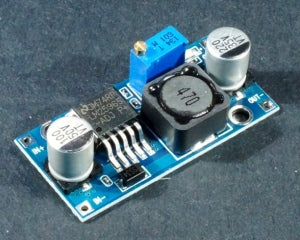
What Is a DC-DC Buck Converter?
A DC-DC buck (step-down) converter takes a higher input voltage and converts it to a lower output voltage efficiently. Unlike linear regulators that waste excess voltage as heat, buck converters use rapid switching and LC filtering to achieve efficiencies of 70–97%.
Common use cases include converting 12V to 5V for microcontrollers, or 5V to 3.3V for sensors in Arduino and Raspberry Pi projects. Browse our Power Supplies & Converters collection for a full range of modules.
Buck Converter vs Linear Regulator
| Feature | Linear Regulator (e.g. 7805) | DC-DC Buck Converter |
|---|---|---|
| Efficiency | Low (excess voltage = heat) | High (70–97%) |
| Heat generation | High | Low |
| Output ripple | Very low | Some ripple present |
| Cost | Low | Slightly higher |
| Complexity | Simple | More complex |
| Best for | Low current, noise-sensitive | Battery-powered, high current |
How a Buck Converter Works
A buck converter rapidly switches an output power transistor on and off, creating a square wave. An LC filter (inductor + capacitor) smooths this back into a stable DC output voltage. The duty cycle of the switching determines the output voltage ratio.
Power dissipation in a buck converter is primarily related to current, not voltage drop — making it far more efficient than a linear regulator when there is a large voltage difference between input and output.
Efficiency Calculation
Efficiency = (Vout × Iout) / (Vin × Iin) × 100%
Example: Converting 15V input to 5V @ 1A output:
- Linear regulator: wastes (15−5) × 1A = 10W as heat
- Buck converter at 85% efficiency: draws only 0.39A from 15V input
Most buck converter modules run 75–95% efficient in real-world conditions. Expect 10–15% less than the manufacturer's quoted peak efficiency.
Key Components and Trade-offs
Electrolytic Capacitors
Capacitor life is primarily determined by operating temperature. Cheap buck converters often use standard ESR capacitors instead of low-ESR types, causing higher self-heating and shorter lifespan. If capacitors are too hot to touch, reduce the load.
Inductors
Budget converters often use undersized inductors to save space and cost. At high loads, the inductor heats up due to wire resistance. If the inductor is too hot to touch, reduce the current load.
Output Ripple and Noise
- Lab bench supply: <10mV ripple
- Quality module: ~100mV ripple
- Budget module: 300–500mV+ ripple
For most digital circuits (Arduino, microcontrollers), ripple is not a concern. For analog circuits, add a secondary LC filter if needed.
Converter IC Heat Sinking
Budget modules (e.g. LM2596-based) often have insufficient copper area for full rated current. Rule of thumb: Derate budget buck converters to ~50% of rated maximum current for reliable long-term operation.
How to Choose a DC-DC Buck Converter
- Input voltage range: Must exceed your source voltage with margin
- Output voltage range: Fixed or adjustable to your target voltage
- Current rating: Choose 2× your expected load for budget modules
- Efficiency: Look for 85%+ for battery-powered applications
- Ripple spec: <100mV for analog circuits, <500mV acceptable for digital
- Capacitor quality: Low-ESR capacitors = longer life and lower ripple
Browse our Power Supplies & Converters collection to find the right module for your project.
Frequently Asked Questions
What is the difference between a buck converter and a linear regulator?
A linear regulator drops voltage by dissipating excess energy as heat (low efficiency). A buck converter switches rapidly and uses an LC filter to step down voltage with much higher efficiency (70–97%), generating far less heat.
Can I use a DC-DC buck converter for Arduino?
Yes. Buck converters are ideal for powering Arduino from higher voltage sources like 12V batteries. Use a converter with adjustable output set to 5V or 7–12V.
Why is my buck converter getting hot?
Overheating usually means the converter is running near or above its rated current. Derate to 50% of rated current for continuous operation and ensure adequate airflow.
Where can I buy DC-DC buck converter modules?
Browse our Power Supplies & Converters collection for a wide range of step-down modules compatible with Arduino, Raspberry Pi, and DIY electronics projects.