



Keszoox
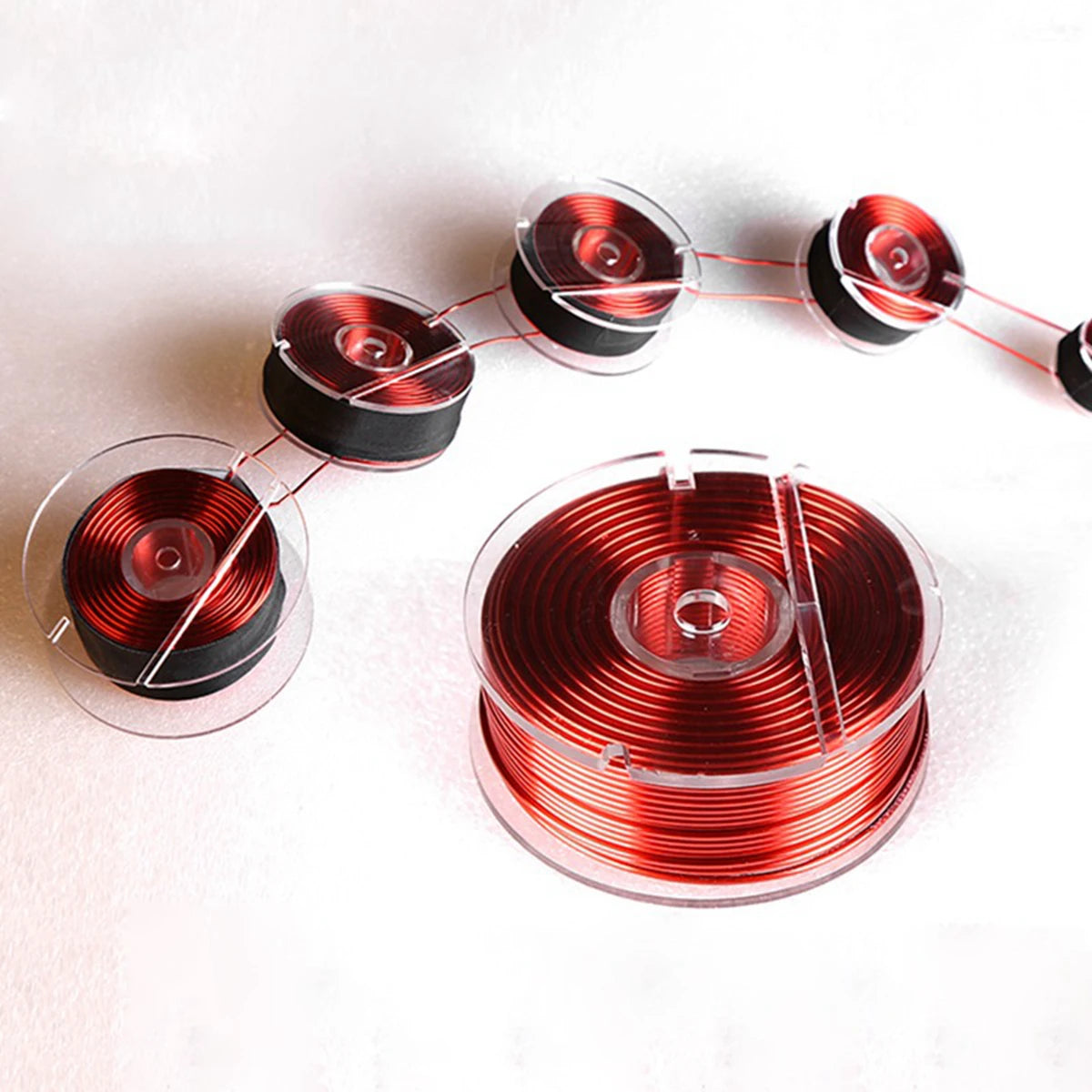
1.0mm Oxygen-Free Copper Air Core Inductor — Speaker Crossover Coil 0.07mH–3.3mH
1.0mm Oxygen-Free Copper Air Core Inductor Speaker Crossover Coil 0.07mH–3.3mH

Couldn't load pickup availability
1.0mm Oxygen-Free Copper Air Core Inductor — Speaker Crossover Coil 0.07mH–3.3mH
These 1.0mm oxygen-free copper (OFC) air core inductors are wound specifically for passive speaker crossover networks. Unlike iron-core inductors, the air core design eliminates magnetic saturation and hysteresis distortion, delivering cleaner, more accurate frequency division across the audio band. With inductance values from 0.07mH to 3.3mH and a ±5% tolerance, these coils are suitable for woofer low-pass and midrange bandpass sections in 2-way and 3-way passive crossover designs.
Key Specifications
| Parameter | Value |
|---|---|
| Wire Material | Oxygen-Free Copper (OFC), 1.0mm diameter |
| Core Type | Air core (no magnetic core) |
| Inductance Range | 0.07mH – 3.3mH (select variant) |
| Inductance Tolerance | ±5% |
| DCR (DC Resistance) | Varies by inductance value (lower for smaller values) |
| Application | Passive speaker crossover networks (low-pass, bandpass filters) |
| Origin | CN |
Air Core vs Iron Core Inductors for Audio
| Feature | Air Core (This Product) | Iron Core |
|---|---|---|
| Magnetic Saturation | ✅ None — linear at all power levels | ❌ Saturates at high power |
| Hysteresis Distortion | ✅ Zero | ❌ Present, adds coloration |
| DCR | ❌ Higher (more wire needed) | ✅ Lower |
| Size | ❌ Larger for same inductance | ✅ More compact |
| Best Use | Tweeter & midrange crossover, audiophile builds | Woofer low-pass in high-power systems |
Typical Applications
- 2-way passive crossover woofer low-pass filter (L-pad section)
- 3-way passive crossover midrange bandpass filter
- DIY audiophile speaker crossover upgrades
- Replacement for degraded or incorrect-value crossover inductors
- Tube amplifier output filter and choke applications
Frequently Asked Questions
Q: How do I select the right inductance value for my crossover?
Use the standard crossover filter formula: L = Z / (2π × f) for a first-order (6dB/octave) low-pass filter, where Z is the driver impedance (typically 4Ω or 8Ω) and f is the crossover frequency in Hz. For higher-order filters, use a crossover design calculator (e.g., the one at crossover-calculator.com) to determine the exact L and C values.
Q: What is the power handling of these inductors?
Power handling depends on the DCR and wire gauge. The 1.0mm OFC wire handles continuous audio power well for most home audio applications (up to ~100W RMS per channel). For high-power PA or subwoofer applications above 200W, consider 1.2mm or 1.4mm wire inductors.
Package Contents
- 1× 1.0mm OFC Air Core Crossover Inductor (inductance value per selected variant)



Blog posts
View all-

IC Chips & Discrete Components Express Shipping...
Shipping IC chips and discrete electronic components internationally requires more than choosing a carrier. ESD-safe packaging, correct HS codes, accurate customs declarations, and carrier selection for your destination all determine...
IC Chips & Discrete Components Express Shipping...
Shipping IC chips and discrete electronic components internationally requires more than choosing a carrier. ESD-safe packaging, correct HS codes, accurate customs declarations, and carrier selection for your destination all determine...
-

From Prototype to Mass Production — How to Scal...
Scaling from prototype to mass production is the most critical transition in a hardware product's lifecycle. The sourcing strategy that works for 10 prototype boards — cut tape, spot pricing,...
From Prototype to Mass Production — How to Scal...
Scaling from prototype to mass production is the most critical transition in a hardware product's lifecycle. The sourcing strategy that works for 10 prototype boards — cut tape, spot pricing,...
-

ISO 9001 Electronic Component Distributor — Wha...
ISO 9001:2015 certification is the most widely recognized quality management standard in the world — but what does it actually mean when an electronic component distributor claims to be ISO...
ISO 9001 Electronic Component Distributor — Wha...
ISO 9001:2015 certification is the most widely recognized quality management standard in the world — but what does it actually mean when an electronic component distributor claims to be ISO...


