



16-Position Hex Rotary Switch — 4-Bit Binary Output, Right Angle PCB Mount
16-Position Hex Rotary Switch 4-Bit Binary Output, Right Angle PCB Mount
Compatible JST cables for sensors and modules — secure & reliable. Shop now.

Couldn't load pickup availability
16-Position Hex Rotary Switch — 4-Bit Binary Output, Right Angle PCB Mount
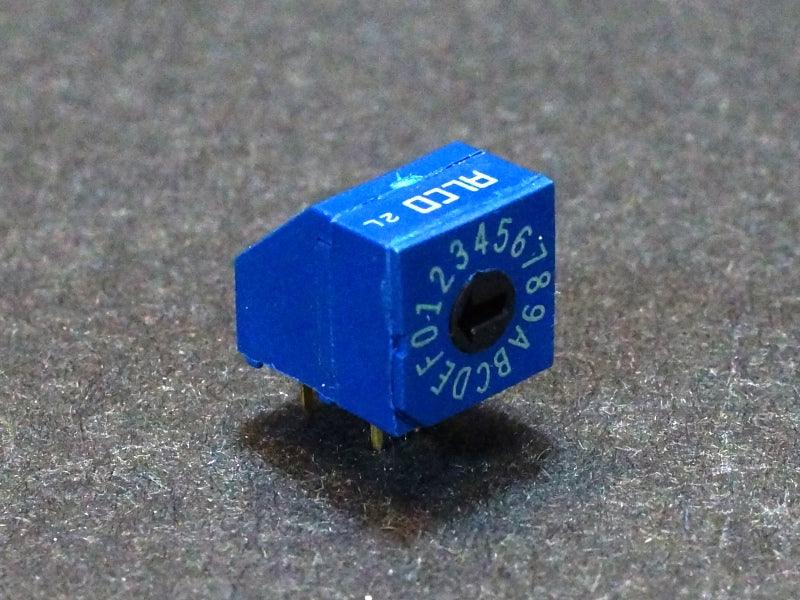
This Alcoswitch 16-position hexadecimal rotary switch provides a clean, reliable way to set a 4-bit binary value (0–F) in embedded systems — ideal for device address selection, DIP switch replacement, and operational mode setting. The right-angle PCB mount design allows the switch to be accessed through a hole in the side of an enclosure without opening it, making it perfect for field-configurable devices. Gold contacts ensure low contact resistance and long service life.
Electrical Specifications
- Positions: 16 (hexadecimal 0–F)
- Output: 4-bit binary code (BCD)
- Contact Rating: 20V DC @ 400mA
- Contact Style: Single-pole / 16-throw
- Contact Material: Gold-plated
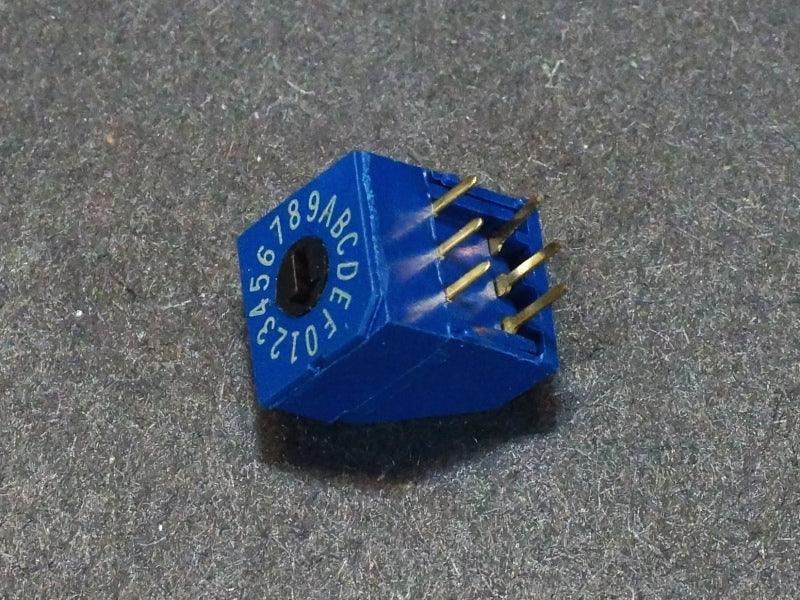
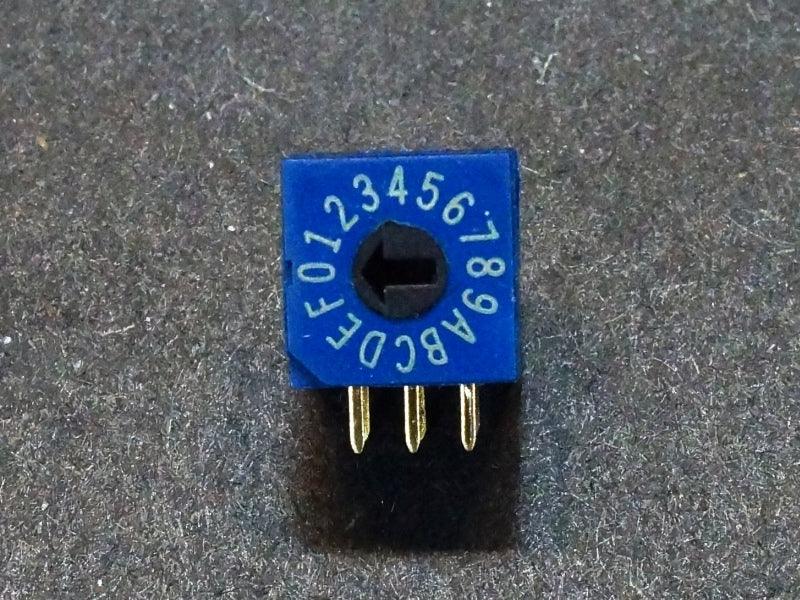
- Termination: 6 PCB solder pins (2.54mm pitch)
- Row Spacing: 5.08mm (0.2")
- Body Dimensions: 12 × 10 × 10mm
How It Works — 4-Bit Binary Output
The switch has 6 PCB pins: 2 common pins (tied together internally) and 4 output pins representing binary values 1, 2, 4, and 8. When the switch is rotated to a position, the corresponding output pins are connected to the common pins, presenting the position value in binary format.
Truth Table (C = Common, X = Connected)
- Position 0: No outputs connected
- Position 1: Pin 1 connected to C
- Position 3: Pins 1 and 2 connected to C
- Position F (15): Pins 1, 2, 4, and 8 all connected to C
Wiring Options
- Active LOW (common to GND): Connect common pins to GND; read output pins with MCU input pull-ups enabled — output pins go LOW when connected
- Active HIGH (common to Vcc): Connect common pins to Vcc via pull-up; output pins go HIGH when connected
- Connect the 4 output pins to 4 digital input pins on your microcontroller to read the binary value
Typical Applications
- I²C / SPI device address selection: Set the hardware address of I²C sensors, EEPROMs, and expanders (0–F = 16 unique addresses)
- Operational mode selection: Select from up to 16 operating modes without firmware changes
- DIP switch replacement: Single rotary switch replaces a 4-switch DIP block with a more user-friendly interface
- Field configuration: Right-angle mount allows access through enclosure panel without opening the device
- Unit ID setting: Assign unique IDs to devices on a shared bus or network
Package Contents
- 1 × Alcoswitch 16-position hex rotary switch (right angle PCB mount)
New old stock Alcoswitch quality — gold contacts, 16 positions, 4-bit binary output in a right-angle PCB package for clean panel-accessible device configuration.

Blog posts
View all-

IC Chips & Discrete Components Express Shipping...
Shipping IC chips and discrete electronic components internationally requires more than choosing a carrier. ESD-safe packaging, correct HS codes, accurate customs declarations, and carrier selection for your destination all determine...
IC Chips & Discrete Components Express Shipping...
Shipping IC chips and discrete electronic components internationally requires more than choosing a carrier. ESD-safe packaging, correct HS codes, accurate customs declarations, and carrier selection for your destination all determine...
-

From Prototype to Mass Production — How to Scal...
Scaling from prototype to mass production is the most critical transition in a hardware product's lifecycle. The sourcing strategy that works for 10 prototype boards — cut tape, spot pricing,...
From Prototype to Mass Production — How to Scal...
Scaling from prototype to mass production is the most critical transition in a hardware product's lifecycle. The sourcing strategy that works for 10 prototype boards — cut tape, spot pricing,...
-

ISO 9001 Electronic Component Distributor — Wha...
ISO 9001:2015 certification is the most widely recognized quality management standard in the world — but what does it actually mean when an electronic component distributor claims to be ISO...
ISO 9001 Electronic Component Distributor — Wha...
ISO 9001:2015 certification is the most widely recognized quality management standard in the world — but what does it actually mean when an electronic component distributor claims to be ISO...


