



1N4007 Rectifier Diode 1000V 1A — DO-41 General Purpose, 10-Pack
1N4007 Rectifier Diode 1000V 1A DO-41 General Purpose, 10-Pack
Compatible JST cables for sensors and modules — secure & reliable. Shop now.

Couldn't load pickup availability
1N4007 Rectifier Diode — 1000V / 1A, DO-41 Package (10-Pack)
The 1N4007 is the highest-rated member of the industry-standard 1N400x rectifier diode family, offering a 1000V peak reverse voltage (VR) with a 1A average forward current (IF) rating. Its 1000V rating makes it the universal choice across the entire 1N400x series — suitable for 50Hz and 60Hz mains rectification in both 120V and 230V AC systems, switch-mode power supply (SMPS) input stages, and any application where maximum reverse voltage margin is required. The 1N4007 is the single diode that replaces all lower-rated 1N400x variants, making it the most widely stocked rectifier diode in the world.
Key Specifications
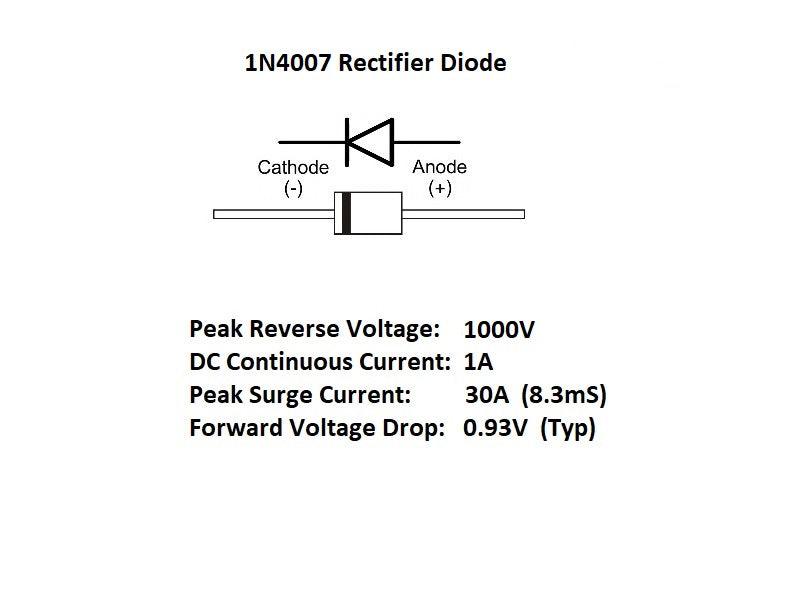
- Peak Reverse Voltage (VR): 1000V
- Average Forward Current (IF): 1A
- Peak Surge Current (IFSM): 30A
- Forward Voltage Drop (VF): 1.1V @ 1A
- Reverse Leakage Current (IR): 5μA @ 1000V
- Reverse Recovery Time (trr): ~2μs (not suitable for high-frequency switching)
- Operating Temperature: -65°C to +175°C (junction)
- Package: DO-41 (axial lead, through-hole)
- Compliance: RoHS compliant
1N400x Series Comparison — Why Choose 1N4007?
- 1N4001: 50V — low-voltage DC circuits only
- 1N4002: 100V — standard transformer rectification
- 1N4003: 200V — 100V AC mains rectification
- 1N4004: 400V — 230V AC mains rectification
- 1N4007 (this): 1000V — universal use; replaces all lower-rated 1N400x variants; maximum safety margin for mains applications
Typical Applications
- Mains rectification: Half-wave and full-wave bridge rectifiers for 120V and 230V AC power supplies
- SMPS input stage: Bridge rectifier at the AC input of switch-mode power supplies
- Flyback / freewheeling diode: Relay coil, motor, and solenoid back-EMF protection
- Reverse polarity protection: Series diode in DC power input circuits
- Battery charger rectification: Transformer-based charger output stage
- Signal clamping and clipping: General-purpose diode in signal conditioning circuits
- Electronics repair and prototyping: Universal replacement for any 1N400x diode
Why the 1N4007 is the Industry Standard
The 1N4007's 1000V rating provides a 4× safety margin over the 230V AC peak voltage (~325V peak), making it the preferred choice for mains-connected circuits where transient overvoltages from lightning, switching surges, and inductive loads can momentarily exceed the nominal voltage. Professional electronics designers and repair technicians worldwide default to the 1N4007 as their standard rectifier diode precisely because its 1000V rating eliminates the risk of reverse breakdown in any mains-frequency application.
Package Contents
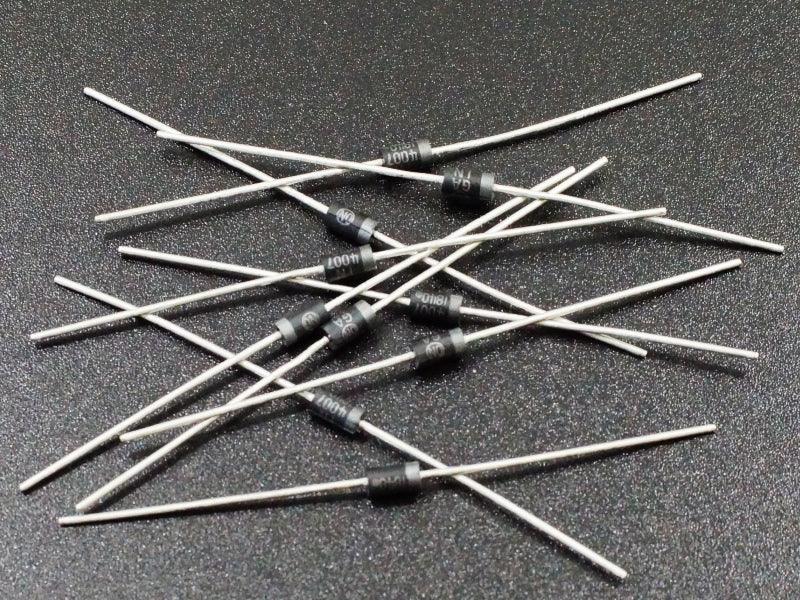
- 10 × 1N4007 Rectifier Diodes (DO-41, axial lead)
Supplied by leading manufacturers including Fairchild (ON Semiconductor), Vishay, STMicroelectronics, and equivalent. RoHS compliant. Suitable for breadboard, through-hole PCB, and point-to-point wiring applications.

Blog posts
View all-

IC Chips & Discrete Components Express Shipping...
Shipping IC chips and discrete electronic components internationally requires more than choosing a carrier. ESD-safe packaging, correct HS codes, accurate customs declarations, and carrier selection for your destination all determine...
IC Chips & Discrete Components Express Shipping...
Shipping IC chips and discrete electronic components internationally requires more than choosing a carrier. ESD-safe packaging, correct HS codes, accurate customs declarations, and carrier selection for your destination all determine...
-

From Prototype to Mass Production — How to Scal...
Scaling from prototype to mass production is the most critical transition in a hardware product's lifecycle. The sourcing strategy that works for 10 prototype boards — cut tape, spot pricing,...
From Prototype to Mass Production — How to Scal...
Scaling from prototype to mass production is the most critical transition in a hardware product's lifecycle. The sourcing strategy that works for 10 prototype boards — cut tape, spot pricing,...
-

ISO 9001 Electronic Component Distributor — Wha...
ISO 9001:2015 certification is the most widely recognized quality management standard in the world — but what does it actually mean when an electronic component distributor claims to be ISO...
ISO 9001 Electronic Component Distributor — Wha...
ISO 9001:2015 certification is the most widely recognized quality management standard in the world — but what does it actually mean when an electronic component distributor claims to be ISO...


