



ULN2003A 7-Channel Darlington Transistor Array IC DIP-16 — 500mA / 50V, Relay & Stepper Driver
ULN2003A 7-Channel Darlington Transistor Array IC DIP-16 500mA / 50V, Relay & Stepper Driver
Compatible JST cables for sensors and modules — secure & reliable. Shop now.

Couldn't load pickup availability
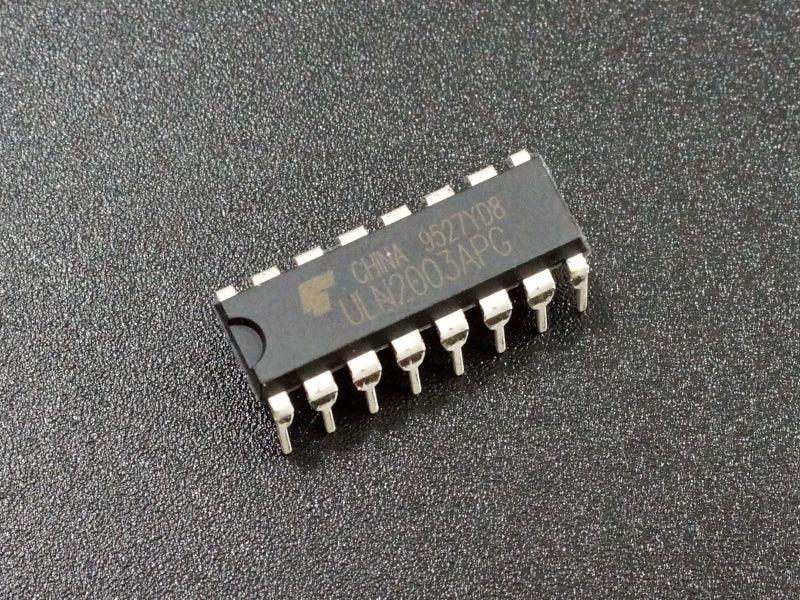
ULN2003A — 7-Channel Darlington Transistor Array, DIP-16
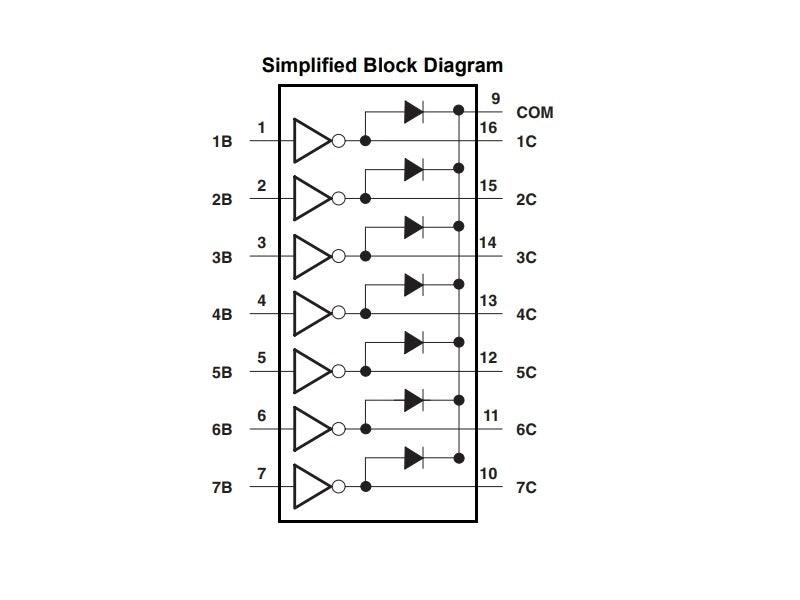
The ULN2003A is the world's most widely used driver IC for interfacing microcontrollers to high-current loads. Its 7 NPN Darlington channels each sink up to 500mA at 50V, with built-in flyback diodes on every output for inductive load protection. It is the standard driver for 28BYJ-48 stepper motors (the most popular Arduino stepper motor), relay boards, solenoids, and high-power LED arrays — all without external transistors or diodes.
The ULN2003A's inputs are directly compatible with 5V TTL and CMOS logic, making it a plug-and-play interface between Arduino GPIO pins and high-current loads. Its DIP-16 package is breadboard-compatible for easy prototyping.
Key Features
- 7 independent Darlington channels — each rated 500mA @ 50V
- Built-in flyback diodes on all outputs — relay and solenoid protection included
- 5V TTL/CMOS compatible inputs — direct connection to Arduino, ESP32, Raspberry Pi GPIO
- Active-low outputs — output sinks current when input is HIGH
- Standard driver for 28BYJ-48 stepper motor
- No external components required for basic relay/solenoid driving
- DIP-16 package — breadboard and through-hole PCB compatible
- RoHS compliant
Technical Specifications
| Channels | 7 |
| Output Voltage (max) | 50V |
| Output Current (per channel) | 500mA continuous |
| Input Voltage (logic HIGH) | 2.4V – 5V (TTL/CMOS compatible) |
| Flyback Diodes | Built-in on all 7 outputs |
| Output Type | Open-collector (active-low sink) |
| Package | DIP-16 (through-hole) |
| Manufacturer | Texas Instruments / STMicroelectronics / Toshiba |
ULN2003A vs ULN2803A
- ULN2003A (this): 7 channels, DIP-16 — standard for 28BYJ-48 stepper motors, 7-segment displays, 7-relay boards
- ULN2803A: 8 channels, DIP-18 — preferred for 8-relay boards and full-byte I/O driving
Typical Applications
- 28BYJ-48 stepper motor driver — the standard driver IC for this popular Arduino stepper
- Relay board driver — drive 7 relays from a single IC with built-in flyback protection
- Solenoid valve array — control 7 solenoids from Arduino or PLC output
- High-power LED driver — drive 7 high-current LEDs or LED segments
- Common-anode 7-segment display digit driver
- Output expander — extend microcontroller I/O to drive 7 high-current loads
Package Contents
- 1 × ULN2003A 7-Channel Darlington Array IC (DIP-16)

Blog posts
View all-

IC Chips & Discrete Components Express Shipping...
Shipping IC chips and discrete electronic components internationally requires more than choosing a carrier. ESD-safe packaging, correct HS codes, accurate customs declarations, and carrier selection for your destination all determine...
IC Chips & Discrete Components Express Shipping...
Shipping IC chips and discrete electronic components internationally requires more than choosing a carrier. ESD-safe packaging, correct HS codes, accurate customs declarations, and carrier selection for your destination all determine...
-

From Prototype to Mass Production — How to Scal...
Scaling from prototype to mass production is the most critical transition in a hardware product's lifecycle. The sourcing strategy that works for 10 prototype boards — cut tape, spot pricing,...
From Prototype to Mass Production — How to Scal...
Scaling from prototype to mass production is the most critical transition in a hardware product's lifecycle. The sourcing strategy that works for 10 prototype boards — cut tape, spot pricing,...
-

ISO 9001 Electronic Component Distributor — Wha...
ISO 9001:2015 certification is the most widely recognized quality management standard in the world — but what does it actually mean when an electronic component distributor claims to be ISO...
ISO 9001 Electronic Component Distributor — Wha...
ISO 9001:2015 certification is the most widely recognized quality management standard in the world — but what does it actually mean when an electronic component distributor claims to be ISO...


