



W25Q512JV 512Mbit (64MB) SPI NOR Flash Memory IC — SOIC-8 / WSON-8, 133MHz, 3.3V
W25Q512JV 512Mbit (64MB) SPI NOR Flash Memory IC SOIC-8 / WSON-8, 133MHz, 3.3V
Compatible JST cables for sensors and modules — secure & reliable. Shop now.

Couldn't load pickup availability
W25Q512JV 512Mbit (64MB) SPI NOR Flash Memory IC — Winbond
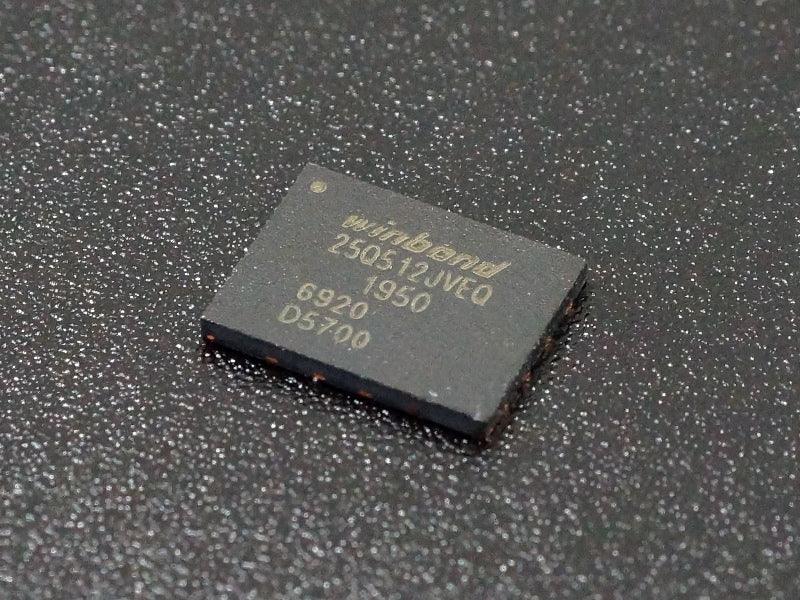
The Winbond W25Q512JV is a high-density 512Mbit (64MB) SPI NOR Flash memory IC combining large non-volatile storage capacity with a fast, flexible serial interface. Operating from a 2.7V–3.6V supply at up to 133MHz SPI clock (266MB/s effective in Quad SPI mode), it delivers execute-in-place (XIP) capability, byte-level random read access, and 100,000 write/erase cycles per sector — making it the preferred choice for embedded firmware storage, OTA update buffers, and large asset repositories in space-constrained designs.
Compatible with the Teensy 4.1 external flash footprint, ESP32, STM32, RP2040, and virtually any microcontroller with an SPI or QSPI peripheral. The W25Q512JV supports standard SPI, Dual SPI, and Quad SPI modes — allowing you to trade off compatibility vs. throughput depending on your MCU’s capabilities.
Key Specifications
| Parameter | Value |
|---|---|
| Capacity | 512Mbit (64MB / 67,108,864 bytes) |
| Technology | NOR Flash (byte-addressable) |
| Interface | Standard SPI / Dual SPI / Quad SPI (QSPI) |
| Max SPI Clock | 133MHz (standard SPI) |
| Max Quad SPI Throughput | 266MB/s (133MHz × 4 data lines) |
| Supply Voltage | 2.7V – 3.6V (3.3V nominal) |
| Standby Current | 1µA typical |
| Active Read Current | 4mA typical |
| Page Size | 256 bytes |
| Sector Size | 4KB (smallest erasable unit) |
| Block Size | 64KB |
| Write Endurance | 100,000 cycles per sector |
| Data Retention | 20 years |
| Execute-in-Place (XIP) | Yes (NOR Flash, byte-addressable) |
| Package | SOIC-8 (1.27mm pitch) / WSON-8 (6×5mm) |
| Operating Temperature | -40°C to +85°C |
| Manufacturer | Winbond Electronics |
| RoHS Compliant | Yes |
NOR Flash vs NAND Flash — Which Do You Need?
| Feature | NOR Flash (W25Q512JV) | NAND Flash (W25N02) |
|---|---|---|
| Random Read Access | ✅ Fast, byte-addressable | ⚠️ Page-based (slower random) |
| Execute-in-Place (XIP) | ✅ Yes — code can run directly | ❌ No |
| Write/Erase Speed | Moderate | Faster (larger pages) |
| Capacity Range | Up to 64MB | Up to 256MB+ |
| Best For | Firmware, bootloaders, code storage | Data files, logs, LittleFS |
| Bad Block Management | Not required | Required (ECC/BBM) |
Why Choose the W25Q512JV?
- 64MB in a tiny SOIC-8 footprint — the largest capacity in the W25Q series, fitting the same 8-pin package as smaller chips
- Execute-in-Place (XIP) — NOR Flash allows code to be executed directly from the chip via QSPI, extending MCU program memory without copying to RAM
- 133MHz Quad SPI — 266MB/s effective throughput for fast firmware loading and asset streaming
- Ultra-low standby current (1µA) — negligible power draw in battery-powered and IoT applications
- 100,000 write cycles — suitable for OTA firmware updates, configuration writes, and moderate-frequency data logging
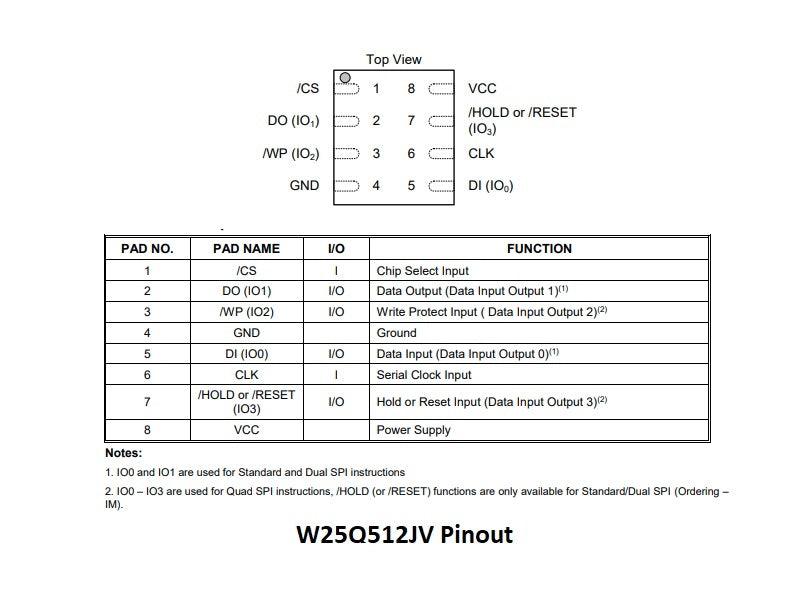
- Industry-standard W25Q pinout — drop-in compatible with W25Q256, W25Q128, and other W25Q series chips
- Wide MCU compatibility — works with Teensy 4.1, ESP32, ESP8266, STM32, RP2040, nRF52840, and any SPI-capable MCU
Compatible Platforms
| Platform | Use Case | Interface Mode |
|---|---|---|
| Teensy 4.1 | External flash footprint (bottom of board) | QSPI (built-in support) |
| ESP32 / ESP32-S3 | External flash expansion via QSPI | Quad SPI |
| STM32 (QSPI peripheral) | Firmware + data storage, XIP | Quad SPI |
| RP2040 (Raspberry Pi Pico) | Program flash replacement/expansion | QSPI |
| Arduino (SPI) | Data/file storage via SPIFlash library | Standard SPI |
Typical Applications
- Teensy 4.1 external program and data flash expansion
- ESP32 / STM32 firmware storage and OTA update buffer
- LittleFS / SPIFFS / FAT file system storage
- Bootloader and multi-partition firmware storage
- Large lookup table, font, and bitmap asset storage for display projects
- Audio sample and waveform storage for synthesizer and audio projects
- Configuration and calibration data non-volatile storage
- Data logger storage for IoT sensor nodes
Frequently Asked Questions
Q: Is the W25Q512JV compatible with the Teensy 4.1 external flash footprint?
Yes. The Teensy 4.1 has a dedicated SOIC-8 footprint on the bottom of the board for external flash. The W25Q512JV fits this footprint directly. Solder before installing header pins for easier access. The Teensy 4.1 bootloader and LittleFS library support the W25Q512JV natively.
Q: Can I execute code directly from this flash chip (XIP)?
Yes — NOR Flash supports execute-in-place. On platforms like STM32 and RP2040 with QSPI memory-mapped mode, the W25Q512JV can be mapped into the MCU’s address space and code can run directly from it. On Teensy 4.1, external flash is used for data storage (LittleFS), not direct code execution.
Q: What is the smallest erasable unit?
The smallest erasable unit is a 4KB sector. Individual bytes can be read or programmed (written from 1→0), but erasing (0→1) requires erasing the entire 4KB sector. Plan your file system or data layout accordingly to minimize unnecessary erase cycles.
Q: How does W25Q512JV compare to W25Q256?
The W25Q512JV has 4× the capacity (64MB vs 16MB) in the same SOIC-8 package with the same pinout. It is a drop-in upgrade for designs using W25Q256 or smaller W25Q series chips, provided the host MCU’s flash driver supports 4-byte addressing (required for capacities above 16MB).
Q: Does this work with the Arduino SPIFlash / SerialFlash library?
Yes. The W25Q512JV is compatible with the Adafruit SPIFlash and SerialFlash libraries for Arduino. Ensure your library version supports 4-byte addressing for full 64MB access. The chip’s JEDEC ID (EF 40 20) is recognized by most SPI Flash libraries.
Package Contents
- 1× Winbond W25Q512JV SPI NOR Flash IC (SOIC-8 or WSON-8)

Blog posts
View all-

IC Chips & Discrete Components Express Shipping...
Shipping IC chips and discrete electronic components internationally requires more than choosing a carrier. ESD-safe packaging, correct HS codes, accurate customs declarations, and carrier selection for your destination all determine...
IC Chips & Discrete Components Express Shipping...
Shipping IC chips and discrete electronic components internationally requires more than choosing a carrier. ESD-safe packaging, correct HS codes, accurate customs declarations, and carrier selection for your destination all determine...
-

From Prototype to Mass Production — How to Scal...
Scaling from prototype to mass production is the most critical transition in a hardware product's lifecycle. The sourcing strategy that works for 10 prototype boards — cut tape, spot pricing,...
From Prototype to Mass Production — How to Scal...
Scaling from prototype to mass production is the most critical transition in a hardware product's lifecycle. The sourcing strategy that works for 10 prototype boards — cut tape, spot pricing,...
-

ISO 9001 Electronic Component Distributor — Wha...
ISO 9001:2015 certification is the most widely recognized quality management standard in the world — but what does it actually mean when an electronic component distributor claims to be ISO...
ISO 9001 Electronic Component Distributor — Wha...
ISO 9001:2015 certification is the most widely recognized quality management standard in the world — but what does it actually mean when an electronic component distributor claims to be ISO...


