



Reed Switch Module — Magnetic Contact Sensor, Digital Output, Arduino Compatible
Reed Switch Module Magnetic Contact Sensor, Digital Output, Arduino Compatible
Compatible JST cables for sensors and modules — secure & reliable. Shop now.

Couldn't load pickup availability
Reed Switch Module — Magnetic Contact Sensor, Digital Output, Arduino Compatible
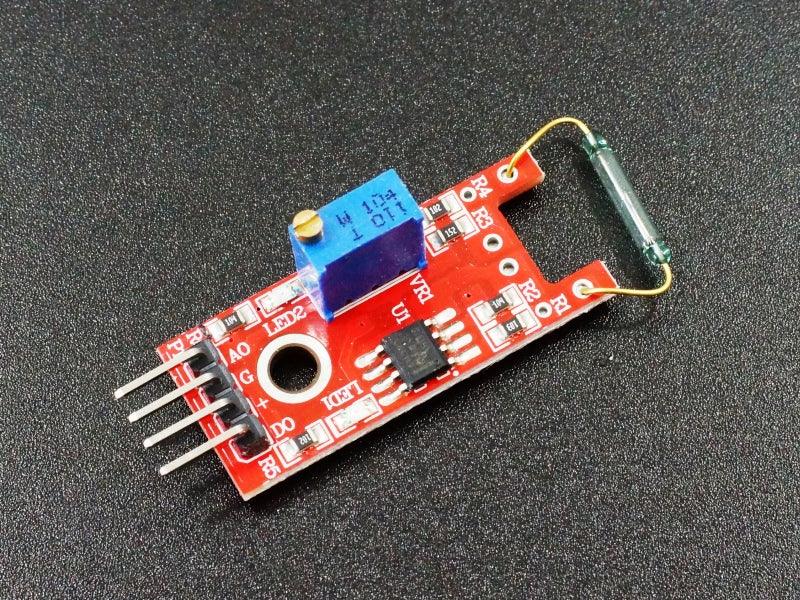
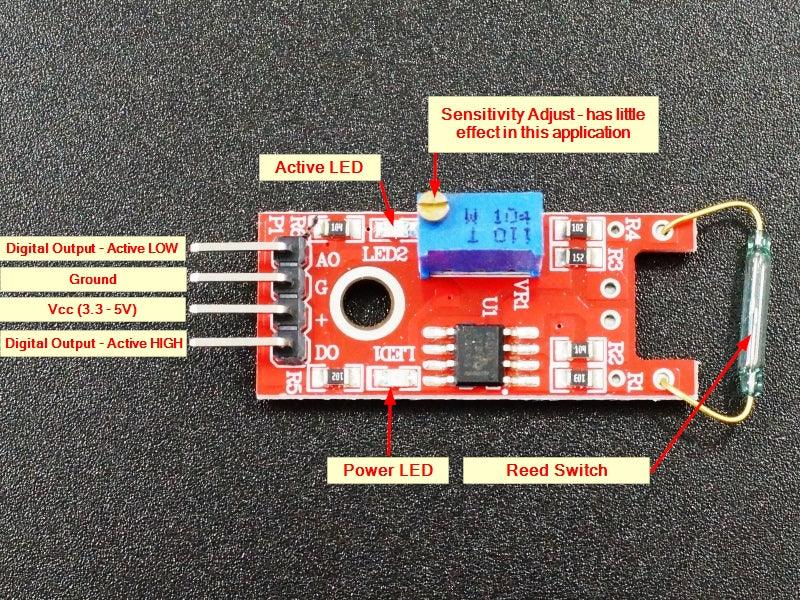
This reed switch module uses a magnetically-actuated reed switch to detect the presence of a magnet without any physical contact. When a magnet is brought within range, the reed switch closes and the module outputs a digital signal. Unlike mechanical switches, reed switches have no moving parts exposed to the environment, making them ideal for sealed enclosures, door/window detection, and liquid level sensing. The module includes a PCB with pull-up resistor and 3-pin header for direct Arduino connection.
Module Specifications
- Sensor Type: Reed switch (magnetically actuated)
- Output: Digital (HIGH when no magnet, LOW when magnet present)
- Operating Voltage: 3.3V – 5V DC
- Connector: 3-pin male header (GND, VCC, Signal)
- Actuation: Magnetic field (no physical contact required)
Reed Switch vs Hall Effect Sensor
- Reed switch: Mechanical contacts, simple digital output, lower cost — for basic presence detection
- Hall effect sensor: Solid-state, can detect polarity and field strength — for precise position and speed sensing
Typical Applications
- Door / window sensor: Detect open/closed state of doors and windows for security systems
- Liquid level detection: Float-mounted magnet triggers reed switch at set liquid level
- Proximity detection: Detect presence of magnetic objects without contact
- Rotation counting: Count rotations of a shaft with a magnet attached
- Tamper detection: Detect opening of enclosures in security applications
Package Contents
- 1 × Reed switch module with 3-pin header
Non-contact magnetic detection — reed switch module with digital output for door/window sensing, liquid level detection, and proximity sensing in Arduino projects.

Blog posts
View all-

IC Chips & Discrete Components Express Shipping...
Shipping IC chips and discrete electronic components internationally requires more than choosing a carrier. ESD-safe packaging, correct HS codes, accurate customs declarations, and carrier selection for your destination all determine...
IC Chips & Discrete Components Express Shipping...
Shipping IC chips and discrete electronic components internationally requires more than choosing a carrier. ESD-safe packaging, correct HS codes, accurate customs declarations, and carrier selection for your destination all determine...
-

From Prototype to Mass Production — How to Scal...
Scaling from prototype to mass production is the most critical transition in a hardware product's lifecycle. The sourcing strategy that works for 10 prototype boards — cut tape, spot pricing,...
From Prototype to Mass Production — How to Scal...
Scaling from prototype to mass production is the most critical transition in a hardware product's lifecycle. The sourcing strategy that works for 10 prototype boards — cut tape, spot pricing,...
-

ISO 9001 Electronic Component Distributor — Wha...
ISO 9001:2015 certification is the most widely recognized quality management standard in the world — but what does it actually mean when an electronic component distributor claims to be ISO...
ISO 9001 Electronic Component Distributor — Wha...
ISO 9001:2015 certification is the most widely recognized quality management standard in the world — but what does it actually mean when an electronic component distributor claims to be ISO...


