



Keszoox
CBB60 Motor Start Capacitor 3µF–80µF 450VAC 50/60Hz | PBT Shell Flame-Retardant | Washing Machine Pump Motor
CBB60 Motor Start Capacitor 3µF–80µF 450VAC 50/60Hz | PBT Shell Flame-Retardant | Washing Machine Pump Motor

Couldn't load pickup availability
CBB60 Motor Start Capacitor — 3µF–80µF | 450VAC | 50/60Hz | Washing Machine & Pump Motor
The CBB60 motor start capacitor is the standard run/start capacitor for single-phase AC induction motors in washing machines, water pumps, air compressors, and HVAC fan motors. Single-phase AC motors cannot self-start — they require a capacitor to create a phase shift between the main winding and the start winding, generating the rotating magnetic field needed to produce starting torque. The CBB60 uses a metallized polypropylene film dielectric in a flame-retardant PBT plastic shell sealed with epoxy resin, providing reliable operation across the full 3µF–80µF capacitance range at 450VAC. Available in 22 capacitance values with physical dimensions matched to the capacitance (larger capacitance = larger body).
Specifications
| Series | CBB60 |
| Dielectric | Metallized polypropylene film |
| Rated Voltage | 450VAC |
| Frequency | 50Hz / 60Hz |
| Capacitance Range | 3µF – 80µF |
| Shell Material | Flame-retardant PBT plastic |
| Sealing | Flame-retardant epoxy resin |
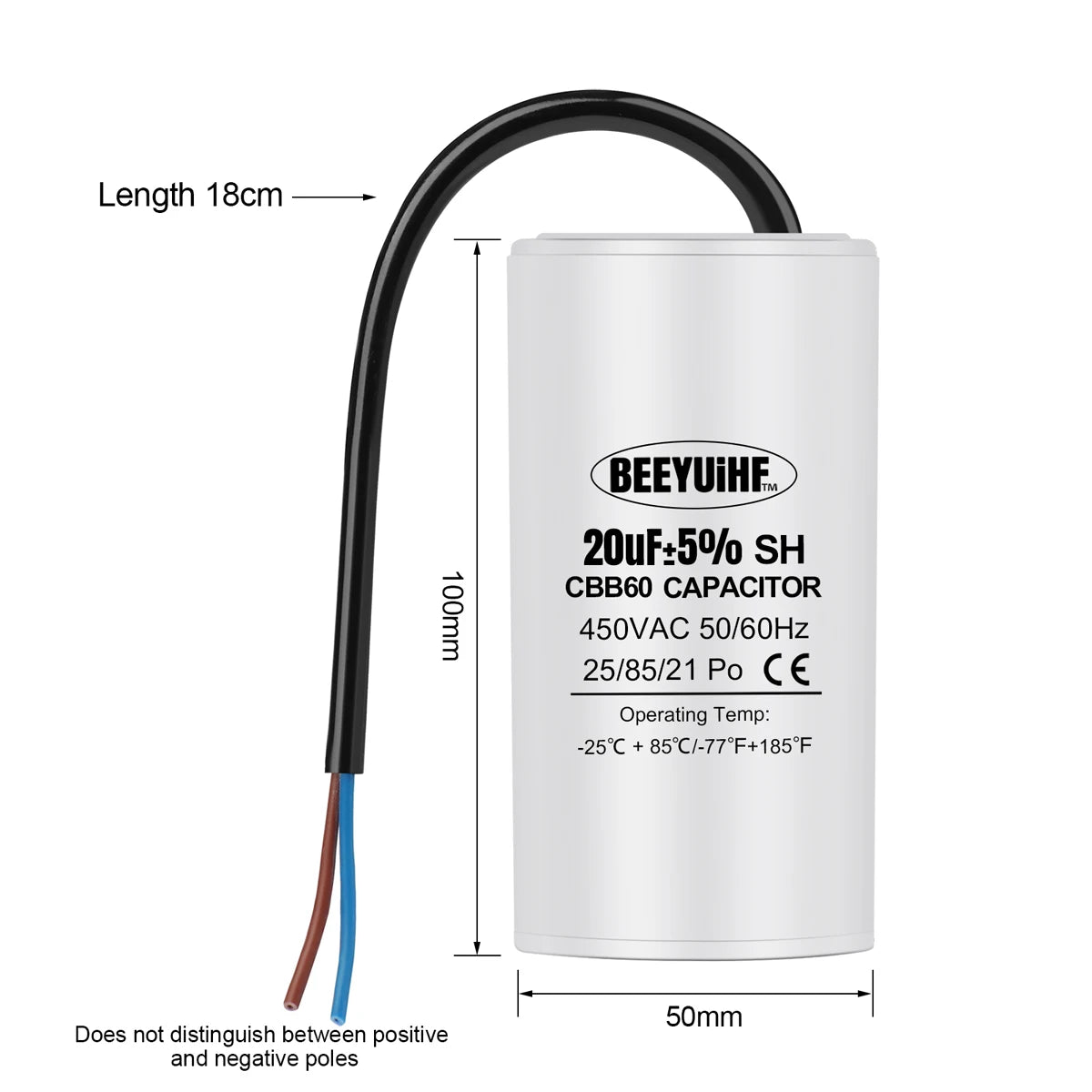
| Lead Type | Plastic-insulated pure copper lead wire |
| Structure | Fixed capacitor (cylindrical) |
| Origin | Mainland China |
Physical Dimensions by Capacitance
| Capacitance Range | Body Dimensions |
|---|---|
| 3µF – 10µF | 34 × 65mm |
| 12µF – 18µF | 38 × 70mm |
| 20µF – 25µF | 38 × 70mm |
| 30µF – 80µF | 50 × 100mm |
How Motor Start Capacitors Work
Single-phase AC induction motors have two windings: the main (run) winding and the auxiliary (start) winding. Without a capacitor, both windings receive the same phase of AC power and the motor cannot develop starting torque. The CBB60 capacitor creates a 90° phase shift between the two windings, producing a rotating magnetic field that generates starting torque. Once the motor reaches approximately 75% of running speed, a centrifugal switch disconnects the start winding (in start capacitor configurations) or the capacitor remains in circuit for improved running efficiency (in run capacitor configurations).
Diagnosing a Failed Motor Capacitor
A failed CBB60 capacitor causes characteristic symptoms:
- Motor hums but does not start — the most common symptom. The motor receives power but cannot develop starting torque without the capacitor phase shift.
- Motor starts slowly or with difficulty — capacitance has drifted below the rated value, reducing starting torque.
- Motor overheats — a failed capacitor causes the motor to draw excessive current as it struggles to start.
- Capacitor body is bulged, cracked, or leaking — physical failure is visible on the capacitor body.
Test with a capacitance meter: a healthy CBB60 should read within ±5% of its rated value. A reading significantly below rated value indicates a failed capacitor.
Key Features
- ✅ Metallized polypropylene film — self-healing dielectric, low ESR, stable capacitance over time
- ✅ 450VAC rated — adequate voltage margin for 220–240VAC mains applications
- ✅ 50/60Hz compatible — works with both European (50Hz) and American (60Hz) mains frequencies
- ✅ Flame-retardant PBT shell — self-extinguishing housing prevents fire propagation on capacitor failure
- ✅ Epoxy resin sealed — moisture-resistant sealing for reliable operation in humid environments
- ✅ Pure copper lead wire — low-resistance connections, compatible with standard spade terminals
- ✅ 3µF–80µF range — covers the full range of single-phase motor starting requirements
Common Applications
- Washing machine motor start/run capacitor
- Water pump motor start capacitor
- Air compressor motor start capacitor
- HVAC fan motor run capacitor
- Pool and spa pump motor capacitor
- Grain auger and agricultural equipment motor capacitor
- Single-phase induction motor starting and running
How to Select the Correct Capacitance
- Check the label on the original capacitor for the rated capacitance (e.g., 10µF) and voltage (450VAC).
- Select the same capacitance value. Do not substitute a significantly different value — incorrect capacitance reduces starting torque and can damage the motor.
- The voltage rating must be equal to or greater than the original. A 450VAC rated capacitor is suitable for all 220–240VAC applications.
- Verify the physical dimensions match the mounting space available.
Frequently Asked Questions
Q: My washing machine motor hums but does not spin — is this the right part?
A: Hum-but-no-start is the classic symptom of a failed motor start capacitor. Measure the capacitance of the existing capacitor and replace with the same value.
Q: Can I use a higher capacitance value if the exact value is not available?
A: No. Motor capacitors must be the rated value. A higher capacitance increases starting torque but causes the motor to overheat during running. Always use the rated value.
Package Contents
- 1× CBB60 Motor Start Capacitor with lead wire (capacitance as selected)



Blog posts
View all-

IC Chips & Discrete Components Express Shipping...
Shipping IC chips and discrete electronic components internationally requires more than choosing a carrier. ESD-safe packaging, correct HS codes, accurate customs declarations, and carrier selection for your destination all determine...
IC Chips & Discrete Components Express Shipping...
Shipping IC chips and discrete electronic components internationally requires more than choosing a carrier. ESD-safe packaging, correct HS codes, accurate customs declarations, and carrier selection for your destination all determine...
-

From Prototype to Mass Production — How to Scal...
Scaling from prototype to mass production is the most critical transition in a hardware product's lifecycle. The sourcing strategy that works for 10 prototype boards — cut tape, spot pricing,...
From Prototype to Mass Production — How to Scal...
Scaling from prototype to mass production is the most critical transition in a hardware product's lifecycle. The sourcing strategy that works for 10 prototype boards — cut tape, spot pricing,...
-

ISO 9001 Electronic Component Distributor — Wha...
ISO 9001:2015 certification is the most widely recognized quality management standard in the world — but what does it actually mean when an electronic component distributor claims to be ISO...
ISO 9001 Electronic Component Distributor — Wha...
ISO 9001:2015 certification is the most widely recognized quality management standard in the world — but what does it actually mean when an electronic component distributor claims to be ISO...


