


Nylon Hex Standoff M4×20mm Female-Female PCB Spacer 10-Pack
Nylon Hex Standoff M4×20mm Female-Female PCB Spacer 10-Pack
Compatible JST cables for sensors and modules — secure & reliable. Shop now.

Couldn't load pickup availability
Nylon Hex Standoff M4×20mm — Female-Female PCB Spacer, 10-Pack
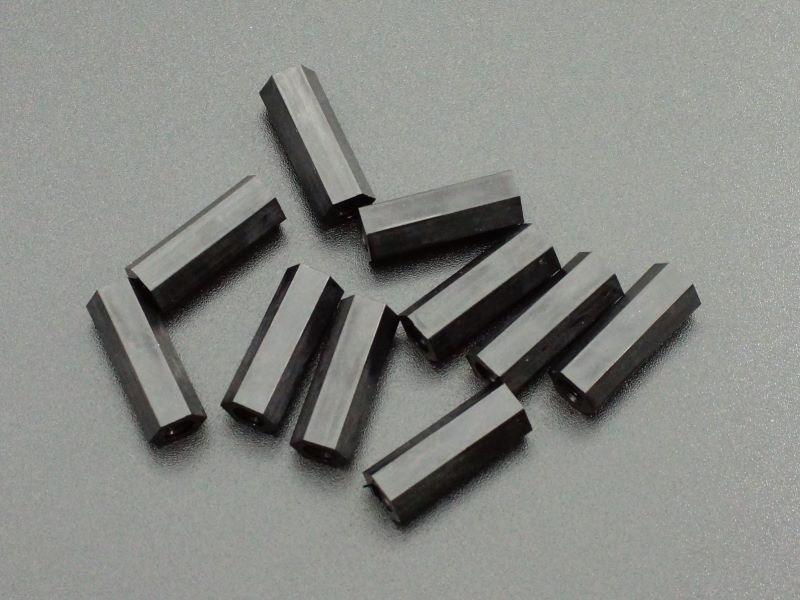
M4×20mm nylon hex female-female standoffs provide 20mm of PCB clearance height for applications requiring substantial space between the PCB and the mounting surface — such as large transformer mounting, tall electrolytic capacitor clearance, and multi-board stacking with cable routing. The M4 thread provides greater structural stability than M3 at this height, and the female-female configuration accepts M4 screws at both ends for flexible mounting.
Key Specifications
| Parameter | Value |
|---|---|
| Thread Size | M4 |
| Length (body) | 20mm |
| Configuration | Female-Female (F-F, both ends tapped) |
| Material | Nylon (PA66) |
| Hex Body AF | 6mm |
| Properties | Electrically non-conductive, non-magnetic, lightweight |
| Quantity | 10pcs per pack |
Why Choose M4×20mm Nylon Standoffs?
- 20mm tall clearance — substantial PCB-to-panel spacing for large transformers, tall electrolytic capacitors, and cable routing under the board
- M4 structural stability — M4 thread provides greater rigidity than M3 at 20mm height; reduces standoff flex under lateral loads
- Female-female configuration — both ends accept M4 screws; flexible mounting to base panel and PCB
- Electrically non-conductive — PA66 nylon eliminates short circuit risk
- Lightweight — nylon construction for weight-critical applications
Typical Applications
- Power supply PCB mounting with large transformer and capacitor clearance
- Multi-board stacking with 20mm inter-board spacing for cable routing
- Industrial electronics enclosure PCB mounting (M4 for heavier boards)
- Audio amplifier board mounting with tall component clearance
- Custom electronics project enclosure with substantial component height
- Control panel PCB mounting in industrial equipment
Compatible With
- M4 machine screws for PCB and base panel attachment
- M4 hex nuts, nyloc nuts, and flat washers
- PCB mounting holes: standard 4.3mm clearance drill
- Can be combined with M4×30mm or M4×40mm standoffs for greater heights
Package Contents
- 10× M4×20mm nylon hex female-female standoffs
Frequently Asked Questions
- Q: At what height should I switch from M3 to M4 standoffs?
- A: For heights above 15mm, M4 standoffs provide better structural rigidity than M3. At 20mm height, M3 standoffs can flex noticeably under lateral loads. Use M4 for heights of 15mm and above, especially for heavier PCBs or applications subject to vibration.
- Q: Can I use 20mm standoffs for Raspberry Pi mounting?
- A: Raspberry Pi uses M3 mounting holes. If you need 20mm clearance for a Raspberry Pi, use M3×20mm nylon standoffs (not M4). M4×20mm standoffs are for M4 mounting hole applications only.
- Q: How do I prevent tall standoffs from flexing?
- A: For tall standoffs (20mm+), use M4 instead of M3 for greater rigidity. Ensure all four standoffs are tightened evenly. For critical applications, add a second PCB or panel at the top of the standoffs to create a rigid frame structure.

Blog posts
View all-

IC Chips & Discrete Components Express Shipping...
Shipping IC chips and discrete electronic components internationally requires more than choosing a carrier. ESD-safe packaging, correct HS codes, accurate customs declarations, and carrier selection for your destination all determine...
IC Chips & Discrete Components Express Shipping...
Shipping IC chips and discrete electronic components internationally requires more than choosing a carrier. ESD-safe packaging, correct HS codes, accurate customs declarations, and carrier selection for your destination all determine...
-

From Prototype to Mass Production — How to Scal...
Scaling from prototype to mass production is the most critical transition in a hardware product's lifecycle. The sourcing strategy that works for 10 prototype boards — cut tape, spot pricing,...
From Prototype to Mass Production — How to Scal...
Scaling from prototype to mass production is the most critical transition in a hardware product's lifecycle. The sourcing strategy that works for 10 prototype boards — cut tape, spot pricing,...
-

ISO 9001 Electronic Component Distributor — Wha...
ISO 9001:2015 certification is the most widely recognized quality management standard in the world — but what does it actually mean when an electronic component distributor claims to be ISO...
ISO 9001 Electronic Component Distributor — Wha...
ISO 9001:2015 certification is the most widely recognized quality management standard in the world — but what does it actually mean when an electronic component distributor claims to be ISO...


