

Keszoox
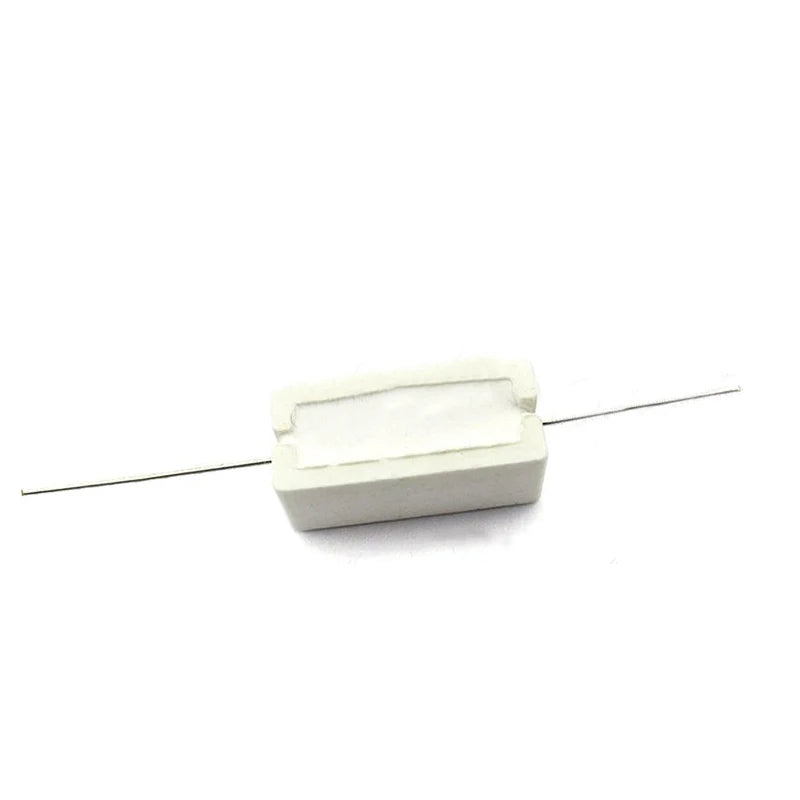
BPR56 Ceramic Wirewound Power Resistor 5W / 10W | 0.1Ω–10kΩ | 5% Tolerance | 2PCS
BPR56 Ceramic Wirewound Power Resistor 5W / 10W | 0.1Ω–10kΩ | 5% Tolerance | 2PCS

Couldn't load pickup availability
BPR56 Ceramic Wirewound Power Resistor — 5W / 10W | 0.1Ω–10kΩ | 5% Tolerance | 2PCS
The BPR56 series ceramic wirewound power resistor is the workhorse of power electronics — a through-hole, cement-encased wirewound resistor designed to dissipate significant power continuously without failure. The ceramic cement body provides excellent thermal conductivity, transferring heat away from the resistance wire and into the surrounding air or heatsink. Available in 5W and 10W power ratings across resistance values from 0.1Ω to 10kΩ, this series covers current sensing shunts, dummy loads, motor braking resistors, power supply bleeder resistors, and high-power voltage dividers. Supplied as 2PCS per order.
Specifications
| Series | BPR56 |
| Type | Wirewound (ceramic cement body) |
| Power Rating | 5W / 10W (as selected) |
| Resistance Range | 0.1Ω – 10kΩ |
| Tolerance | ±5% |
| Technology | Cermet wirewound |
| Package | Through-hole, axial lead |
| Body Colour | White (ceramic cement) |
| Quantity | 2PCS per order |
| Origin | Mainland China |
Why Wirewound Ceramic Resistors for High-Power Applications
| Property | Wirewound Ceramic (BPR56) | Carbon Film Resistor | Metal Film Resistor |
|---|---|---|---|
| Power rating | 5W – 10W (this product) | 0.125W – 0.5W | 0.125W – 2W |
| Thermal stability | Excellent (ceramic body) | Poor at high power | Good up to rated power |
| Overload survival | High (ceramic encapsulation) | Low (film burns) | Moderate |
| Inductance | Moderate (wirewound) | Very low | Very low |
| Best for | Power dissipation, current sensing, braking | Signal circuits | Precision signal circuits |
Resistance Value Selection Guide
| Resistance | Typical Application |
|---|---|
| 0.1Ω – 1Ω | Current sensing shunt, motor current measurement |
| 1Ω – 10Ω | Inrush current limiting, soft-start circuits |
| 10Ω – 100Ω | Dummy load, power supply testing, bleeder resistor |
| 100Ω – 1kΩ | Motor braking resistor, discharge resistor |
| 1kΩ – 10kΩ | High-voltage bleeder, voltage divider in power circuits |
Key Features
- ✅ Ceramic cement body — excellent thermal conductivity, transfers heat efficiently to surrounding air or heatsink
- ✅ 5W and 10W ratings — handles continuous power dissipation that would destroy standard film resistors
- ✅ 0.1Ω–10kΩ range — covers current sensing through high-resistance bleeder applications
- ✅ ±5% tolerance — adequate for power dissipation and current sensing applications
- ✅ Through-hole axial lead — easy PCB mounting or chassis mounting with lead bending
- ✅ Overload resistant — ceramic encapsulation survives brief overloads that would destroy film resistors
- ✅ 2PCS per order — matched pair for balanced load applications
Common Applications
- Current sensing shunt resistor (low-value, high-power)
- Dummy load for power supply and amplifier testing
- Motor braking resistor (regenerative braking energy dissipation)
- Power supply bleeder resistor (capacitor discharge)
- Inrush current limiting resistor
- High-power voltage divider
- LED driver current limiting (high-power LEDs)
- Battery discharge resistor
Thermal Derating Guide
Power resistors must be derated at elevated ambient temperatures. As a general rule:
- At 25°C ambient: operate at full rated power (5W or 10W)
- At 70°C ambient: derate to approximately 50% of rated power
- For continuous operation near rated power, mount the resistor with leads bent to allow airflow around the ceramic body, or attach to a heatsink
Frequently Asked Questions
Q: Can I use a 5W resistor for a 3W continuous application?
A: Yes, with adequate derating. A 5W resistor running at 3W continuous will run warm but within safe limits at normal ambient temperatures. Ensure adequate airflow around the resistor body.
Q: Are wirewound resistors suitable for high-frequency circuits?
A: Wirewound resistors have inherent inductance due to the wire coil construction. For DC and low-frequency AC applications (power supplies, motor drives, audio), this is not an issue. For RF and high-frequency circuits, use non-inductive resistors instead.
Q: Can I mount these vertically on a PCB?
A: Yes. Bend the leads to the required pitch and mount vertically or horizontally. For high-power applications, ensure the resistor body is not in contact with the PCB to allow heat dissipation.
Package Contents
- 2× BPR56 Ceramic Wirewound Power Resistor (power rating and resistance value as selected)