



Infrared Counting Sensor Module
Infrared Counting Sensor Module
Compatible JST cables for sensors and modules — secure & reliable. Shop now.

Couldn't load pickup availability
Count or detect objects that move through the U-shaped uprights.
DESCRIPTION
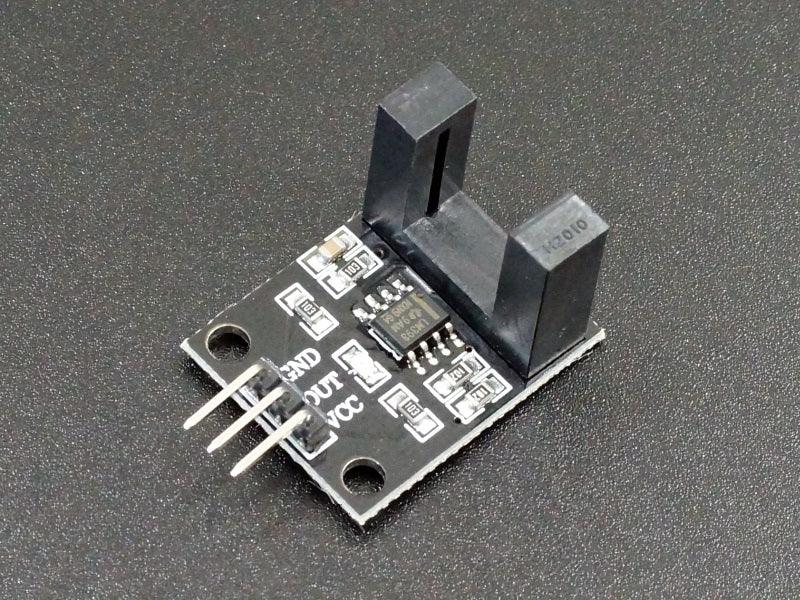
The Infrared Counting Sensor Module is used to count or detect objects that move through the U-shaped detector uprights.
PACKAGE INCLUDES:
- Infrared Counting Sensor Module
KEY FEATURES OF INFRARED COUNTING SENSOR MODULE MODULE:
- IR transmitter / receiver pair
- LM393 comparator circuit for clean detection
- LED indicator of detection
- 3.3 and 5V compatible
The module has an IR transmitter and receiver pair that face each other across a U-shaped housing. An object moving through these uprights breaks the IR beam.
These modules are typically used to count something as it passes through the uprights. This could be cogs on a wheel if it is counting revolutions or RPM, or something like pellets dropping through a chute if it is part of a feeder for a pellet stove or rabbit. Another use is as an optical limit switch or to detect when something is open or closed if it causes an object to move in or out of the beam.
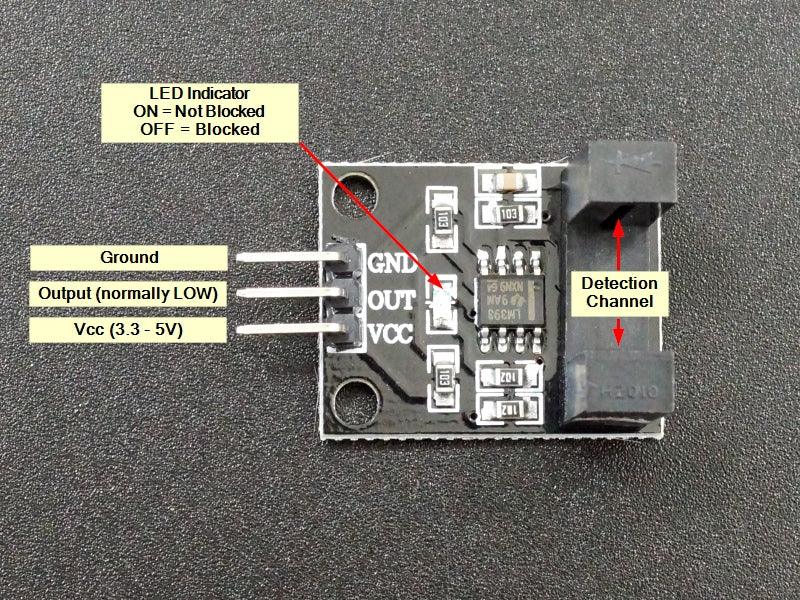
The sensor output is normally LOW and the red LED on the module will be normally lit. If the IR beam between the uprights is broken, the output goes HIGH and the LED goes off.
Module Connections
The module has a 3 pin header for making connections.
1 x 3 Header
- GND – Ground
- OUT – Output, normally LOW. Goes HIGH when IR beam is broken
- VCC – 3.3 – 5V
The module has two holes for mounting.
OUR EVALUATION RESULTS:
While this module is similar in functionality to the less expensive Light Block Sensor Module, the Infrared Counting Sensor Module has much higher and wider detector uprights and a LM393 comparator circuit that make it more robust and flexible in applications it can be used in.
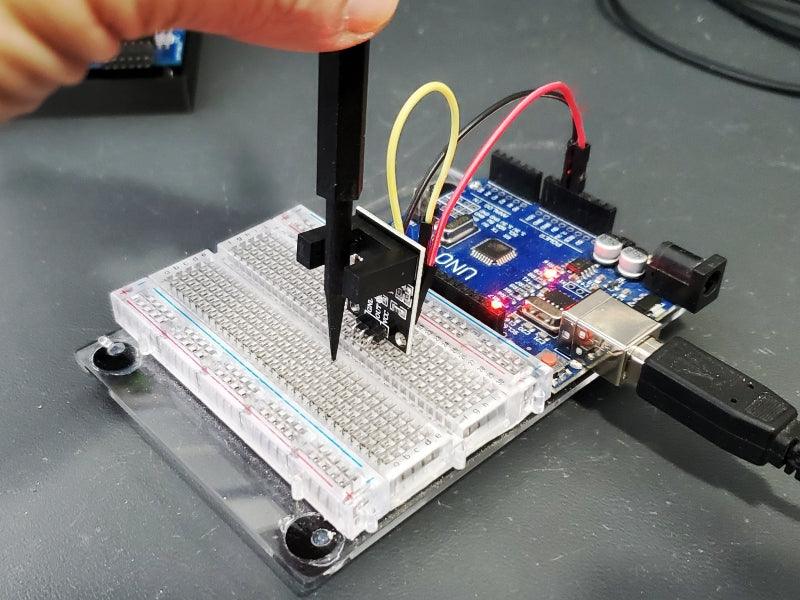
The example program below simply monitors the output of the module and if the beam is broken, it turns the on-board LED on. It used pin 8 in the example, but this can be changed to any digital input pin.
Infrared Counting Sensor Module Test Program
/*
Light Interrupter Sensor Test

Monitor output from sensor module and light the on-board LED when
an object is blocking the IR beam between the sensor uprights.
*/
int sensorPin = 8;   // Can be any digital input pin
int ledPin = 13;       // Pin that on-board LED is connected to
int sensorVal = 0;  // variable to store the value coming from the sensor
//===============================================================================
//  Initialization
//===============================================================================
void setup() {
  pinMode(ledPin, OUTPUT); // LED pin as output
  pinMode(sensorPin, INPUT); //Sensor pin as input
}
//===============================================================================
//  Main
//===============================================================================
void loop() {
  sensorVal = digitalRead(sensorPin); //read the value of the sensor
  if(sensorVal == HIGH) // turn on LED when sensor is blocked
  {
    digitalWrite(ledPin,HIGH);
  }
  else
  {
    digitalWrite(ledPin,LOW);
  }
}
BEFORE THEY ARE SHIPPED, THESE MODULES ARE:
- Sample inspected and tested per incoming shipment
Notes:
- None
TECHNICAL SPECIFICATIONS
| Operating Ratings | Vcc Range | 3.3-5V |
| Logic high (Vcc = 5V) | > 3.5V | |
| Logic Low | < 0.2V | |
| Dimensions | L x W (PCB) | 25 x 20mm (1 x 0.8″) |
| Height U-Channel | 15mm (0.59″) | |
| H x W (Inside U-Channel) | 12 x 10mm (0.47 x 0.39″) | |
| Depth of intrusion into U-Channel to interrupt beam | 3mm (0.12″) | |
| Country of Origin | China |

Blog posts
View all-

IC Chips & Discrete Components Express Shipping...
Shipping IC chips and discrete electronic components internationally requires more than choosing a carrier. ESD-safe packaging, correct HS codes, accurate customs declarations, and carrier selection for your destination all determine...
IC Chips & Discrete Components Express Shipping...
Shipping IC chips and discrete electronic components internationally requires more than choosing a carrier. ESD-safe packaging, correct HS codes, accurate customs declarations, and carrier selection for your destination all determine...
-

From Prototype to Mass Production — How to Scal...
Scaling from prototype to mass production is the most critical transition in a hardware product's lifecycle. The sourcing strategy that works for 10 prototype boards — cut tape, spot pricing,...
From Prototype to Mass Production — How to Scal...
Scaling from prototype to mass production is the most critical transition in a hardware product's lifecycle. The sourcing strategy that works for 10 prototype boards — cut tape, spot pricing,...
-

ISO 9001 Electronic Component Distributor — Wha...
ISO 9001:2015 certification is the most widely recognized quality management standard in the world — but what does it actually mean when an electronic component distributor claims to be ISO...
ISO 9001 Electronic Component Distributor — Wha...
ISO 9001:2015 certification is the most widely recognized quality management standard in the world — but what does it actually mean when an electronic component distributor claims to be ISO...


