

Keszoox
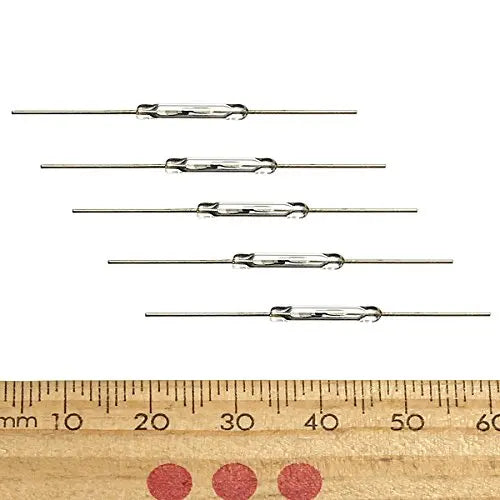
Magnetic Reed Switch — 2×14mm, Normally Open (NO), Glass Tube, Arduino (5-Pack)
Magnetic Reed Switch 2×14mm, Normally Open (NO), Glass Tube, Arduino (5-Pack)

Couldn't load pickup availability
Magnetic Reed Switch — 2×14mm, Normally Open (NO), Glass Tube (5-Pack)
These 2×14mm glass-encapsulated normally open (NO) reed switches are the compact version of the standard 4×28mm reed switch, offering the same reliable magnetic proximity switching in a smaller package. The contacts close when a magnet is brought within proximity and open when the magnet is removed. The hermetically sealed glass tube protects the contacts from contamination, making them suitable for compact door/window sensors, flow meters, bicycle speedometers, and miniature proximity detection applications where the larger 4×28mm switch does not fit.
Key Specifications
| Parameter | Value |
|---|---|
| Dimensions | 2mm diameter × 14mm length |
| Contact Type | Normally Open (NO) — closes on magnet proximity |
| Enclosure | Hermetically sealed glass tube |
| Contact Rating | 10W max (typical) |
| Max Switching Voltage | 100V DC / 100V AC |
| Max Switching Current | 0.5A |
| Operate Distance | ~5–15mm (magnet dependent) |
| Operating Temperature | -40°C to +70°C |
| Quantity | 5 pieces |
2×14mm vs 4×28mm Reed Switch
| Feature | 2×14mm (this listing) | 4×28mm |
|---|---|---|
| Size | Compact (2mm × 14mm) | Standard (4mm × 28mm) |
| Operate distance | ~5–15mm | ~10–20mm |
| Current rating | 0.5A | 0.5A |
| Best for | Compact sensors, PCB mount, tight spaces | Door/window sensors, standard applications |
Why Choose 2×14mm Reed Switches?
- Compact 2×14mm size — fits in tight spaces where 4×28mm switches are too large
- Hermetically sealed — contacts protected from dust, moisture, and corrosive gases
- No power consumption — passive switch, zero idle current draw
- Fast switching — <1ms operation for flow meter pulse counting
- 5-pack value — sufficient for multiple sensor installations
Compatible With / Common Use Cases
- Arduino door/window sensor: Connect between GPIO (INPUT_PULLUP) and GND — LOW = magnet present, HIGH = magnet removed
- Compact flow meter: 2×14mm switch triggered by rotating magnet on miniature flow meter paddle
- Bicycle speedometer: Small reed switch + magnet on spoke for compact speed sensor
- PCB-mounted sensor: Solder leads directly to PCB for compact proximity detection
- Wearable electronics: Compact magnetic switch for wearable device lid/clasp detection
Frequently Asked Questions
Q: How do I connect a 2×14mm reed switch to Arduino?
A: Connect one lead to a digital pin (e.g., D2), the other lead to GND. In code: pinMode(2, INPUT_PULLUP); When the magnet is near, the switch closes and the pin reads LOW. When the magnet is removed, the internal pull-up holds the pin HIGH. No external resistor needed with INPUT_PULLUP mode.
Q: What magnet works best with the 2×14mm reed switch?
A: Use a small neodymium (NdFeB) magnet for reliable operation at 5–15mm distance. The smaller size of this switch means it has a shorter operate distance than the 4×28mm version — position the magnet within 10mm for reliable switching. Rare earth magnets (neodymium) provide stronger fields than ceramic magnets for the same size.
Q: Can I solder the 2×14mm reed switch leads directly to a PCB?
A: Yes — the leads can be soldered to PCB through-holes. Use a low-wattage iron (25–30W) and apply heat briefly (2–3 seconds maximum) to avoid cracking the glass tube from thermal shock. Do not grip the glass tube with pliers during soldering — hold the leads only. Bend leads gently at least 3mm from the glass end.
Package Contents
- 5× Magnetic Reed Switch (2×14mm, normally open, glass tube)