



Mean Well LRS-100-36 Switching Power Supply 36V 2.8A 100W | 85–264VAC Input | UL CE Approved
Mean Well LRS-100-36 Switching Power Supply 36V 2.8A 100W | 85–264VAC Input | UL CE Approved
Compatible JST cables for sensors and modules — secure & reliable. Shop now.

Couldn't load pickup availability
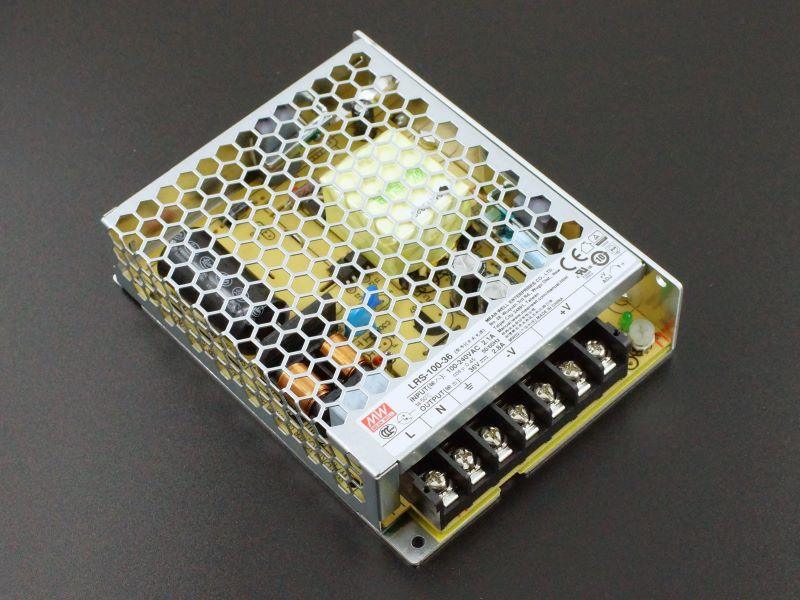
Mean Well LRS-100-36 Switching Power Supply — 36V 2.8A 100W
The Mean Well LRS-100-36 is a professional-grade single-output switching power supply from Mean Well — one of the world’s most trusted power supply manufacturers. Delivering a regulated 36V DC at 2.8A (100.8W) from a universal 85–264VAC input, the LRS-100 series is the industry standard for CNC machines, laser engravers, LED drivers, industrial automation, and 3D printer power systems. The ultra-slim 30mm profile, convection cooling (no fan), and UL/CE safety certification make it the preferred choice for both OEM integration and DIY builds requiring reliable, regulated DC power.
Specifications
| Model | LRS-100-36 |
| Manufacturer | Mean Well |
| Output Voltage | 36V DC |
| Output Current | 2.8A |
| Rated Power | 100.8W |
| Input Voltage | 85–264VAC (universal, 47–63Hz) |
| Efficiency | 90.5% |
| Output Voltage Adjustment | 32.4–39.6V (trimmer adjustable) |
| Output Ripple & Noise | 200mVp-p (max) |
| Overload Protection | 110–150% rated power, hiccup mode auto-recovery |
| Operating Temperature | -30°C to +70°C |
| Cooling | Convection (fanless) |
| Enclosure | Fully enclosed metal case |
| Dimensions | 129 × 97 × 30mm (5.1 × 3.8 × 1.2 inches) |
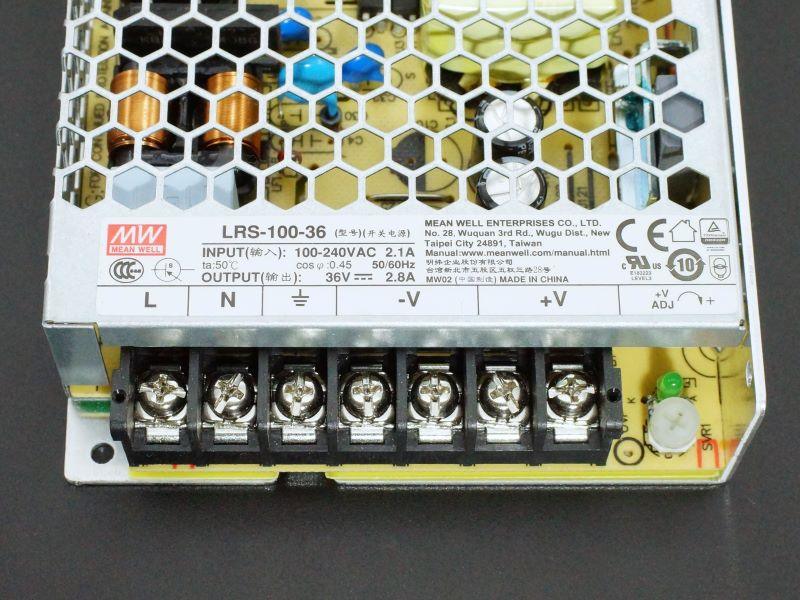
| Connections | Terminal strip: L, N, GND (AC in) | −V, +V (DC out) |
| Certifications | UL, CE |
Why Mean Well LRS-100 Series?
The LRS-100 series has become the de facto standard power supply for maker, CNC, and industrial automation communities worldwide for good reason:
- Mean Well reliability — Mean Well is a Taiwanese manufacturer with 40+ years of power supply engineering. LRS-100 units routinely run 24/7 for years without failure in industrial environments.
- Universal input — 85–264VAC covers 100V (Japan), 110V (North America), and 230V (Europe/Asia) without switching or modification
- 90.5% efficiency — minimal heat generation, enabling fanless convection cooling and silent operation
- Adjustable output — trimmer pot allows fine adjustment from 32.4V to 39.6V for precise voltage requirements
- Hiccup overload protection — automatically recovers from overload without manual reset, protecting both the PSU and connected equipment
- UL and CE certified — meets North American and European safety standards for commercial and industrial use
Key Features
- ✅ 36V 2.8A regulated output — stable DC output for demanding loads
- ✅ Universal 85–264VAC input — works worldwide without voltage switching
- ✅ 90.5% efficiency — low heat, fanless operation, silent
- ✅ Adjustable output 32.4–39.6V — fine-tune voltage with onboard trimmer
- ✅ Hiccup overload protection — auto-recovery, no manual reset needed
- ✅ -30°C to +70°C operating range — suitable for cold workshop and high-ambient industrial environments
- ✅ Ultra-slim 30mm profile — fits in tight enclosures and DIN rail installations
- ✅ UL + CE certified — meets international safety standards
- ✅ Terminal strip connections — easy wiring for both AC input and DC output
Common Applications
- CNC router and CNC plasma cutter power supply
- CO₂ and diode laser engraver / cutter power supply
- 3D printer heated bed and stepper motor power supply
- Industrial automation and PLC power supply
- LED strip and panel driver power supply
- Servo motor and stepper driver power supply
- Telecommunications and networking equipment power
- DIY bench power supply base unit
Wiring Guide
| Terminal | Connection |
|---|---|
| L | AC Live (Line) |
| N | AC Neutral |
| GND (⏚) | Earth / Ground |
| −V | DC Negative output |
| +V | DC Positive output (36V) |
Always connect earth/ground for safety. Ensure AC input wiring is rated for the supply current and local electrical code requirements.
Frequently Asked Questions
Q: Can I run this at full 100W load continuously?
A: Yes. The LRS-100-36 is rated for continuous operation at full load up to 50°C ambient. Above 50°C, derate the output by 2.5% per degree Celsius up to 70°C maximum.
Q: Is this suitable for a CNC router with NEMA 23 stepper motors?
A: Yes. The LRS-100-36 is one of the most popular power supplies for CNC routers using NEMA 23 steppers with DM542 or similar drivers. The 36V output is within the optimal voltage range for most NEMA 23 stepper driver combinations.
Q: Can I adjust the output voltage?
A: Yes. The onboard trimmer pot adjusts output from 32.4V to 39.6V. Use a small flathead screwdriver to adjust while measuring output voltage with a multimeter.
Package Contents
- 1× Mean Well LRS-100-36 Switching Power Supply (36V 2.8A 100W)

Blog posts
View all-

IC Chips & Discrete Components Express Shipping...
Shipping IC chips and discrete electronic components internationally requires more than choosing a carrier. ESD-safe packaging, correct HS codes, accurate customs declarations, and carrier selection for your destination all determine...
IC Chips & Discrete Components Express Shipping...
Shipping IC chips and discrete electronic components internationally requires more than choosing a carrier. ESD-safe packaging, correct HS codes, accurate customs declarations, and carrier selection for your destination all determine...
-

From Prototype to Mass Production — How to Scal...
Scaling from prototype to mass production is the most critical transition in a hardware product's lifecycle. The sourcing strategy that works for 10 prototype boards — cut tape, spot pricing,...
From Prototype to Mass Production — How to Scal...
Scaling from prototype to mass production is the most critical transition in a hardware product's lifecycle. The sourcing strategy that works for 10 prototype boards — cut tape, spot pricing,...
-

ISO 9001 Electronic Component Distributor — Wha...
ISO 9001:2015 certification is the most widely recognized quality management standard in the world — but what does it actually mean when an electronic component distributor claims to be ISO...
ISO 9001 Electronic Component Distributor — Wha...
ISO 9001:2015 certification is the most widely recognized quality management standard in the world — but what does it actually mean when an electronic component distributor claims to be ISO...


