



Potentiometer 100KΩ Single-Turn Panel Mount — 6mm Shaft, Linear Taper, with Nut & Washer
Potentiometer 100KΩ Single-Turn Panel Mount 6mm Shaft, Linear Taper, with Nut & Washer
Compatible JST cables for sensors and modules — secure & reliable. Shop now.

Couldn't load pickup availability
Potentiometer — 100KΩ Single-Turn, Panel Mount / PCB Mount, 6mm Shaft
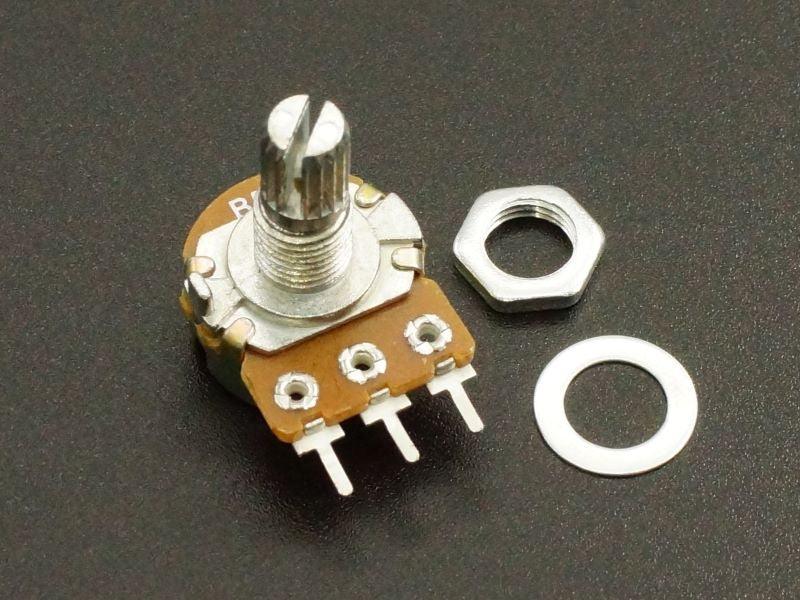
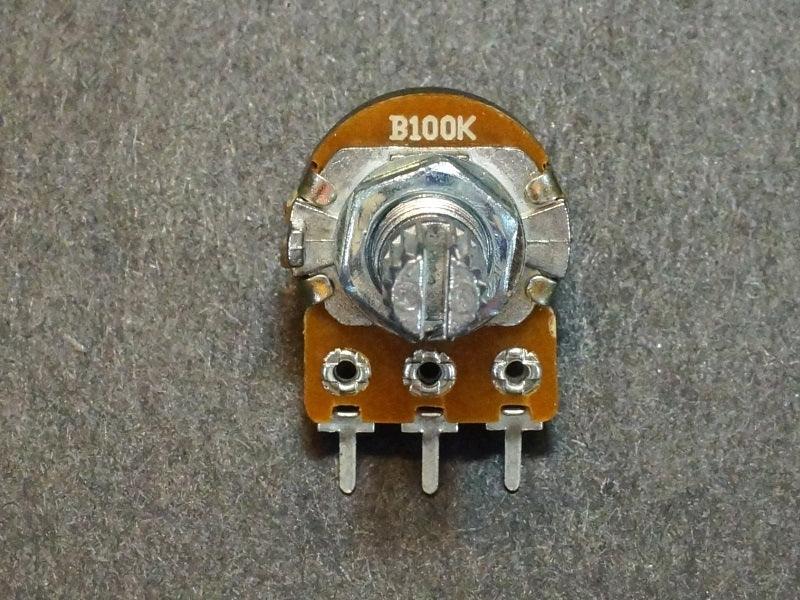
A 100KΩ linear taper single-turn potentiometer with a standard 6mm knurled shaft — designed for both panel mounting through an enclosure and direct PCB soldering. Supplied with mounting nut and washer for panel installation. The 100KΩ value is the preferred choice for high-impedance circuits including JFET bias adjustment, electret microphone sensitivity, RC oscillator frequency control, and audio circuits where minimal current loading is critical.
The smooth ~300° rotation with good linearity makes this potentiometer suitable for user-facing controls in audio equipment, DIY synthesizers, and high-impedance signal conditioning circuits. The 6mm shaft accepts all standard potentiometer knobs available worldwide.
Key Specifications
| Resistance | 100KΩ (100,000Ω) |
| Taper | Linear (Type B) |
| Tolerance | ±15% (typical measured) |
| Power Rating | 0.5W |
| Turns | Single-turn (~300° rotation) |
| Resistive Element | Carbon film |
| Shaft Diameter | 6mm (knurled, standard knob compatible) |
| Shaft Length | 15mm (0.59″) |
| Body Width | 18mm (0.71″) |
| Body + Shaft Length | 24mm (0.95″) |
| Panel Mounting Hole | 7mm (9/32″) |
| PCB Lead Spacing | 5.08mm (0.2″) centers |
| Package | Metal body, 3 radial leads |
Mounting Options
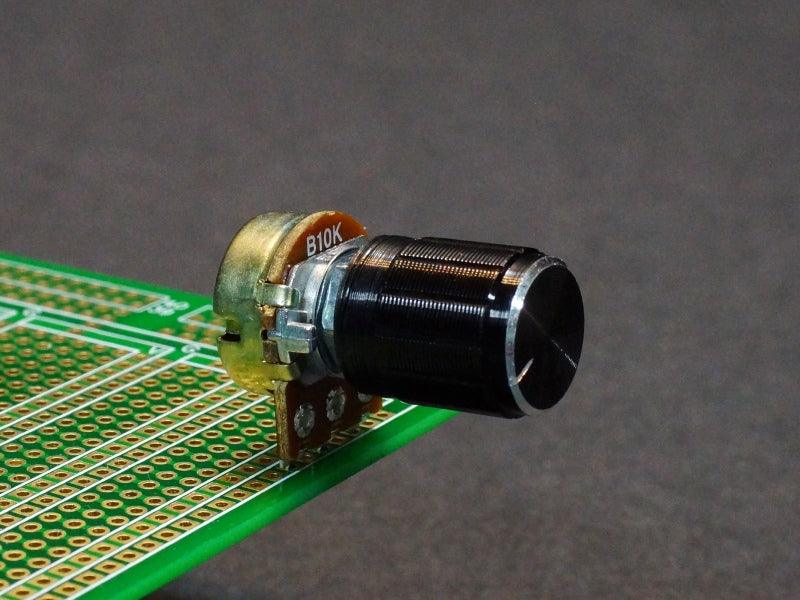
- Panel mount: Insert shaft through a 7mm (9/32″) hole in the enclosure panel. Secure with the supplied washer and 10mm nut. Solder wires to the three pins. Add any standard 6mm-shaft knob for user control.
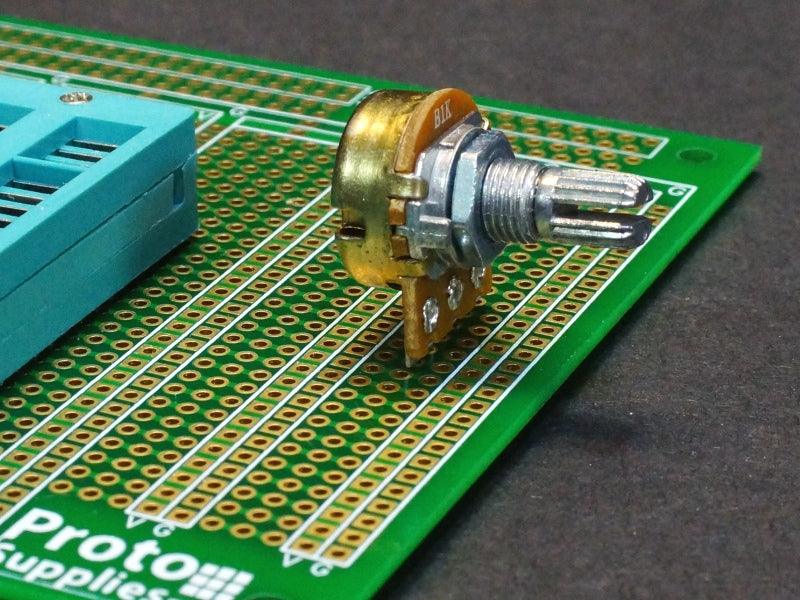
- PCB mount: Solder directly to PCB using the 5.08mm (0.2″) lead spacing — compatible with standard 0.1″ perfboard hole spacing. Note: leads are not long enough for solderless breadboards.
- Anti-rotation tab: A locator tab on the body prevents rotation in enclosures with a matching slot. Can be snapped off with pliers if not needed.
100KΩ vs Other Values — When to Choose 100K
- 1KΩ: Low-impedance circuits — motor speed control, low-impedance audio sources
- 5KΩ: Op-amp feedback networks, audio tone controls
- 10KΩ: Most common value — Arduino analog input, comparator threshold, general-purpose voltage divider
- 100KΩ (this): High-impedance circuits — JFET gate bias, electret microphone sensitivity, RC oscillator frequency (NE555 high-frequency range), audio volume in high-impedance amplifier inputs, crystal oscillator load trimming
Typical Applications
- RC oscillator frequency control — NE555 astable mode high-frequency range (100KΩ + small capacitor)
- JFET gate bias adjustment — J201, 2N5457, MPF102 bias setting in audio preamp circuits
- Electret microphone sensitivity control — high-impedance input level adjustment
- Audio volume control for high-impedance amplifier inputs
- DIY synthesizer VCO and VCF frequency controls
- High-impedance voltage divider — minimal current draw from battery-powered circuits
- Phototransistor and LDR sensitivity adjustment
- Analog filter cutoff frequency control (high-frequency RC filters)
Package Contents
- 1 × Potentiometer 100KΩ Single-Turn (6mm shaft, linear taper, carbon film)
- 1 × Mounting nut (10mm)
- 1 × Washer

Blog posts
View all-

IC Chips & Discrete Components Express Shipping...
Shipping IC chips and discrete electronic components internationally requires more than choosing a carrier. ESD-safe packaging, correct HS codes, accurate customs declarations, and carrier selection for your destination all determine...
IC Chips & Discrete Components Express Shipping...
Shipping IC chips and discrete electronic components internationally requires more than choosing a carrier. ESD-safe packaging, correct HS codes, accurate customs declarations, and carrier selection for your destination all determine...
-

From Prototype to Mass Production — How to Scal...
Scaling from prototype to mass production is the most critical transition in a hardware product's lifecycle. The sourcing strategy that works for 10 prototype boards — cut tape, spot pricing,...
From Prototype to Mass Production — How to Scal...
Scaling from prototype to mass production is the most critical transition in a hardware product's lifecycle. The sourcing strategy that works for 10 prototype boards — cut tape, spot pricing,...
-

ISO 9001 Electronic Component Distributor — Wha...
ISO 9001:2015 certification is the most widely recognized quality management standard in the world — but what does it actually mean when an electronic component distributor claims to be ISO...
ISO 9001 Electronic Component Distributor — Wha...
ISO 9001:2015 certification is the most widely recognized quality management standard in the world — but what does it actually mean when an electronic component distributor claims to be ISO...


