

Keszoox
HC-49S Quartz Crystal Oscillator Kit — 32.768kHz to 25MHz, Through-Hole, Timing Circuits
HC-49S Quartz Crystal Oscillator Kit 32.768kHz to 25MHz, Through-Hole, Timing Circuits

Couldn't load pickup availability
HC-49S Quartz Crystal Oscillator Kit — 32.768kHz to 25MHz, Through-Hole
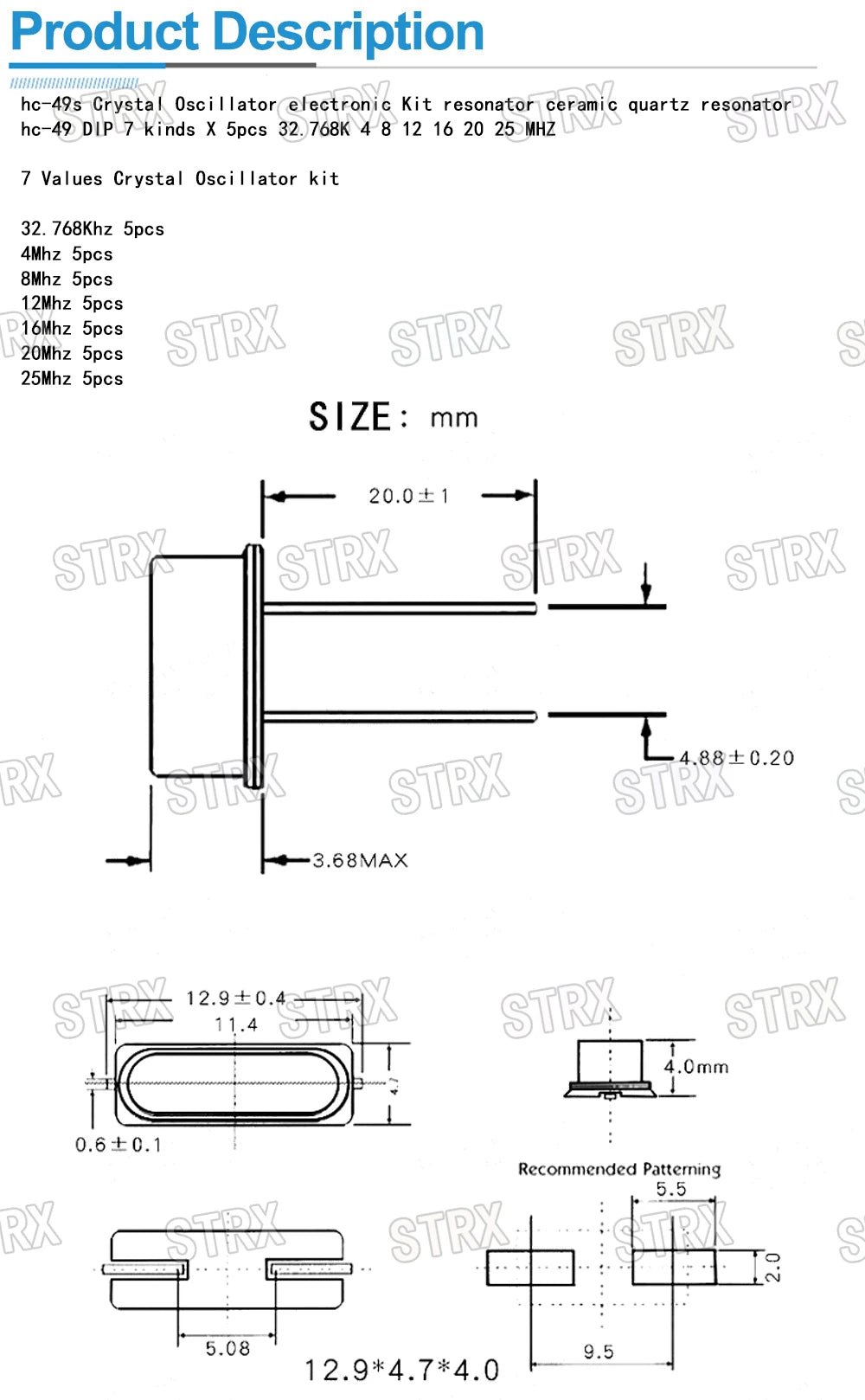
This HC-49S quartz crystal oscillator kit covers the most commonly used frequencies from 32.768kHz (RTC clock) to 25MHz (microcontroller system clock), in a low-profile HC-49S through-hole package. Quartz crystals provide highly accurate and stable clock references for microcontrollers, real-time clocks, UART baud rate generation, and RF carrier frequency applications. Select your required frequency from the dropdown.
Key Specifications
| Parameter | Value |
|---|---|
| Package | HC-49S (low-profile through-hole, 2-pin) |
| Frequency Range | 32.768kHz – 25MHz (select from dropdown) |
| Frequency Tolerance | ±30ppm (at 25°C) |
| Frequency Stability | ±50ppm (-20°C to +70°C) |
| Load Capacitance | 12pF or 20pF (frequency dependent) |
| Drive Level | 100μW max |
| Operating Temperature | -20°C to +70°C |
Common Frequencies and Applications
| Frequency | Application | Used With |
|---|---|---|
| 32.768kHz | RTC clock (32768 = 2¹⁵ Hz, divides to 1Hz) | DS1307, DS3231, PCF8563 RTC ICs |
| 4MHz | MCU system clock | PIC16F, ATmega8 at 4MHz |
| 8MHz | MCU system clock | ATmega328P (Arduino Pro Mini 3.3V), STM32 |
| 11.0592MHz | UART baud rate generation | 8051, ATmega — exact baud rates (9600, 115200) |
| 12MHz | USB clock, MCU clock | CH340G, CP2102, STM32 USB |
| 16MHz | Arduino UNO/Nano system clock | ATmega328P (Arduino UNO, Nano, Pro Mini 5V) |
| 20MHz | High-speed MCU clock | ATmega at 20MHz, PIC18F |
| 25MHz | Ethernet PHY clock, high-speed MCU | W5500, ENC28J60 Ethernet modules |
Why Choose HC-49S Crystals?
- Low-profile HC-49S package — shorter than HC-49U, fits low-clearance PCB designs
- ±30ppm tolerance — accurate enough for UART, I²C, SPI, and RTC applications
- Wide frequency range — one kit covers RTC (32.768kHz) through high-speed MCU (25MHz)
- Through-hole 2-pin — easy to solder on perfboard and prototype PCBs
- Kit value — multiple frequencies in one purchase for different projects
Frequently Asked Questions
Q: What load capacitors do I need for an HC-49S crystal oscillator circuit?
A: Most HC-49S crystals specify 12pF or 20pF load capacitance. For a Pierce oscillator (standard MCU crystal circuit), use two capacitors (C1 and C2) from each crystal pin to GND. C1 = C2 = 2 × CL − Cstray, where CL is the crystal load capacitance and Cstray ≈ 3–5pF. For CL=12pF: C1=C2=18–22pF. For CL=20pF: C1=C2=33–39pF.
Q: Why does Arduino UNO use 16MHz and Arduino Pro Mini 3.3V use 8MHz?
A: ATmega328P is rated for 16MHz at 5V and 8MHz at 3.3V (per Atmel datasheet). Running at 16MHz on 3.3V is technically overclocking and may cause instability. Arduino Pro Mini 3.3V uses an 8MHz crystal to stay within the safe operating range for 3.3V operation.
Q: Why is 11.0592MHz used for 8051 UART baud rate generation?
A: 11.0592MHz divides evenly to produce standard UART baud rates (9600, 19200, 38400, 57600, 115200) with 0% error using the 8051 timer reload formula. Other frequencies (12MHz, 16MHz) produce small baud rate errors that can cause communication failures at high baud rates.
Package Contents
- HC-49S Quartz Crystal Oscillator(s) — frequency as selected