



Knock Sensor Module
Knock Sensor Module
Compatible JST cables for sensors and modules — secure & reliable. Shop now.

Couldn't load pickup availability
Detects when the module is tapped, hit or otherwise knocked about.
Description
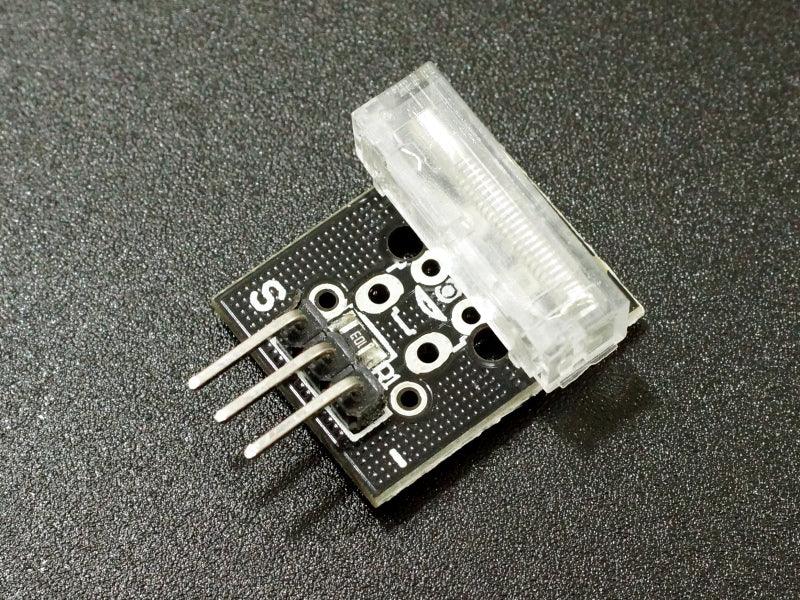
The Knock Sensor Module detects when the module is tapped, hit, bumped or otherwise knocked about.
PACKAGE INCLUDES:
- Knock Sensor Module
KEY FEATURES OF KNOCK SENSOR MODULE:
- Outputs a logic LOW when module is knocked
- 3.3 and 5V compatible
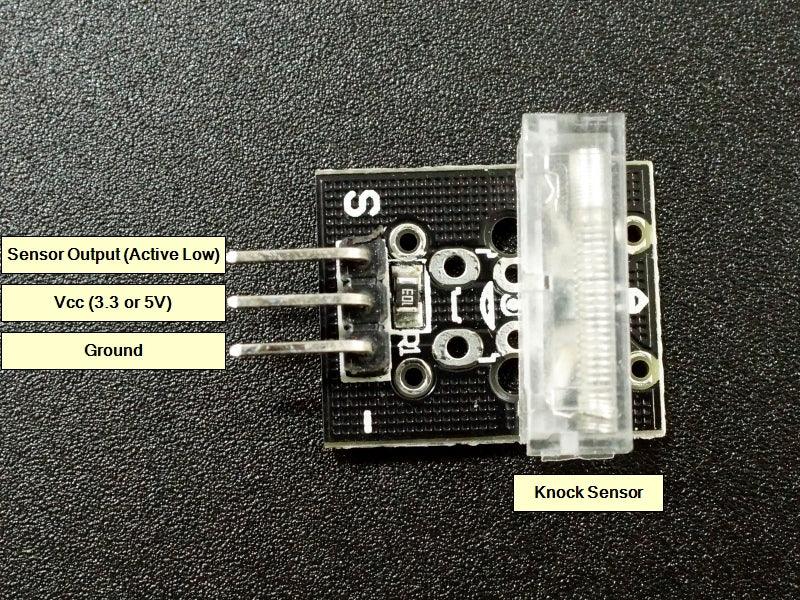
This module incorporates a mechanical knock sensor consisting of a coiled spring held fixed in position on one end and free floating on the other end. It is encased in a clear plastic housing.
The output of the module is normally pulled HIGH via an integrated pull-up resistor. When the sensor is knocked or tapped, the free end of the spring moves and makes contact with the ground terminal and the output transitions LOW for a short time and then returns back to HIGH.
Module Connections
There is a 3-pin header on the assembly for making connections.
1 x 3 Header
- ‘-‘ = Ground
- Center pin = Vcc (3.3 – 5V)
- S = Signal output, connects to digital input on MCU
OUR EVALUATION RESULTS:
This is a simple module that can be used to experiment with a number of applications that take some type of action when a physical knock or tap on the module is detected.
The module is not very sensitive and the sensitivity can depend on the module orientation. Also be aware that the spring tends to create a very noisy output, so some type of debouncing in software will usually be required to get an output that is clean enough to be usable. Finding use in practical applications is very limited.
If you are looking for a more capable sensor, the 801S Vibration Sensor Module below would be a better choice.
Notes:
- None
Technical Specifications
| Operating Ratings | Vcc Range | 3.3 – 5V (match to MCU) |
| Logic high (normal operation) | Pulled to Vcc | |
| Logic Low (knock detected) | Pulled to Gnd | |
| Dimensions | L x W (PCB) | 20mm x 15mm (0.79 x 0.6″) |

Blog posts
View all-

Best JST Connector Crimping Tools in 2026: Engi...
Choosing the wrong crimping tool ruins JST connectors and wastes wire. This guide compares the top crimping tools for JST SH, GH, PH, XH, and VH series — including Engineer...
Best JST Connector Crimping Tools in 2026: Engi...
Choosing the wrong crimping tool ruins JST connectors and wastes wire. This guide compares the top crimping tools for JST SH, GH, PH, XH, and VH series — including Engineer...
-

Molex KK 254 vs Mini-Fit Jr. vs Micro-Fit 3.0: ...
Choosing between Molex KK 254, Mini-Fit Jr., and Micro-Fit 3.0? This guide compares pitch, current rating, locking mechanism, wire gauge, and typical applications — with decision tables, part number references,...
Molex KK 254 vs Mini-Fit Jr. vs Micro-Fit 3.0: ...
Choosing between Molex KK 254, Mini-Fit Jr., and Micro-Fit 3.0? This guide compares pitch, current rating, locking mechanism, wire gauge, and typical applications — with decision tables, part number references,...
-

DuPont Connector vs JST PH 2.0: Pinout, Specs &...
Not sure whether to use a DuPont 2.54mm or JST PH 2.0mm connector? This guide compares pitch, locking mechanism, current rating, pinout, and best use cases — so you can...
DuPont Connector vs JST PH 2.0: Pinout, Specs &...
Not sure whether to use a DuPont 2.54mm or JST PH 2.0mm connector? This guide compares pitch, locking mechanism, current rating, pinout, and best use cases — so you can...


