

Keszoox
MAX30102 Heart Rate & SpO2 Pulse Oximetry Sensor Module — I²C, Ultra-Low Power, Arduino
MAX30102 Heart Rate & SpO2 Pulse Oximetry Sensor Module I²C, Ultra-Low Power, Arduino

Couldn't load pickup availability
MAX30102 Heart Rate & SpO2 Pulse Oximetry Sensor Module — I²C, Ultra-Low Power, Arduino
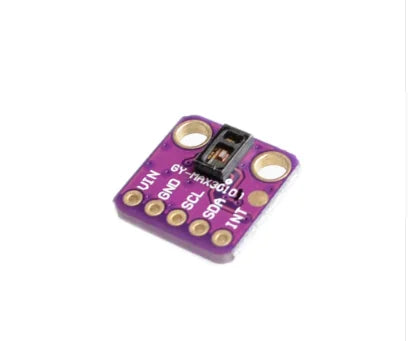
The MAX30102 module integrates a high-sensitivity pulse oximeter and heart rate sensor from Maxim Integrated (now Analog Devices) on a compact breakout board. Using red (660nm) and infrared (880nm) LEDs with a photodetector, it measures blood oxygen saturation (SpO2) and heart rate (BPM) via photoplethysmography (PPG). With I²C interface, ultra-low power consumption (0.7mW typical), and 1.8V–3.3V operation, it is the standard sensor for Arduino wearable health monitoring and fitness tracking projects.
Key Specifications
| Parameter | Value |
|---|---|
| Sensor IC | MAX30102 (Maxim / Analog Devices) |
| Interface | I²C (up to 400kHz, address 0x57 fixed) |
| Supply Voltage | 1.8V – 3.3V (onboard LDO for 5V input) |
| LED Wavelengths | Red: 660nm, IR: 880nm |
| ADC Resolution | 18-bit |
| Sample Rate | 50–3200 samples/sec (configurable) |
| Power Consumption | 0.7mW typical (active), 0.7μA (standby) |
| Operating Temperature | -40°C to +85°C |
Why Choose MAX30102?
- Integrated red + IR LEDs — both wavelengths on one chip for SpO2 and heart rate in a single sensor
- 18-bit ADC — high resolution for accurate PPG signal acquisition
- Ultra-low standby power (0.7μA) — ideal for battery-powered wearable devices
- I²C interface — only 2 wires needed, easy integration with any MCU
- Onboard LDO — module accepts 3.3V or 5V supply, no external regulator needed
Compatible With
- Arduino: SparkFun MAX3010x library or Protocentral MAX30102 library (I²C address 0x57)
- ESP32 / ESP8266: Wire.h at 3.3V, same libraries
- STM32: HAL I²C driver
- Raspberry Pi: smbus2 Python library
- Display pairing: 0.96" OLED (SSD1306) for real-time BPM/SpO2 display
Frequently Asked Questions
Q: Can MAX30102 accurately measure SpO2 like a medical pulse oximeter?
A: MAX30102 provides indicative SpO2 readings suitable for fitness and wellness monitoring, not medical diagnosis. Accuracy depends heavily on sensor placement, motion artifacts, and the signal processing algorithm used. For research-grade accuracy, use the MAX30101 with calibrated coefficients. Never use for clinical decision-making.
Q: Why is my MAX30102 reading 0 or showing no pulse?
A: Common causes: (1) Finger not placed firmly on the sensor — apply gentle, steady pressure. (2) Ambient light interference — shield the sensor from bright light. (3) Wrong I²C address — MAX30102 is fixed at 0x57, not 0x56. (4) Missing interrupt pin connection — connect INT pin to MCU for interrupt-driven reading.
Q: What is the difference between MAX30100 and MAX30102?
A: MAX30102 is the improved successor to MAX30100. Key improvements: separate 1.8V LED supply (better noise performance), higher ADC resolution (18-bit vs 16-bit), configurable LED current up to 50mA (vs 24mA), and temperature sensor for SpO2 calibration. MAX30100 is discontinued; use MAX30102 for new designs.
Package Contents
- 1× MAX30102 Heart Rate & SpO2 Pulse Oximetry Sensor Module



- ★Product Description
- ★About us
- ★Custom cable
MAX30102 Heart Rate & SpO2 Pulse Oximetry Sensor Module — I²C, Ultra-Low Power, Arduino
The MAX30102 module integrates a high-sensitivity pulse oximeter and heart rate sensor from Maxim Integrated (now Analog Devices) on a compact breakout board. Using red (660nm) and infrared (880nm) LEDs with a photodetector, it measures blood oxygen saturation (SpO2) and heart rate (BPM) via photoplethysmography (PPG). With I²C interface, ultra-low power consumption (0.7mW typical), and 1.8V–3.3V operation, it is the standard sensor for Arduino wearable health monitoring and fitness tracking projects.
Key Specifications
| Parameter | Value |
|---|---|
| Sensor IC | MAX30102 (Maxim / Analog Devices) |
| Interface | I²C (up to 400kHz, address 0x57 fixed) |
| Supply Voltage | 1.8V – 3.3V (onboard LDO for 5V input) |
| LED Wavelengths | Red: 660nm, IR: 880nm |
| ADC Resolution | 18-bit |
| Sample Rate | 50–3200 samples/sec (configurable) |
| Power Consumption | 0.7mW typical (active), 0.7μA (standby) |
| Operating Temperature | -40°C to +85°C |
Why Choose MAX30102?
- Integrated red + IR LEDs — both wavelengths on one chip for SpO2 and heart rate in a single sensor
- 18-bit ADC — high resolution for accurate PPG signal acquisition
- Ultra-low standby power (0.7μA) — ideal for battery-powered wearable devices
- I²C interface — only 2 wires needed, easy integration with any MCU
- Onboard LDO — module accepts 3.3V or 5V supply, no external regulator needed
Compatible With
- Arduino: SparkFun MAX3010x library or Protocentral MAX30102 library (I²C address 0x57)
- ESP32 / ESP8266: Wire.h at 3.3V, same libraries
- STM32: HAL I²C driver
- Raspberry Pi: smbus2 Python library
- Display pairing: 0.96" OLED (SSD1306) for real-time BPM/SpO2 display
Frequently Asked Questions
Q: Can MAX30102 accurately measure SpO2 like a medical pulse oximeter?
A: MAX30102 provides indicative SpO2 readings suitable for fitness and wellness monitoring, not medical diagnosis. Accuracy depends heavily on sensor placement, motion artifacts, and the signal processing algorithm used. For research-grade accuracy, use the MAX30101 with calibrated coefficients. Never use for clinical decision-making.
Q: Why is my MAX30102 reading 0 or showing no pulse?
A: Common causes: (1) Finger not placed firmly on the sensor — apply gentle, steady pressure. (2) Ambient light interference — shield the sensor from bright light. (3) Wrong I²C address — MAX30102 is fixed at 0x57, not 0x56. (4) Missing interrupt pin connection — connect INT pin to MCU for interrupt-driven reading.
Q: What is the difference between MAX30100 and MAX30102?
A: MAX30102 is the improved successor to MAX30100. Key improvements: separate 1.8V LED supply (better noise performance), higher ADC resolution (18-bit vs 16-bit), configurable LED current up to 50mA (vs 24mA), and temperature sensor for SpO2 calibration. MAX30100 is discontinued; use MAX30102 for new designs.
Package Contents
- 1× MAX30102 Heart Rate & SpO2 Pulse Oximetry Sensor Module


- ♥Hear From Our Happy Customers
- ♥Verified Buyer Reviews
- ♥Trusted by Professionals and Engineers