

Keszoox
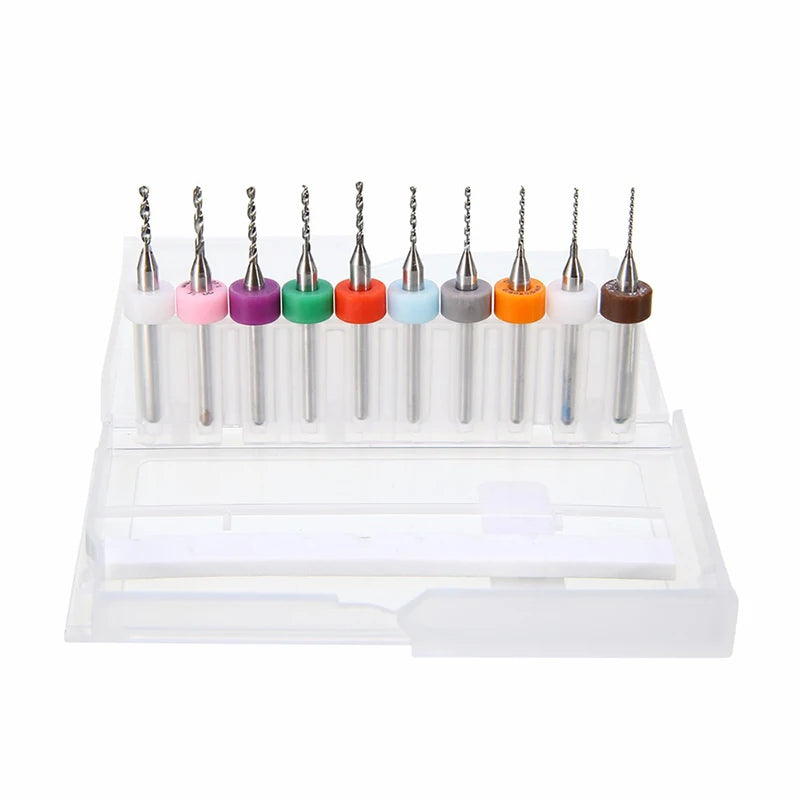
PCB Mini Drill Bits — 0.3–1.2mm Tungsten Steel, CNC Precision Drilling, Circuit Boards
PCB Mini Drill Bits 0.3–1.2mm Tungsten Steel, CNC Precision Drilling, Circuit Boards

Couldn't load pickup availability
PCB Mini Drill Bits — 0.3–1.2mm Tungsten Carbide, CNC & Hand Drilling, Circuit Boards
These precision micro drill bits are made from solid tungsten carbide (WC-Co), providing the hardness and wear resistance required for drilling printed circuit boards (PCBs), fiberglass (FR4), and composite materials. Available in diameters from 0.3mm to 1.2mm, they cover the full range of PCB via, pad, and through-hole drilling requirements. Compatible with CNC PCB routers, Dremel rotary tools, and PCB hand drill pin vises.
Key Specifications
| Parameter | Value |
|---|---|
| Material | Solid tungsten carbide (WC-Co) |
| Diameter Range | 0.3mm – 1.2mm (select size) |
| Shank Diameter | 3.175mm (1/8") — standard CNC collet size |
| Total Length | ~38mm |
| Flute Length | ~8–12mm (diameter dependent) |
| Compatible Materials | FR4, FR2, CEM-1, copper, fiberglass, PCB laminates |
| Coating | Uncoated (bare carbide) |
Drill Bit Size Guide for PCB Applications
| Diameter | Common PCB Use | Component Examples |
|---|---|---|
| 0.3mm | Micro via, fine-pitch pad | HDI PCB vias |
| 0.5mm | Standard via, SMD pad via | 0402/0603 component vias |
| 0.8mm | Standard through-hole component | Resistors, capacitors, small ICs |
| 1.0mm | DIP IC, connector pin | DIP-8/14/16 ICs, 2.54mm headers |
| 1.2mm | Large through-hole, terminal block | Power connectors, screw terminals |
Why Choose Tungsten Carbide PCB Drill Bits?
- Tungsten carbide hardness — 10× harder than HSS (high-speed steel), essential for abrasive FR4 fiberglass
- Long tool life — carbide bits drill hundreds of holes in FR4 before dulling vs. HSS bits that dull after tens of holes
- 3.175mm (1/8") shank — standard size for CNC PCB router collets (3018 Pro, Genmitsu, Sainsmart) and Dremel
- Precision ground — tight diameter tolerance for accurate hole sizing
- Full range 0.3–1.2mm — covers all standard PCB drilling requirements
Compatible With
- CNC PCB routers: 3018 Pro, Genmitsu 3030, Sainsmart Genmitsu, Snapmaker (with 3.175mm ER11 collet)
- Dremel rotary tool: Dremel 3000, 4000, 8220 with 3.175mm collet or Dremel 335 drill press
- PCB drill press: Dedicated PCB drill press with 3.175mm chuck
- Hand pin vise: Manual drilling for single-hole repairs and prototyping
- PCB materials: FR4, FR2, CEM-1, aluminum-backed PCB (with reduced speed)
Frequently Asked Questions
Q: What spindle speed should I use for PCB drilling with these bits?
A: For FR4 PCB drilling, use high spindle speeds: 0.3–0.5mm bits: 30,000–60,000 RPM; 0.8–1.0mm bits: 20,000–40,000 RPM; 1.2mm bits: 15,000–25,000 RPM. Use a slow feed rate (plunge slowly) and clear chips frequently. High speed + slow feed = clean holes and longer bit life.
Q: How do I prevent PCB drill bits from breaking?
A: Carbide bits are brittle — they break from lateral force, not axial load. Key tips: (1) Ensure the PCB is firmly clamped — movement causes breakage. (2) Drill straight — any angle causes side load. (3) Use a sacrificial backing board (MDF or scrap PCB) to prevent tear-out on exit. (4) Do not use dull bits — increased force causes breakage.
Q: Can these bits drill aluminum-backed PCBs (metal core PCBs)?
A: Yes, but reduce spindle speed by 50% and use cutting fluid (WD-40 or light oil) to prevent heat buildup. Aluminum is softer than FR4 but conducts heat poorly, which can cause carbide to crack at high temperatures. For high-volume aluminum PCB drilling, use dedicated aluminum-optimized carbide bits.
Package Contents
- PCB Mini Drill Bit(s) — diameter as selected (tungsten carbide, 3.175mm shank)