





Potentiometer 10KΩ Single-Turn Panel Mount — 6mm Shaft, Linear Taper, with Nut & Washer
Potentiometer 10KΩ Single-Turn Panel Mount 6mm Shaft, Linear Taper, with Nut & Washer
Compatible JST cables for sensors and modules — secure & reliable. Shop now.

Couldn't load pickup availability
Potentiometer — 10KΩ Single-Turn, Panel Mount / PCB Mount, 6mm Shaft
The 10KΩ single-turn panel mount potentiometer is the most widely used potentiometer value in electronics — the universal choice for Arduino analog input control knobs, voltage dividers, comparator thresholds, and general-purpose user controls. With a standard 6mm knurled shaft, smooth ~300° linear rotation, and dual panel/PCB mounting capability, this potentiometer is the default choice when you need a user-adjustable control in any circuit.
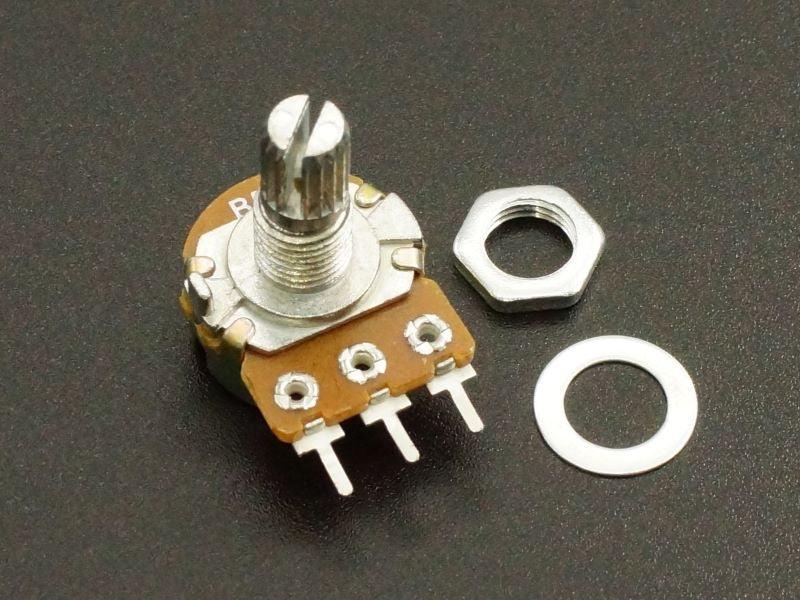
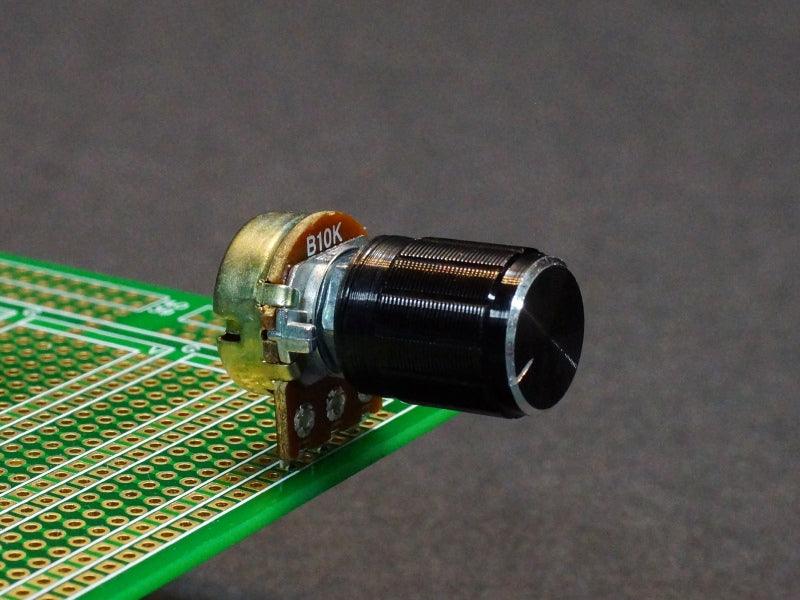
Supplied with mounting nut and washer for panel installation. The 6mm shaft accepts all standard potentiometer knobs available worldwide — from simple plastic caps to precision aluminum knobs for professional instrument panels.
Key Specifications
| Resistance | 10KΩ (10,000Ω) |
| Taper | Linear (Type B) |
| Tolerance | ±15% (typical measured) |
| Power Rating | 0.5W |
| Turns | Single-turn (~300° rotation) |
| Resistive Element | Carbon film |
| Shaft Diameter | 6mm (knurled, standard knob compatible) |
| Shaft Length | 15mm (0.59″) |
| Body Width | 18mm (0.71″) |
| Body + Shaft Length | 24mm (0.95″) |
| Panel Mounting Hole | 7mm (9/32″) |
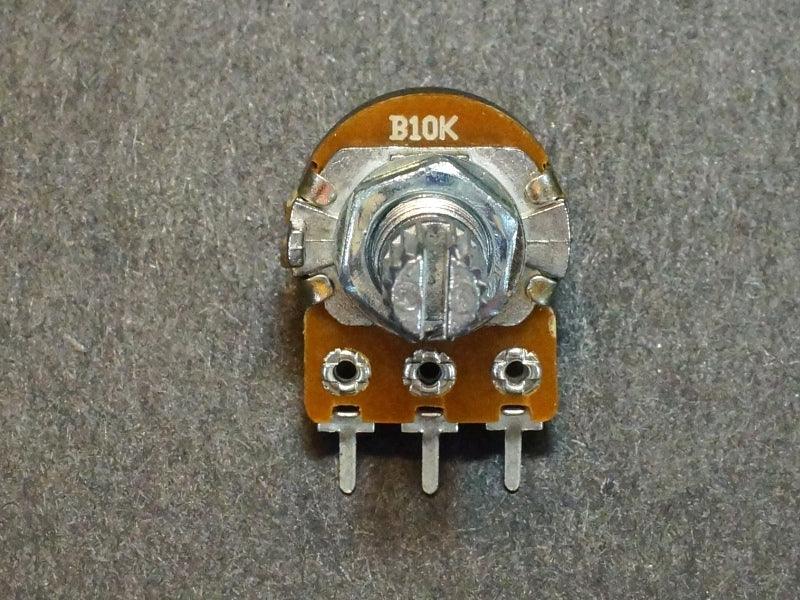
| PCB Lead Spacing | 5.08mm (0.2″) centers |
| Package | Metal body, 3 radial leads |
Mounting Options
- Panel mount: Insert shaft through a 7mm (9/32″) hole in the enclosure panel. Secure with the supplied washer and 10mm nut. Solder wires to the three pins. Add any standard 6mm-shaft knob for user control.
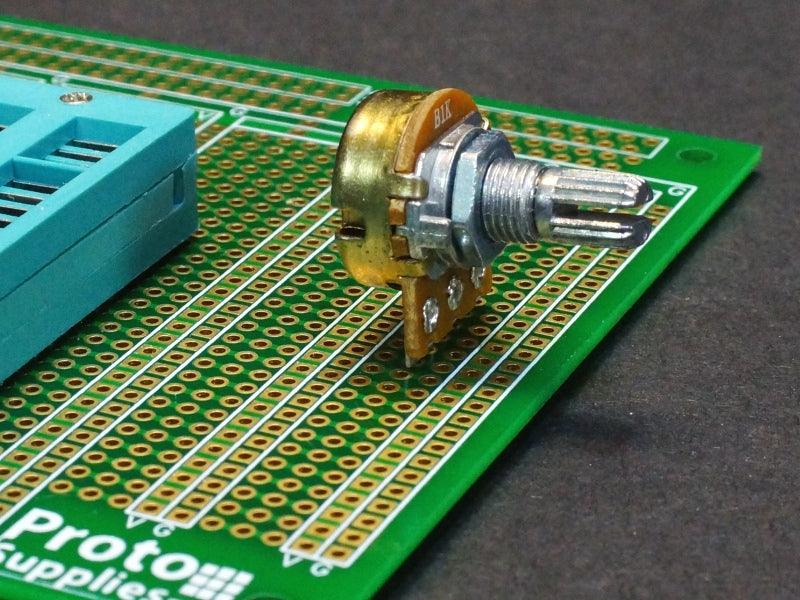
- PCB mount: Solder directly to PCB using the 5.08mm (0.2″) lead spacing — compatible with standard 0.1″ perfboard hole spacing. Note: leads are not long enough for solderless breadboards.
- Anti-rotation tab: A locator tab on the body prevents rotation in enclosures with a matching slot. Can be snapped off with pliers if not needed.
- Screwdriver adjust: If recessed behind a panel on a PCB, the slotted/knurled shaft can be adjusted with a flat-head screwdriver without a knob.
Why 10KΩ is the Universal Potentiometer Value
10KΩ is the default potentiometer value because it balances two competing requirements: low enough to drive most circuit inputs without loading effects, and high enough to limit current draw to a negligible level. At 10KΩ, a voltage divider from 5V draws only 0.5mA — negligible for any power supply, yet low enough impedance to drive op-amp inputs, comparators, and ADC inputs without error. It is the value specified in the vast majority of Arduino tutorials, electronics textbooks, and reference designs worldwide.
Typical Applications
- Arduino analog input control knob — the standard potentiometer for analogRead() tutorials and projects
- Comparator threshold setting — LM393, LM339: set switching voltage with a 10K voltage divider
- Op-amp gain and offset control — LM358, TL071: adjustable gain in amplifier circuits
- NE555 / TLC555 timing control — adjust oscillator frequency or monostable pulse width
- Bench power supply voltage adjust — user-facing output voltage control knob
- DIY synthesizer and audio effect controls — cutoff frequency, resonance, envelope time
- Sensor sensitivity adjustment — LDR, NTC thermistor, and pressure sensor threshold setting
- Function generator amplitude and frequency control
Package Contents
- 1 × Potentiometer 10KΩ Single-Turn (6mm shaft, linear taper, carbon film)
- 1 × Mounting nut (10mm)
- 1 × Washer

Blog posts
View all-

Best JST Connector Crimping Tools in 2026: Engi...
Choosing the wrong crimping tool ruins JST connectors and wastes wire. This guide compares the top crimping tools for JST SH, GH, PH, XH, and VH series — including Engineer...
Best JST Connector Crimping Tools in 2026: Engi...
Choosing the wrong crimping tool ruins JST connectors and wastes wire. This guide compares the top crimping tools for JST SH, GH, PH, XH, and VH series — including Engineer...
-

Molex KK 254 vs Mini-Fit Jr. vs Micro-Fit 3.0: ...
Choosing between Molex KK 254, Mini-Fit Jr., and Micro-Fit 3.0? This guide compares pitch, current rating, locking mechanism, wire gauge, and typical applications — with decision tables, part number references,...
Molex KK 254 vs Mini-Fit Jr. vs Micro-Fit 3.0: ...
Choosing between Molex KK 254, Mini-Fit Jr., and Micro-Fit 3.0? This guide compares pitch, current rating, locking mechanism, wire gauge, and typical applications — with decision tables, part number references,...
-

DuPont Connector vs JST PH 2.0: Pinout, Specs &...
Not sure whether to use a DuPont 2.54mm or JST PH 2.0mm connector? This guide compares pitch, locking mechanism, current rating, pinout, and best use cases — so you can...
DuPont Connector vs JST PH 2.0: Pinout, Specs &...
Not sure whether to use a DuPont 2.54mm or JST PH 2.0mm connector? This guide compares pitch, locking mechanism, current rating, pinout, and best use cases — so you can...


