



Trimmer Potentiometer 10KΩ Multi-Turn 3296 — 20-Turn Precision Cermet, Top-Adjust, 5-Pack
Trimmer Potentiometer 10KΩ Multi-Turn 3296 20-Turn Precision Cermet, Top-Adjust, 5-Pack
Compatible JST cables for sensors and modules — secure & reliable. Shop now.

Couldn't load pickup availability
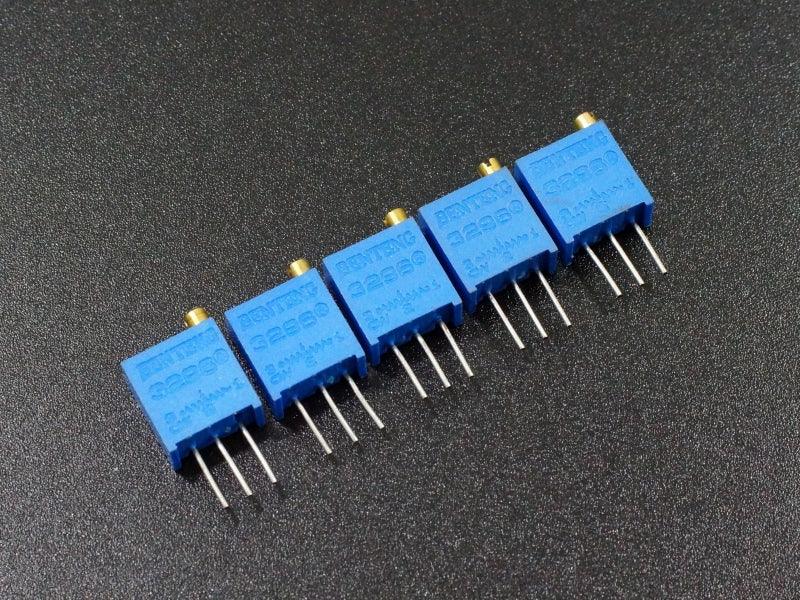
Trimmer Potentiometer — 10KΩ Multi-Turn 3296, 20-Turn Precision (5-Pack)
When a single-turn trimmer isn’t precise enough, the 3296 multi-turn trimmer potentiometer is the professional solution. This 10KΩ cermet trimmer spreads its full resistance range across ~20 turns of screwdriver adjustment, giving you 20× finer resolution than a single-turn trimmer — the difference between setting a reference voltage to within ±500mV versus ±25mV. Once set, the multi-turn mechanism holds its position securely, resisting vibration and accidental movement that would shift a single-turn trimmer off calibration.
The 3296 is the industry-standard footprint for precision trimmers — used in test equipment, industrial controllers, medical instruments, and professional audio gear worldwide. The cermet resistive element maintains calibration across temperature extremes (−40°C to +85°C) and humidity, making it suitable for both bench prototyping and permanent installation.
Key Specifications
| Resistance | 10KΩ (10,000Ω) |
| Tolerance | ±10% |
| Power Rating | 0.5W |
| Turns | ~20 turns (multi-turn) |
| Adjustment | Top-mounted screwdriver slot |
| Resistive Element | Cermet (stable over temperature and humidity) |
| Min Resistance (wiper) | <1Ω |
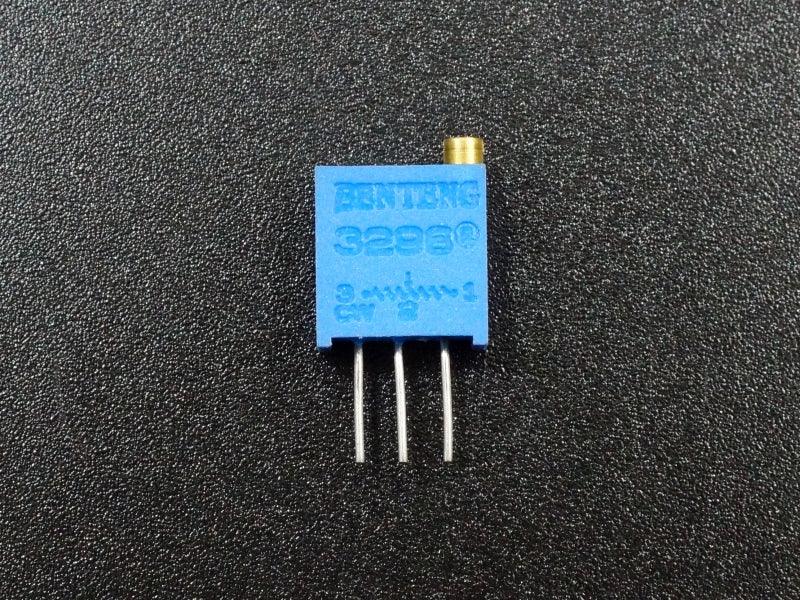
| Footprint | 3296 type — 10×10×4.5mm, 3 radial leads |
| Wiper Pin | Pin 2 (center pin) |
| Compliance | RoHS compliant |
Precision Comparison: Multi-Turn vs Single-Turn
| Single-Turn | Multi-Turn 3296 (this) | |
| Rotation for full range | ~270° (1 turn) | ~7,200° (20 turns) |
| Resolution per degree | ~0.37% of full range | ~0.014% of full range |
| Vibration resistance | Low | High (self-locking mechanism) |
| Best for | Coarse, fast adjustment | Precision calibration, stable settings |
Typical Applications
- Precision reference voltage — set exact Vref for ADC (ADS1115, MCP3208), DAC, and comparator circuits to millivolt accuracy
- Op-amp offset null — LM741, TL071, OPA2134: eliminate DC offset in audio and instrumentation amplifiers
- Stepper motor driver current limit — A4988, DRV8825, TMC2208 Vref adjustment for precise motor current setting
- Sensor span and zero calibration — pressure sensors, load cells, thermocouples, pH probes: set zero-point and full-scale output
- PID controller gain tuning — proportional, integral, and derivative gain adjustment in analog PID circuits
- Oscillator frequency trimming — RC and LC oscillator fine-tuning for frequency accuracy
- Power supply output voltage — fine-adjust output voltage in adjustable regulators (LM317, LM338)
- Audio amplifier bias — quiescent current setting in Class AB amplifier output stages
Global Use Cases
The 3296 multi-turn trimmer is used globally in industrial automation (PLC analog output calibration), laboratory instruments (oscilloscope vertical gain trim), medical devices (sensor signal conditioning), and professional audio equipment (channel balance and EQ trim). Its standardized footprint means it is a direct replacement for Bourns 3296W, Vishay T93, and equivalent trimmers from any manufacturer.
Package Contents
- 5 × Trimmer Potentiometer 10KΩ Multi-Turn 3296 (top-adjust, cermet, ~20 turns)

Blog posts
View all-

Best JST Connector Crimping Tools in 2026: Engi...
Choosing the wrong crimping tool ruins JST connectors and wastes wire. This guide compares the top crimping tools for JST SH, GH, PH, XH, and VH series — including Engineer...
Best JST Connector Crimping Tools in 2026: Engi...
Choosing the wrong crimping tool ruins JST connectors and wastes wire. This guide compares the top crimping tools for JST SH, GH, PH, XH, and VH series — including Engineer...
-

Molex KK 254 vs Mini-Fit Jr. vs Micro-Fit 3.0: ...
Choosing between Molex KK 254, Mini-Fit Jr., and Micro-Fit 3.0? This guide compares pitch, current rating, locking mechanism, wire gauge, and typical applications — with decision tables, part number references,...
Molex KK 254 vs Mini-Fit Jr. vs Micro-Fit 3.0: ...
Choosing between Molex KK 254, Mini-Fit Jr., and Micro-Fit 3.0? This guide compares pitch, current rating, locking mechanism, wire gauge, and typical applications — with decision tables, part number references,...
-

DuPont Connector vs JST PH 2.0: Pinout, Specs &...
Not sure whether to use a DuPont 2.54mm or JST PH 2.0mm connector? This guide compares pitch, locking mechanism, current rating, pinout, and best use cases — so you can...
DuPont Connector vs JST PH 2.0: Pinout, Specs &...
Not sure whether to use a DuPont 2.54mm or JST PH 2.0mm connector? This guide compares pitch, locking mechanism, current rating, pinout, and best use cases — so you can...


