



2N3904 NPN General Purpose Transistor (10-Pack)
2N3904 NPN General Purpose Transistor (10-Pack)
Compatible JST cables for sensors and modules — secure & reliable. Shop now.

Couldn't load pickup availability
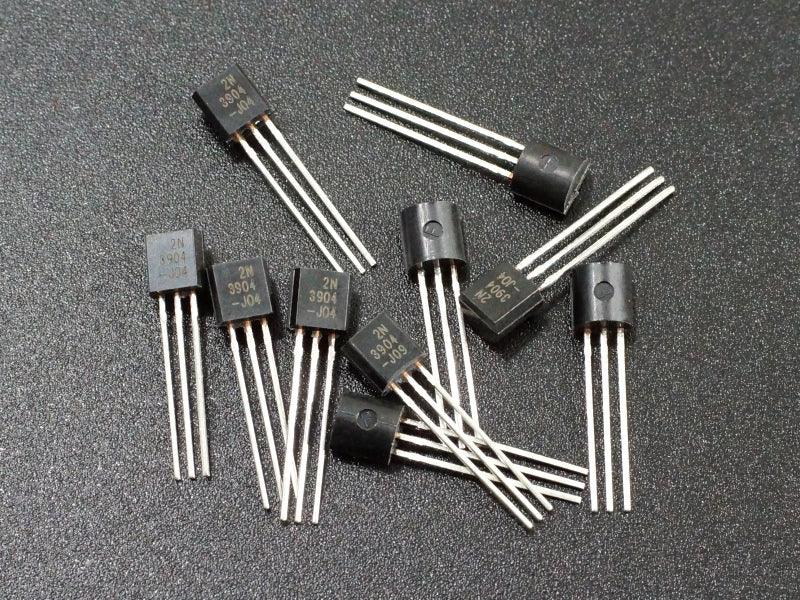
2N3904 NPN General Purpose Transistor — TO-92, 40V / 200mA, 10 Pieces
The 2N3904 is one of the most widely used NPN bipolar junction transistors (BJT) in electronics, found in virtually every hobbyist parts bin and professional prototype lab. It is a general-purpose small-signal transistor optimized for low-power amplification and switching applications, with a collector-emitter voltage of 40V, 200mA collector current, and a transition frequency of 300MHz. Its TO-92 plastic package with standard EBC (Emitter-Base-Collector) pinout makes it compatible with breadboards, perfboards, and PCBs.
10 pieces per pack.
Key Specifications
- Type: NPN Bipolar Junction Transistor (BJT), silicon
- Package: TO-92 (through-hole, plastic)
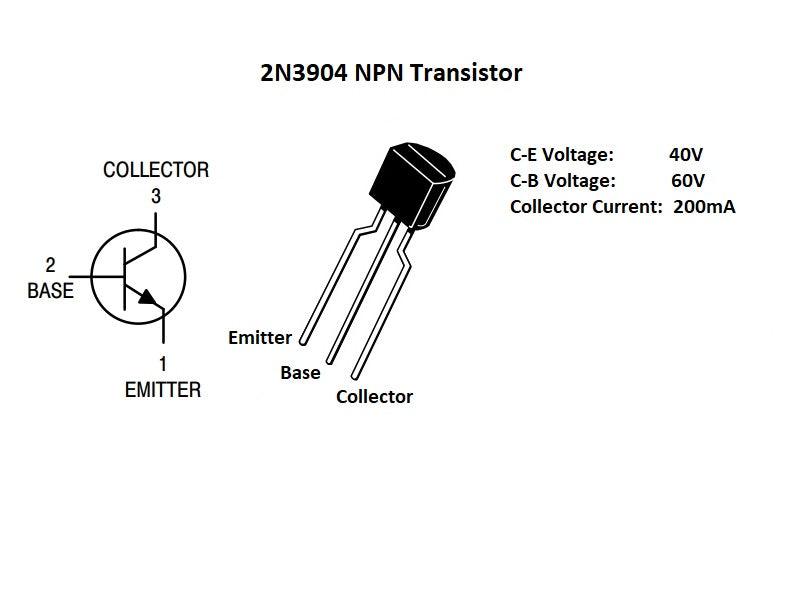
- Pinout (flat face forward, left to right): Emitter (E) — Base (B) — Collector (C)
- Collector-Emitter Voltage (Vceo): 40V
- Collector-Base Voltage (Vcbo): 60V
- Emitter-Base Voltage (Vebo): 6V
- Collector Current (Ic): 200mA continuous
- DC Current Gain (hFE): 100–300 (@ Ic=10mA, Vce=1V)
- Power Dissipation (Pd): 625mW
- Transition Frequency (fT): 300MHz
- Saturation Voltage (Vce(sat)): 0.2V @ Ic=10mA
- Manufacturer: Fairchild / ON Semiconductor
- Quantity: 10 pieces
TO-92 Pinout (Flat Face Forward)
- Pin 1 (left): Emitter (E)
- Pin 2 (center): Base (B)
- Pin 3 (right): Collector (C)
Basic Switching Circuit (Arduino GPIO Buffering)
To switch a load that exceeds Arduino GPIO current limits (20–40mA), use the 2N3904 as a low-side switch:
- Base (B) → Arduino GPIO via 4.7kΩ resistor (limits base current to safe levels)
- Collector (C) → Load negative terminal
- Emitter (E) → GND
- Load positive → Supply voltage (up to 40V)
- Add flyback diode across inductive loads (motors, relays, solenoids)
- GPIO HIGH = transistor ON (load powered); GPIO LOW = transistor OFF
Example: driving 3 LEDs (60mA total) from a single Arduino pin — base resistor 4.7kΩ, current-limiting resistor 50Ω in series with LEDs.
Base Resistor Calculation
For switching (saturation): Rb = (Vb − 0.7V) / Ib, where Ib = Ic / hFE. For Ic=100mA, hFE=100: Ib = 1mA. Rb = (5V − 0.7V) / 1mA = 4.3kΩ. Use 4.7kΩ standard value. For amplification, bias the base for the desired operating point.
2N3904 vs. PN2222A vs. TIP120
- 2N3904: 40V, 200mA, hFE 100–300. Best for signal switching, LED driving, relay coil activation at low current.
- PN2222A: 40V, 600mA, hFE 100–300. Higher current for loads up to 600mA (small motors, multiple LEDs).
- TIP120: 60V, 5A, hFE ≥1000 (Darlington). For high-current loads (motors, fans) up to 5A.
Typical Applications
- Arduino/ESP32 GPIO current buffering (driving loads beyond GPIO current limit)
- LED driver (single or multiple LEDs up to 200mA total)
- Relay coil driver (5V/12V relay coils, typically 50–150mA)
- Signal amplification in audio and RF circuits
- Logic-level signal inversion (common emitter configuration)
- Oscillator and timer circuits
- Sensor signal conditioning
- Gate drive for small MOSFETs (NPN transistor as gate driver)
Package Contents
- 10 × 2N3904 NPN general purpose transistor, TO-92

Blog posts
View all-

IC Chips & Discrete Components Express Shipping...
Shipping IC chips and discrete electronic components internationally requires more than choosing a carrier. ESD-safe packaging, correct HS codes, accurate customs declarations, and carrier selection for your destination all determine...
IC Chips & Discrete Components Express Shipping...
Shipping IC chips and discrete electronic components internationally requires more than choosing a carrier. ESD-safe packaging, correct HS codes, accurate customs declarations, and carrier selection for your destination all determine...
-

From Prototype to Mass Production — How to Scal...
Scaling from prototype to mass production is the most critical transition in a hardware product's lifecycle. The sourcing strategy that works for 10 prototype boards — cut tape, spot pricing,...
From Prototype to Mass Production — How to Scal...
Scaling from prototype to mass production is the most critical transition in a hardware product's lifecycle. The sourcing strategy that works for 10 prototype boards — cut tape, spot pricing,...
-

ISO 9001 Electronic Component Distributor — Wha...
ISO 9001:2015 certification is the most widely recognized quality management standard in the world — but what does it actually mean when an electronic component distributor claims to be ISO...
ISO 9001 Electronic Component Distributor — Wha...
ISO 9001:2015 certification is the most widely recognized quality management standard in the world — but what does it actually mean when an electronic component distributor claims to be ISO...


