



2N3906 PNP General Purpose Transistor (10-Pack)
2N3906 PNP General Purpose Transistor (10-Pack)
Compatible JST cables for sensors and modules — secure & reliable. Shop now.

Couldn't load pickup availability
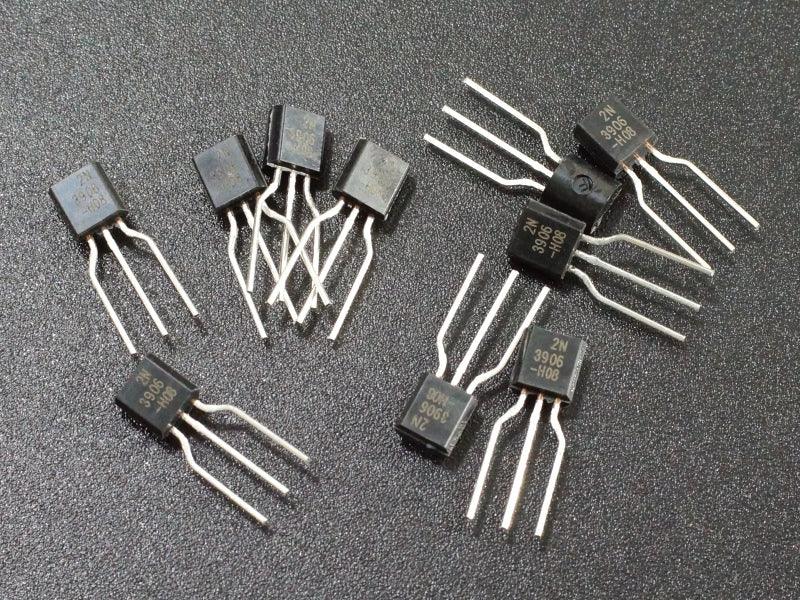
2N3906 PNP General Purpose Transistor — TO-92, 40V / 200mA, 10 Pieces
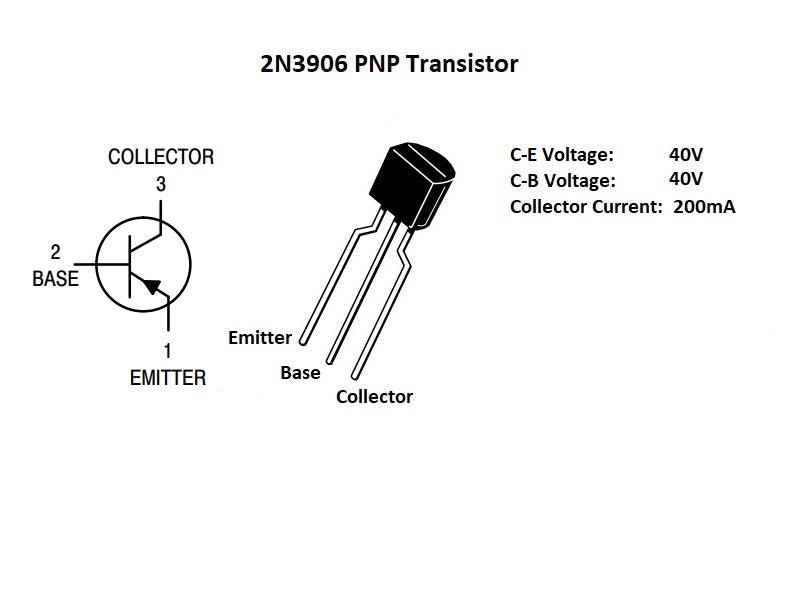
The 2N3906 is the standard PNP complement to the 2N3904 NPN transistor — sharing the same TO-92 package, EBC pinout, and general-purpose small-signal ratings. Rated at 40V collector-emitter voltage and 200mA collector current, it is used for high-side switching, signal amplification, and level shifting in circuits where a PNP device is required. Together with the 2N3904, they form the most commonly stocked complementary BJT pair in electronics.
10 pieces per pack.
Key Specifications
- Type: PNP Bipolar Junction Transistor (BJT), silicon
- Package: TO-92 (through-hole, plastic)
- Pinout (flat face forward, left to right): Emitter (E) — Base (B) — Collector (C)
- Collector-Emitter Voltage (Vceo): −40V
- Collector-Base Voltage (Vcbo): −40V
- Emitter-Base Voltage (Vebo): 5V
- Collector Current (Ic): 200mA continuous
- DC Current Gain (hFE): 100–300 (@ Ic=10mA, Vce=−1V)
- Power Dissipation (Pd): 625mW
- Transition Frequency (fT): 250MHz
- Saturation Voltage (Vce(sat)): −0.25V @ Ic=10mA
- Manufacturer: Fairchild / ON Semiconductor
- Quantity: 10 pieces
PNP vs. NPN Operation
PNP transistors operate with reversed polarity compared to NPN. The key differences:
- Current direction: Conventional current flows from Emitter to Collector (opposite to NPN)
- Turn-on condition: Base must be pulled LOW relative to Emitter (Vbe ≈ −0.7V) to turn ON
- High-side switching: PNP is naturally suited for high-side switching — Emitter connects to positive supply, Collector connects to load
- MCU control: GPIO LOW = transistor ON; GPIO HIGH = transistor OFF (inverted logic vs. NPN)
High-Side Switch Wiring (5V Load)
- Emitter (E) → +5V supply
- Collector (C) → Load positive terminal
- Load negative terminal → GND
- Base (B) → Arduino GPIO via 4.7kΩ resistor
- 10kΩ pull-up from Base to Emitter (+5V) — ensures transistor is OFF when GPIO is floating
- GPIO LOW = transistor ON (load powered); GPIO HIGH = transistor OFF
2N3906 vs. 2N3904 vs. PN2907
- 2N3906 (PNP): 40V, 200mA. High-side switching, complementary pair with 2N3904.
- 2N3904 (NPN): 40V, 200mA. Low-side switching. Complementary pair with 2N3906.
- PN2907 (PNP): 40V, 800mA. Higher current PNP for loads up to 800mA.
Typical Applications
- High-side load switching controlled by Arduino/ESP32 GPIO
- Complementary push-pull output stage (paired with 2N3904)
- Signal amplification in audio preamplifier circuits
- Level shifting and logic inversion
- Current mirror circuits
- Oscillator and timer circuits (complementary to NPN)
- LED driver (high-side, up to 200mA)
Package Contents
- 10 × 2N3906 PNP general purpose transistor, TO-92

Blog posts
View all-

IC Chips & Discrete Components Express Shipping...
Shipping IC chips and discrete electronic components internationally requires more than choosing a carrier. ESD-safe packaging, correct HS codes, accurate customs declarations, and carrier selection for your destination all determine...
IC Chips & Discrete Components Express Shipping...
Shipping IC chips and discrete electronic components internationally requires more than choosing a carrier. ESD-safe packaging, correct HS codes, accurate customs declarations, and carrier selection for your destination all determine...
-

From Prototype to Mass Production — How to Scal...
Scaling from prototype to mass production is the most critical transition in a hardware product's lifecycle. The sourcing strategy that works for 10 prototype boards — cut tape, spot pricing,...
From Prototype to Mass Production — How to Scal...
Scaling from prototype to mass production is the most critical transition in a hardware product's lifecycle. The sourcing strategy that works for 10 prototype boards — cut tape, spot pricing,...
-

ISO 9001 Electronic Component Distributor — Wha...
ISO 9001:2015 certification is the most widely recognized quality management standard in the world — but what does it actually mean when an electronic component distributor claims to be ISO...
ISO 9001 Electronic Component Distributor — Wha...
ISO 9001:2015 certification is the most widely recognized quality management standard in the world — but what does it actually mean when an electronic component distributor claims to be ISO...


