


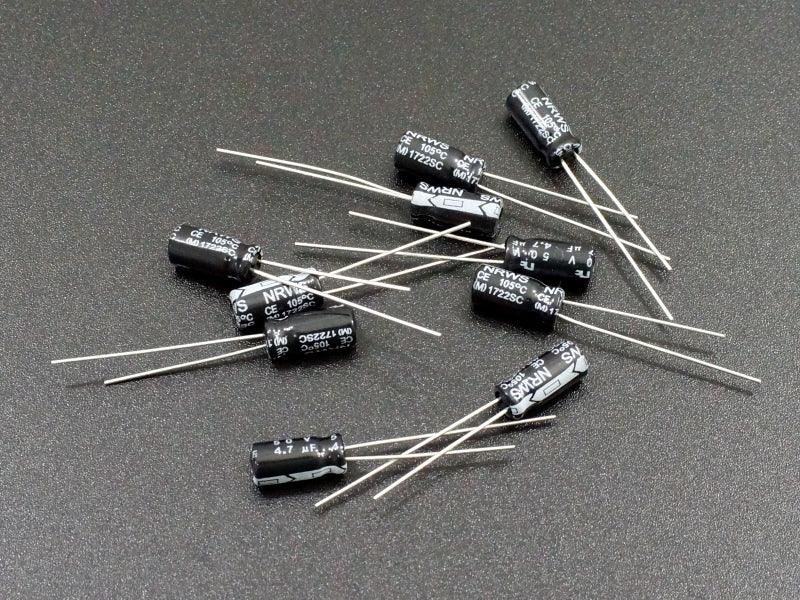
Electrolytic Capacitor 4.7μF 50V — Radial, 105°C, Through-Hole, 10-Pack
Electrolytic Capacitor 4.7μF 50V Radial, 105°C, Through-Hole, 10-Pack
Compatible JST cables for sensors and modules — secure & reliable. Shop now.

Couldn't load pickup availability
Electrolytic Capacitor — 4.7μF / 50V, Radial Through-Hole (10-Pack)
A standard 4.7μF 50V aluminum electrolytic capacitor in radial through-hole package — rated for 105°C operation. The 4.7μF value is one of the most commonly used capacitances in electronics, appearing in power supply filtering, audio coupling, op-amp stability, and microcontroller decoupling circuits. The 50V rating provides adequate margin for 5V, 12V, and 24V supply rails.
Key Specifications
| Capacitance | 4.7μF |
| Voltage Rating | 50V DC |
| Temperature Rating | 105°C |
| Type | Aluminum electrolytic, radial |
| Polarity | Polarized (observe − stripe marking) |
| Lead Spacing | 2.0mm (standard radial) |
| Compliance | RoHS compliant |
Polarity — Important
Electrolytic capacitors are polarized — the negative lead is marked with a stripe on the capacitor body and is the shorter lead. Always connect the negative lead to the lower-voltage side of the circuit. Reverse polarity will damage or destroy the capacitor.
Typical Applications
- Power supply output filtering and bulk decoupling
- Op-amp input/output coupling and stability capacitor
- Audio signal coupling and bypass
- Linear voltage regulator (7805/7812) output capacitor
- Microcontroller and sensor power rail decoupling
- NE555 timer circuit timing capacitor
Package Contents
- 10 × Electrolytic Capacitor 4.7μF 50V (radial, 105°C)

Blog posts
View all-

IC Chips & Discrete Components Express Shipping...
Shipping IC chips and discrete electronic components internationally requires more than choosing a carrier. ESD-safe packaging, correct HS codes, accurate customs declarations, and carrier selection for your destination all determine...
IC Chips & Discrete Components Express Shipping...
Shipping IC chips and discrete electronic components internationally requires more than choosing a carrier. ESD-safe packaging, correct HS codes, accurate customs declarations, and carrier selection for your destination all determine...
-

From Prototype to Mass Production — How to Scal...
Scaling from prototype to mass production is the most critical transition in a hardware product's lifecycle. The sourcing strategy that works for 10 prototype boards — cut tape, spot pricing,...
From Prototype to Mass Production — How to Scal...
Scaling from prototype to mass production is the most critical transition in a hardware product's lifecycle. The sourcing strategy that works for 10 prototype boards — cut tape, spot pricing,...
-

ISO 9001 Electronic Component Distributor — Wha...
ISO 9001:2015 certification is the most widely recognized quality management standard in the world — but what does it actually mean when an electronic component distributor claims to be ISO...
ISO 9001 Electronic Component Distributor — Wha...
ISO 9001:2015 certification is the most widely recognized quality management standard in the world — but what does it actually mean when an electronic component distributor claims to be ISO...


