


12MHz Crystal with 18pF Caps
12MHz Crystal with 18pF Caps
Compatible JST cables for sensors and modules — secure & reliable. Shop now.

Couldn't load pickup availability
12MHz Crystal Oscillator with 18pF Load Capacitors — Arduino & ATmega Microcontroller Clock
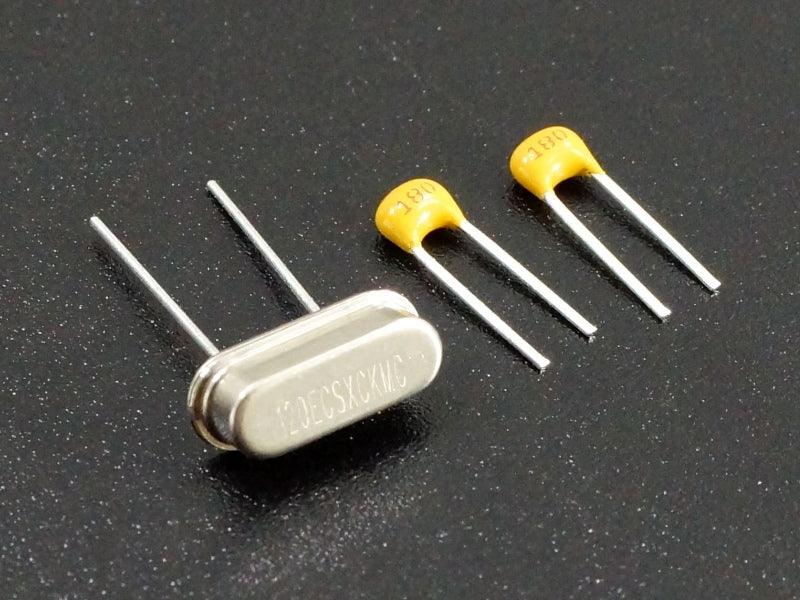
A 12MHz fundamental mode quartz crystal resonator in HC-49S (or HC-49US low-profile) package, supplied with a matched pair of 18pF ceramic load capacitors for a complete crystal oscillator circuit. The 12MHz crystal is commonly used as the clock source for ATmega microcontrollers (ATmega328P, ATmega2560, ATmega32U4) in standalone Arduino circuits, USB interface circuits (where 12MHz provides the exact USB full-speed clock), and general-purpose microcontroller clock applications. The 18pF load capacitors are matched to the crystal’s specified load capacitance for accurate frequency operation.
Technical Specifications
| Parameter | Value |
|---|---|
| Frequency | 12.000MHz |
| Frequency Tolerance | ±30ppm (at 25°C) |
| Frequency Stability | ±50ppm (−20°C to +70°C) |
| Load Capacitance | 18pF (matched capacitors included) |
| Package | HC-49S (through-hole, 2-pin) |
| Equivalent Series Resistance (ESR) | <80Ω |
| Drive Level | 100µW max |
| Operating Temperature | −20°C to +70°C |
| Certification | RoHS |
Why 12MHz for USB Applications?
| USB Speed | Bit Rate | Required Clock | 12MHz Suitability |
|---|---|---|---|
| USB Low Speed | 1.5Mbps | 12MHz / 8 = 1.5MHz | Yes (exact) |
| USB Full Speed | 12Mbps | 12MHz (exact) | Yes (exact) |
| USB High Speed | 480Mbps | 480MHz | No (requires PLL) |
Crystal Oscillator Circuit
Connect the crystal and load capacitors as follows for ATmega microcontrollers:
- Crystal pin 1 → XTAL1 pin of ATmega + 18pF capacitor to GND
- Crystal pin 2 → XTAL2 pin of ATmega + 18pF capacitor to GND
- Set ATmega fuse bits to external crystal oscillator mode (CKSEL = 1111, SUT = 11 for 12MHz crystal)
Typical Applications
- Standalone Arduino: 12MHz clock source for standalone ATmega328P Arduino circuits on custom PCBs
- USB Interface: 12MHz crystal for ATmega32U4 and V-USB software USB implementations requiring exact 12MHz clock
- Microcontroller Clock: General-purpose 12MHz clock source for PIC, AVR, STM32, and other microcontrollers supporting external crystal oscillators
- UART Baud Rate: 12MHz provides exact baud rates for 9600, 19200, 38400, 57600, and 115200 bps UART communication with zero error
FAQ
Q: Can I use a 12MHz crystal instead of the standard 16MHz Arduino crystal?
A: Yes. ATmega328P supports 12MHz external crystal. Update the Arduino board definition to 12MHz (or use a custom boards.txt entry) to ensure correct timing for delay(), millis(), and UART baud rate calculations.
Q: Why are 18pF capacitors included?
A: The 18pF load capacitors are required for the crystal oscillator circuit to oscillate at the specified frequency. The capacitor value must match the crystal’s specified load capacitance (CL = 18pF for this crystal). Using incorrect capacitor values will cause frequency error or oscillation failure.
Package Contents
- 1 × 12MHz HC-49S quartz crystal
- 2 × 18pF ceramic capacitors (load capacitors)

Blog posts
View all-

IC Chips & Discrete Components Express Shipping...
Shipping IC chips and discrete electronic components internationally requires more than choosing a carrier. ESD-safe packaging, correct HS codes, accurate customs declarations, and carrier selection for your destination all determine...
IC Chips & Discrete Components Express Shipping...
Shipping IC chips and discrete electronic components internationally requires more than choosing a carrier. ESD-safe packaging, correct HS codes, accurate customs declarations, and carrier selection for your destination all determine...
-

From Prototype to Mass Production — How to Scal...
Scaling from prototype to mass production is the most critical transition in a hardware product's lifecycle. The sourcing strategy that works for 10 prototype boards — cut tape, spot pricing,...
From Prototype to Mass Production — How to Scal...
Scaling from prototype to mass production is the most critical transition in a hardware product's lifecycle. The sourcing strategy that works for 10 prototype boards — cut tape, spot pricing,...
-

ISO 9001 Electronic Component Distributor — Wha...
ISO 9001:2015 certification is the most widely recognized quality management standard in the world — but what does it actually mean when an electronic component distributor claims to be ISO...
ISO 9001 Electronic Component Distributor — Wha...
ISO 9001:2015 certification is the most widely recognized quality management standard in the world — but what does it actually mean when an electronic component distributor claims to be ISO...


