

Keszoox
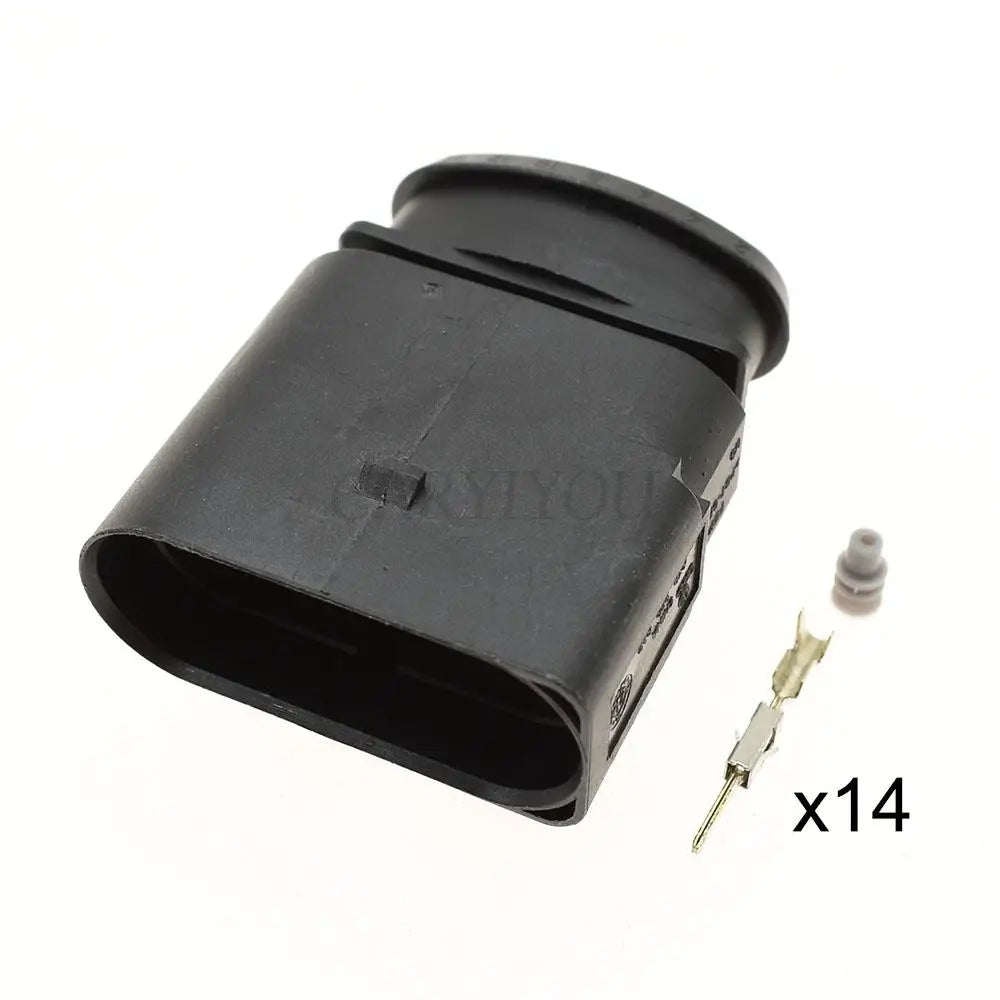
6X0973817 / 6X0973717 Automotive 14-Pin Waterproof Connector — VW / Audi 09G Aisin TF-60SN Gearbox Wiring Harness Socket
6X0973817 / 6X0973717 Automotive 14-Pin Waterproof Connector VW / Audi 09G Aisin TF-60SN Gearbox Wiring Harness Socket

Couldn't load pickup availability
6X0973817 / 6X0973717 Automotive 14-Pin Waterproof Connector — VW / Audi 09G Aisin TF-60SN Gearbox
The 6X0973817 (female socket) and 6X0973717 (male plug) are the external wiring harness connectors for the VW / Audi 09G automatic transmission — the Aisin-Warner TF-60SN 6-speed unit fitted to millions of VW Group vehicles from 2003 onward. This 14-pin sealed connector is the critical electrical interface between the Transmission Control Unit (TCU) and the transmission’s internal solenoid pack, input/output speed sensors, and fluid temperature sensor. Failure of this connector — through ATF contamination, terminal corrosion, or seal degradation — is one of the most common causes of 09G transmission fault codes, harsh shifting, and limp-mode activation.
Unlike the internal wiring harness (which requires transmission removal), the 6X0973817/6X0973717 external connector is accessible from underneath the vehicle without dropping the gearbox — making it a cost-effective first diagnostic and repair step before committing to a full transmission service.
Key Specifications
| Parameter | Value |
|---|---|
| OEM Part Numbers | 6X0973817 (female) / 6X0973717 (male) |
| VW Format | 6X0 973 817 / 6X0 973 717 |
| Pin Count | 14-pin |
| Application | 09G (Aisin TF-60SN) external wiring harness connector |
| Sealing | Waterproof (sealed housing + wire seals) |
| Housing Material | PA66 glass-filled nylon |
| Terminal Material | Tin-plated copper alloy |
| Wire Range | 0.35–1.0mm² (22–18 AWG) |
| Operating Temperature | -40°C to +125°C |
| ATF Resistance | Yes (sealed against transmission fluid) |
| Compatible Transmission | VW/Audi 09G (Aisin TF-60SN) 6-speed automatic |
| Compliance | RoHS |
Compatible Vehicles (09G Transmission)
| Brand | Model | Years |
|---|---|---|
| Volkswagen | Golf Mk5 / Mk6, Jetta Mk5, Passat B6, Tiguan Mk1, Touran | 2003–2015 |
| Audi | A3 8P, A4 B7/B8, TT 8J | 2004–2013 |
| SEAT | Leon Mk2, Altea, Toledo Mk3 | 2005–2012 |
| Skoda | Octavia Mk2, Superb Mk2 | 2004–2013 |
Why the 09G External Connector Fails
- ATF seal degradation — the connector sits on the transmission case and is exposed to ATF vapour and minor leaks; over time, the wire seals harden and crack, allowing ATF to wick into the connector and corrode the terminals
- Terminal oxidation from heat cycling — the transmission runs at 80–120°C under load; repeated thermal cycling causes terminal oxidation that increases contact resistance, triggering solenoid circuit faults
- Connector damage during service — the 09G connector is frequently damaged during transmission fluid changes or mechatronics unit replacement; the locking tab is brittle on aged connectors
Fault Codes Associated with This Connector
| DTC | Description | Likely Circuit |
|---|---|---|
| P0750 | Shift Solenoid A Circuit Malfunction | Solenoid N88 (pin 1/2) |
| P0755 | Shift Solenoid B Circuit Malfunction | Solenoid N89 (pin 3/4) |
| P0760 | Shift Solenoid C Circuit Malfunction | Solenoid N90 (pin 5/6) |
| P0765 | Shift Solenoid D Circuit Malfunction | Solenoid N91 (pin 7/8) |
| P0715 | Input/Turbine Speed Sensor Circuit | G182 sensor (pin 9/10) |
| P0720 | Output Speed Sensor Circuit | G195 sensor (pin 11/12) |
| P0710 | Transmission Fluid Temperature Sensor | G93 sensor (pin 13/14) |
Repair Procedure — External Connector Replacement
- Disconnect the battery negative terminal and wait 5 minutes
- Raise the vehicle on a lift or axle stands; locate the 09G connector on the left side of the transmission case
- Clean the connector area with brake cleaner to remove ATF residue before disconnecting
- Press the locking tab and pull the connector straight out — do not twist
- Inspect all 14 terminals for corrosion, push-back, or damage; clean with electrical contact cleaner if replacing only the housing
- Install new wire seals on each wire before crimping new terminals (if replacing terminals)
- Insert terminals into the new housing until each clicks into place; verify with a gentle pull-test
- Apply a thin film of dielectric grease to the connector mating face before reconnecting
- Reconnect battery, clear DTCs, and perform a transmission adaptation reset using VCDS or equivalent
Frequently Asked Questions
Q: Can a faulty external connector cause limp mode on the 09G?
Yes — and it’s one of the most common causes. The 09G TCU monitors solenoid circuit resistance continuously; a corroded terminal increases circuit resistance above the fault threshold, triggering a solenoid circuit DTC and activating limp mode (typically locked in 3rd gear). Before replacing the mechatronics unit (which costs €300–€800), always inspect and test the external connector first. A €15 connector replacement has resolved limp mode on countless 09G-equipped vehicles.
Q: How do I distinguish a connector fault from a faulty mechatronics unit?
Disconnect the external connector and measure resistance between the corresponding terminal pairs on the transmission side of the connector (not the TCU side). Compare readings to the 09G workshop manual specifications: solenoids typically read 3–10Ω, speed sensors 200–1500Ω, and the temperature sensor varies with temperature. If resistance values are within spec at the transmission connector but DTCs persist, the fault is in the external connector, wiring harness, or TCU — not the mechatronics unit.
Q: Do I need to perform a transmission adaptation reset after replacing the connector?
Yes — after any transmission wiring repair, perform a transmission adaptation reset using VCDS (VAG-COM), OBD Eleven, or equivalent VW/Audi diagnostic software. This clears the TCU’s learned shift adaptation values, which may have been skewed by the connector fault. Without a reset, the transmission may continue to shift harshly even after the connector is repaired. The adaptation reset procedure takes approximately 15–20 minutes of normal driving to complete.