

Keszoox
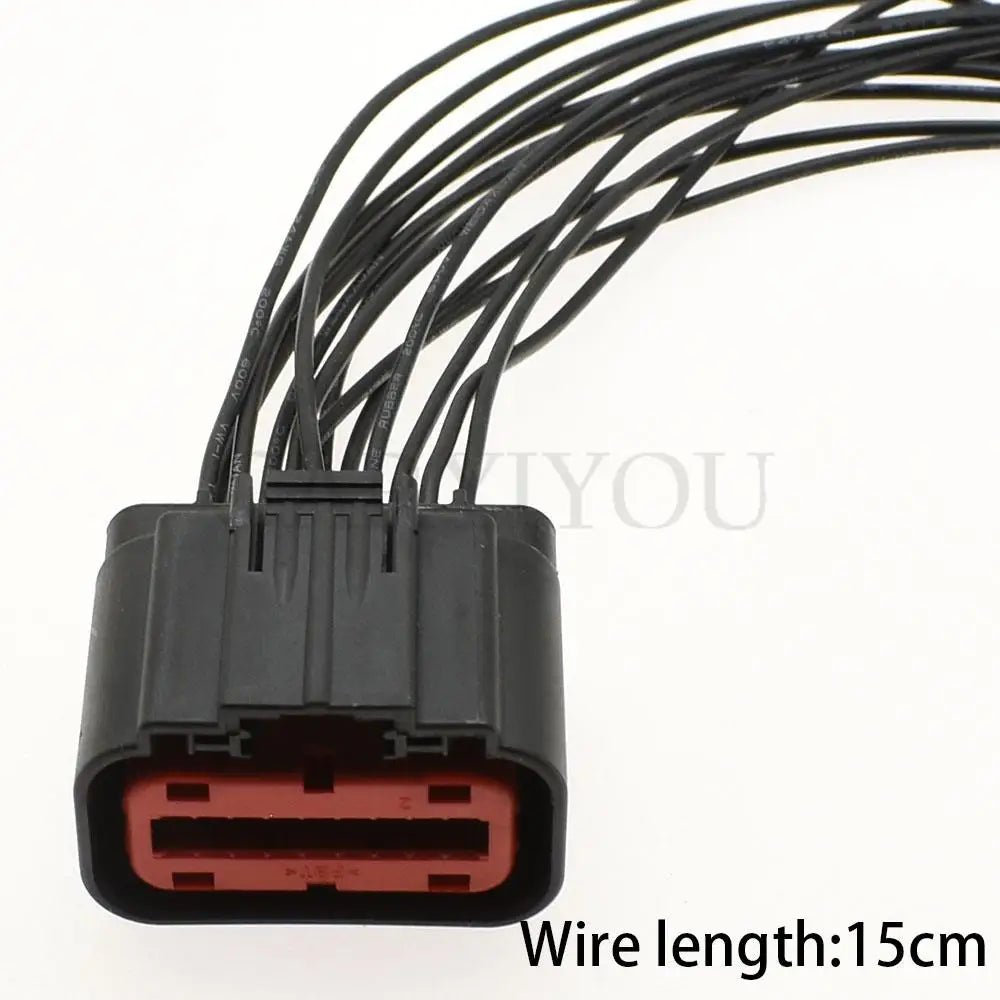
1488533-5 Automotive 18-Pin ECU Socket — Air Flow Meter & ACC Cruise Connector for Land Rover / Ford / Range Rover
1488533-5 Automotive 18-Pin ECU Socket Air Flow Meter & ACC Cruise Connector for Land Rover / Ford / Range Rover

Couldn't load pickup availability
1488533-5 Automotive 18-Pin ECU Socket — Air Flow Meter & ACC Cruise Connector
The 1488533-5 is an 18-pin automotive ECU socket connector for air flow meter (MAF sensor), adaptive cruise control (ACC), and related sensor wiring harness applications on Land Rover, Ford, and Range Rover vehicles. This TE Connectivity part number is used in underhood sensor connector applications on Jaguar Land Rover (JLR) and Ford platforms, where the 18-pin configuration accommodates the multiple circuits required by integrated sensor assemblies combining airflow measurement, temperature sensing, and electronic throttle control circuits.
The 1488533-5 is closely related to the 1488533-6 variant — both are 18-pin connectors in the same TE series, differing in minor dimensional or color details. The “-5” variant is specifically referenced in Land Rover and Range Rover service documentation for MAF sensor and ACC module connector applications.
Key Specifications
| Parameter | Value |
|---|---|
| OEM Part Number | 1488533-5 |
| Manufacturer | TE Connectivity |
| Pin Count | 18-pin |
| Application | MAF sensor / ACC cruise / ECU socket |
| Housing Material | PA66 glass-filled nylon |
| Terminal Material | Tin-plated copper alloy |
| Operating Temperature | -40°C to +125°C |
| Compatible Platforms | Land Rover, Range Rover, Ford (JLR / Ford platforms) |
| Compliance | RoHS |
Compatible Models
| Brand | Model | Application |
|---|---|---|
| Land Rover | Discovery 3/4 (L319/L320), Freelander 2 (L359) | MAF sensor connector |
| Range Rover | Sport (L320), Evoque (L538) | MAF / ACC connector |
| Ford | Mondeo Mk4, S-Max, Galaxy (CD345) | MAF sensor connector |
| Jaguar | XF (X250), XJ (X351) | ECU sensor connector |
MAF Sensor Connector on Land Rover / Range Rover — Known Issues
- P0100–P0104 DTCs on JLR vehicles — MAF sensor circuit faults are common on Land Rover Discovery 3/4 and Range Rover Sport; the connector is frequently the root cause rather than the MAF sensor itself
- Underhood heat and vibration — JLR V6/V8 engines generate significant underhood heat; the MAF connector experiences thermal cycling that fatigues terminal contact springs over time
- ACC cruise control faults — on models where the 1488533-5 is used for the ACC module connector, terminal corrosion causes ACC system faults and cruise control unavailability warnings
- Misdiagnosis as MAF sensor failure — MAF sensor replacement is a common but often unnecessary repair on JLR vehicles; always inspect and test the connector before replacing the sensor (£150–£400)
Frequently Asked Questions
Q: What is the difference between 1488533-5 and 1488533-6?
The 1488533-5 and 1488533-6 are revision variants within the same TE Connectivity 18-pin connector series. The “-5” variant is referenced in Land Rover/Range Rover service documentation; the “-6” variant is referenced in Ford and other platform documentation. Both are 18-pin connectors with the same mating interface. If your original connector is stamped with either part number, either variant can be used as a replacement — verify the housing color and locking mechanism match your original before ordering.
Q: How do I diagnose a MAF sensor connector fault on Land Rover Discovery 3/4?
Disconnect the MAF sensor connector and inspect all 18 terminals for corrosion. Use a multimeter to measure the MAF sensor output voltage with the engine running — a good MAF sensor should produce a voltage that increases with engine RPM (typically 0.5–4.5V for a frequency-type MAF). If the sensor output is correct at the sensor terminals but the ECU still reports a MAF fault, the fault is in the connector or wiring between the sensor and ECU. Use a JLR-compatible scan tool (IDS, SDD, or Pathfinder) to read live MAF data and confirm the fault location.
Q: Can a faulty MAF connector cause poor fuel economy on Range Rover?
Yes — a corroded MAF connector terminal causes the ECU to receive an incorrect airflow signal, resulting in an incorrect air/fuel mixture. This manifests as poor fuel economy (ECU running rich to compensate for perceived low airflow), rough idle, hesitation under acceleration, and black smoke from the exhaust. These symptoms are often attributed to fuel injector or fuel system faults — always check the MAF connector first as it is the most common and cheapest fix.