



24LC256 256Kbit (32KB) I²C Serial EEPROM IC DIP-8 – Microchip
24LC256 256Kbit (32KB) I²C Serial EEPROM IC DIP-8 – Microchip
Compatible JST cables for sensors and modules — secure & reliable. Shop now.

Couldn't load pickup availability
24LC256 256Kbit (32KB) I²C Serial EEPROM IC – DIP-8
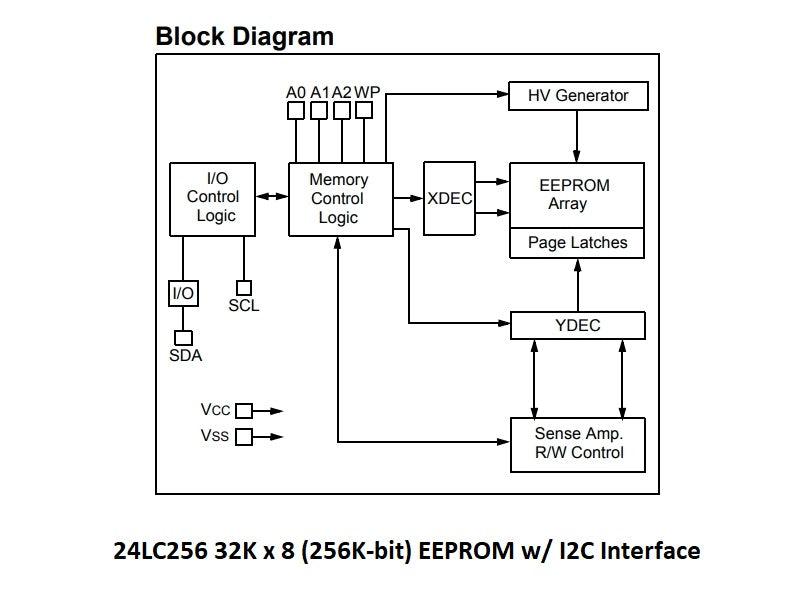
The 24LC256 from Microchip Technology is a 256Kbit (32KB) I²C serial EEPROM in a through-hole DIP-8 package – the most popular EEPROM size for Arduino data logging and embedded configuration storage. With 32KB of non-volatile storage accessible over a 2-wire I²C interface, it provides far more storage than the internal EEPROM of most microcontrollers (Arduino Uno has only 1KB). Up to 8 devices can share a single I²C bus for up to 256KB of addressable storage. The DIP-8 package is ideal for breadboard prototyping.
Electrical Specifications
- Part Number: 24LC256 / 24LC256-I/P / AT24C256
- Package: DIP-8 (through-hole, 2.54mm pitch)
- Capacity: 256Kbit = 32KB = 32,768 bytes
- Interface: I²C (2-wire: SDA + SCL)
- I²C Speed: 400kHz (Fast Mode)
- Supply Voltage: 2.5V – 5.5V
- I²C Address: 0x50–0x57 (set via A0, A1, A2 pins)
- Page Write Size: 64 bytes
- Write Cycle Time: 5ms (typical)
- Write Endurance: 1,000,000 cycles
- Data Retention: 200 years
- Operating Temperature: −40°C to +85°C
Arduino Wiring
- Pin 1 (A0), 2 (A1), 3 (A2): Pull to GND for address 0x50
- Pin 4 (VSS): GND
- Pin 5 (SDA): Arduino A4 (with 4.7kΩ pull-up to VCC)
- Pin 6 (SCL): Arduino A5 (with 4.7kΩ pull-up to VCC)
- Pin 7 (WP): GND (write enabled)
- Pin 8 (VCC): 5V
Typical Applications
- Arduino data logging: Store sensor readings and timestamps (32KB = ~16,000 float values)
- Configuration storage: Non-volatile settings for embedded systems
- Calibration data: Store sensor calibration coefficients
- User preferences: Persistent settings in consumer electronics
Package Contents
- 1 × 24LC256 DIP-8 256Kbit I²C EEPROM IC
32KB of reliable I²C non-volatile storage in a breadboard-friendly DIP-8 package – the 24LC256 is the go-to EEPROM for Arduino data logging and embedded configuration storage.


Blog posts
View all-

IC Chips & Discrete Components Express Shipping...
Shipping IC chips and discrete electronic components internationally requires more than choosing a carrier. ESD-safe packaging, correct HS codes, accurate customs declarations, and carrier selection for your destination all determine...
IC Chips & Discrete Components Express Shipping...
Shipping IC chips and discrete electronic components internationally requires more than choosing a carrier. ESD-safe packaging, correct HS codes, accurate customs declarations, and carrier selection for your destination all determine...
-

From Prototype to Mass Production — How to Scal...
Scaling from prototype to mass production is the most critical transition in a hardware product's lifecycle. The sourcing strategy that works for 10 prototype boards — cut tape, spot pricing,...
From Prototype to Mass Production — How to Scal...
Scaling from prototype to mass production is the most critical transition in a hardware product's lifecycle. The sourcing strategy that works for 10 prototype boards — cut tape, spot pricing,...
-

ISO 9001 Electronic Component Distributor — Wha...
ISO 9001:2015 certification is the most widely recognized quality management standard in the world — but what does it actually mean when an electronic component distributor claims to be ISO...
ISO 9001 Electronic Component Distributor — Wha...
ISO 9001:2015 certification is the most widely recognized quality management standard in the world — but what does it actually mean when an electronic component distributor claims to be ISO...


