



801S Vibration Sensor Module
801S Vibration Sensor Module
Compatible JST cables for sensors and modules — secure & reliable. Shop now.

Couldn't load pickup availability
Sensitive micro shock detecting sensor that outputs pulses when a shock or vibration is detected.
DESCRIPTION
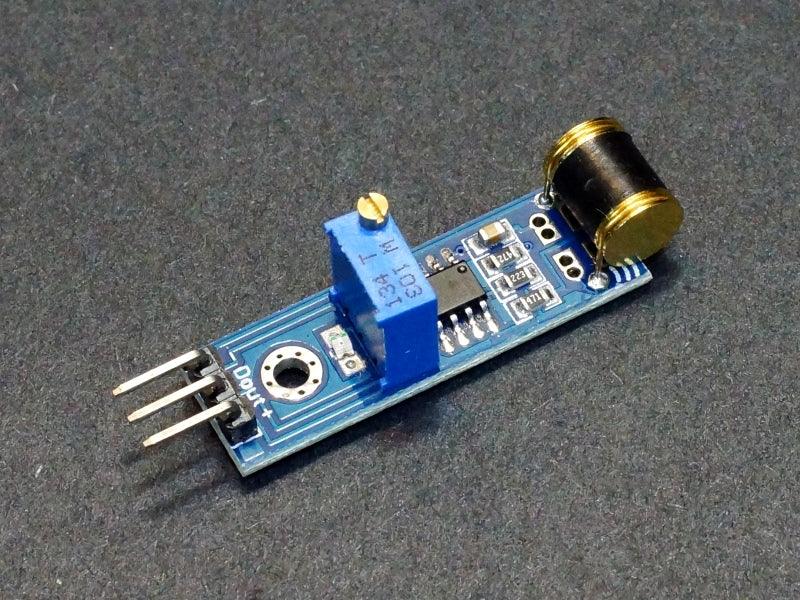
The 801S Vibration Sensor Module is a sensitive micro shock detecting sensor that operates by changing its resistance when a shock or vibration is detected.
PACKAGE INCLUDES:
- 801S Vibration Sensor Module
KEY FEATURES OF 801S VIBRATION SENSOR MODULE:
- Outputs a logic HIGH when module senses a vibration
- On-board LED indicator
- A gold alloy plating ensures a long service life of sensor
- 3.3V and 5V logic compatible
The sensor operates in any orientation and is extremely sensitive to any type of movement such as a light tap or vibration. Unlike many sensors that use a mechanical switching element, this sensor uses resistive element that changes resistance with motion.
The module output is normally LOW and outputs a series of random HIGH pulses when a vibration or shock is detected. The on-board LED is normally ON and goes OFF momentarily or appears to flicker when a shock is detected. It can take up to 2 seconds for the output to return to a steady LOW after the shock / vibration is removed
There are two variants we have seen on this module with different resistor values. The current draw is either about 2mA or about 10mA @ 5V. Most of that is due to the on-board LED.
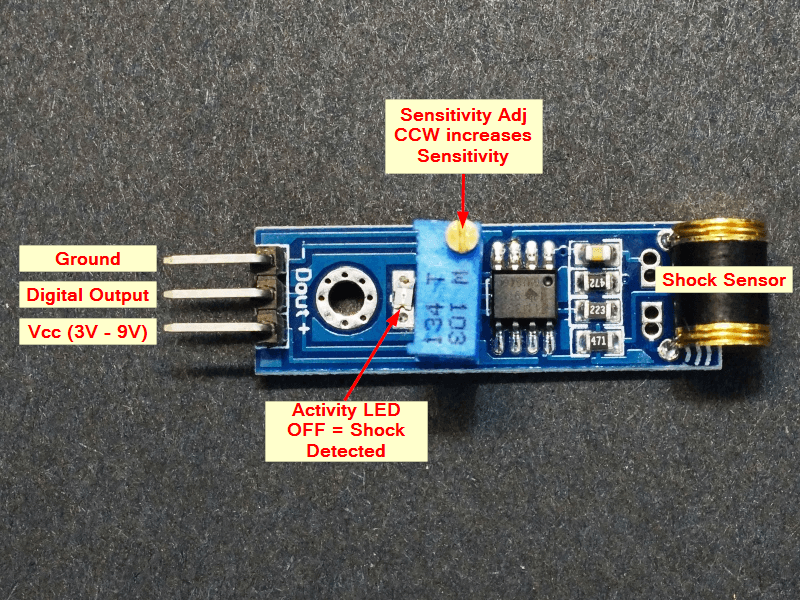
The module includes an LM393 comparator with a potentiometer to allow adjustment of basic sensitivity level. Turning the potentiometer CCW increases sensitivity.
Module Connections
There is a 3-pin header on the assembly for making connections.
1 x 3 Header
- ‘-‘ = Ground
- Dout = Digital Output
- ‘+’ = Vcc 3V to 9V (3.3V or 5V typical)
OUR EVALUATION RESULTS:
This module can be used in a number of applications where an action needs to be taken if a physical shock or vibration is detected.
The scope capture below shows the typical output waveform when the surface the sensor is sitting on is lightly tapped. In this case, the module is being operated at 5V.
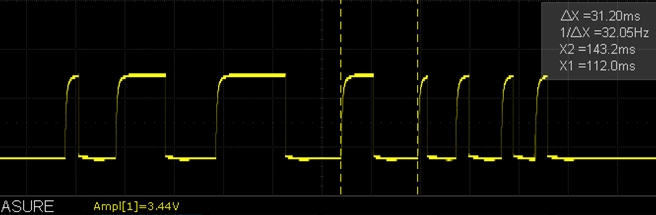
When tapped, the output will transition from LOW to HIGH multiple times as shown in the scope capture. If monitoring the output of the sensor with an MCU input, it may need to be debounced in the software in the same fashion as a typical mechanical switch would be by ignoring transitions for a period of time after the first LOW to HIGH transition is detected.
The datasheet is pretty terse and specifies 9V operation, but we have tested the module from 3V to 9V and it seems to work fine over that range.
BEFORE THEY ARE SHIPPED, THESE MODULES ARE:
- Sample inspected and tested per incoming shipment.
Notes:
- None
TECHNICAL SPECIFICATIONS
| Operating Ratings | Vcc Range | 3.0 – 9V |
| Maximum Current | < 2mA @ 5V | |
| Logic high | Pulled toward Vcc | |
| Logic Low | < 0.2V | |
| Dimensions | L x W (PCB) | 35 x 11.5mm (1.4 x 0.45″) |
| Datasheet | Sencera | 801S |

Blog posts
View all-

IC Chips & Discrete Components Express Shipping...
Shipping IC chips and discrete electronic components internationally requires more than choosing a carrier. ESD-safe packaging, correct HS codes, accurate customs declarations, and carrier selection for your destination all determine...
IC Chips & Discrete Components Express Shipping...
Shipping IC chips and discrete electronic components internationally requires more than choosing a carrier. ESD-safe packaging, correct HS codes, accurate customs declarations, and carrier selection for your destination all determine...
-

From Prototype to Mass Production — How to Scal...
Scaling from prototype to mass production is the most critical transition in a hardware product's lifecycle. The sourcing strategy that works for 10 prototype boards — cut tape, spot pricing,...
From Prototype to Mass Production — How to Scal...
Scaling from prototype to mass production is the most critical transition in a hardware product's lifecycle. The sourcing strategy that works for 10 prototype boards — cut tape, spot pricing,...
-

ISO 9001 Electronic Component Distributor — Wha...
ISO 9001:2015 certification is the most widely recognized quality management standard in the world — but what does it actually mean when an electronic component distributor claims to be ISO...
ISO 9001 Electronic Component Distributor — Wha...
ISO 9001:2015 certification is the most widely recognized quality management standard in the world — but what does it actually mean when an electronic component distributor claims to be ISO...


