



Keszoox
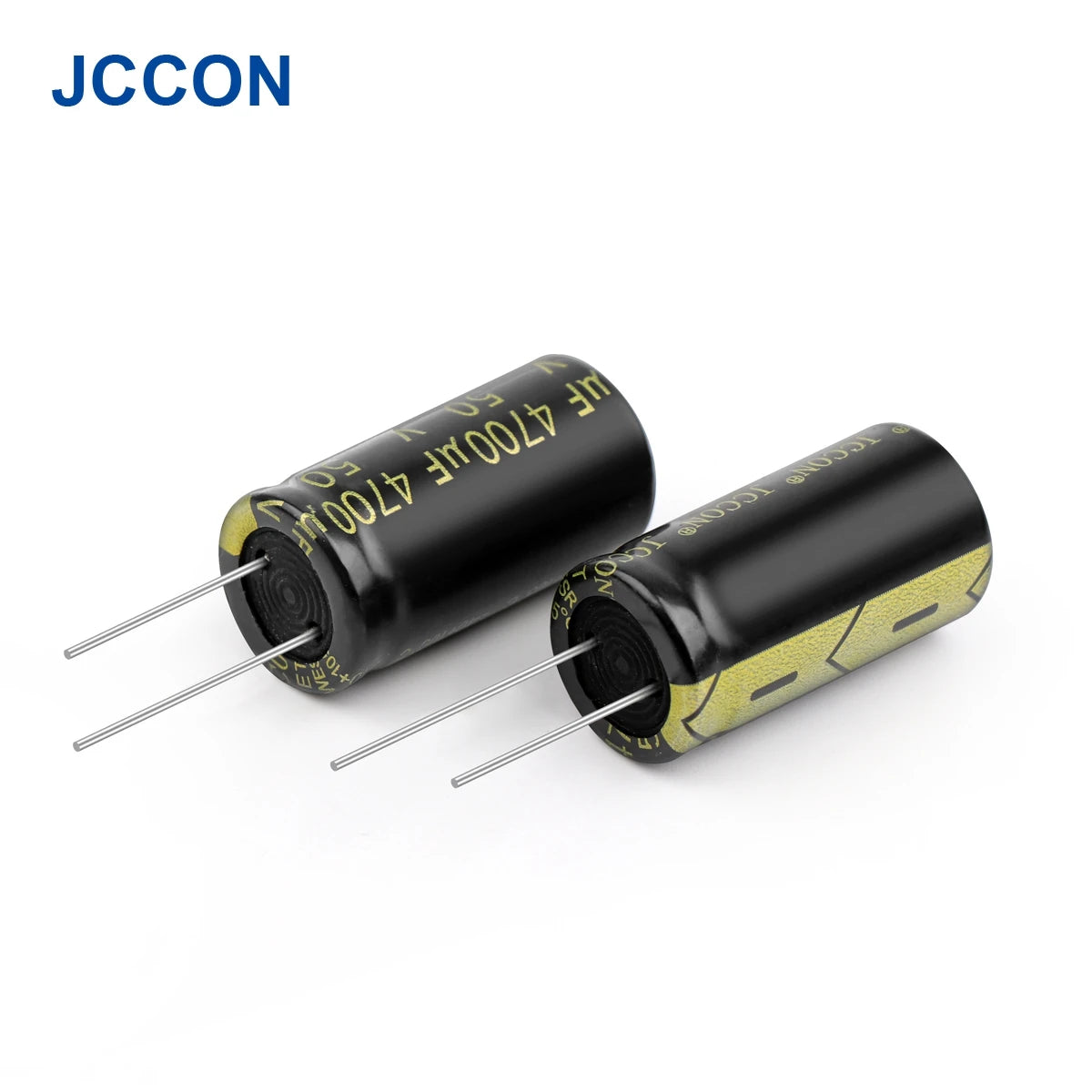
Aluminum Electrolytic Capacitor 50V 4700uF High Frequency Low ESR Low Resistance
Aluminum Electrolytic Capacitor 50V 4700uF High Frequency Low ESR Low Resistance

Couldn't load pickup availability
Aluminum Electrolytic Capacitor — 50V 4700µF, High Frequency, Low ESR
A large-value aluminum electrolytic capacitor rated at 50V 4700µF with low ESR (Equivalent Series Resistance) and high-frequency optimised electrolyte. Designed for power supply bulk filtering, audio amplifier power rail decoupling, DC-DC converter output smoothing, and motor drive energy storage where high capacitance, low impedance at switching frequencies, and 105°C temperature rating are required.
Technical Specifications
| Parameter | Value |
|---|---|
| Capacitance | 4700µF |
| Rated Voltage | 50V DC |
| Tolerance | −20% / +20% (M grade) |
| ESR | Low ESR (high-frequency series) |
| Operating Temperature | −40°C to +105°C |
| Lifetime | 2000–5000 hours at 105°C |
| Lead Pitch | 10mm (standard radial through-hole) |
| Polarity | Polarised (observe + / − marking) |
| Certification | RoHS |
Typical Applications
- Power Supply Bulk Filter: Primary bulk capacitance on the output of linear regulators and switching power supplies to reduce output ripple voltage on 24V–48V rails
- Audio Amplifier Power Rail: Power rail decoupling for Class AB and Class D audio amplifiers — 4700µF provides energy reservoir for transient current demands during bass peaks
- DC-DC Converter Output: Output filter capacitor for 24V–48V buck, boost, and buck-boost converters to smooth switching ripple
- Motor Drive Energy Storage: Energy buffer for DC motor driver circuits to absorb back-EMF spikes and supply peak motor starting current on 24V–48V systems
- Schottky Rectifier Power Supply: Output filter capacitor in transformer-rectifier power supplies for speaker amplifiers and audio equipment
- Industrial Power Supply: Bulk capacitance in 48V industrial power supplies, UPS systems, and battery chargers
Installation Notes
- Observe polarity: The negative lead is marked with a stripe. Reverse polarity will damage the capacitor and may cause venting or rupture.
- Voltage derating: Operate at no more than 80% of rated voltage (40V for a 50V-rated capacitor) for maximum reliability
- Temperature derating: Capacitor lifetime halves for every 10°C above rated temperature — ensure adequate ventilation
FAQ
Q: Can I use this capacitor in a 36V or 48V power supply?
A: Yes. A 50V-rated capacitor is suitable for 36V (72% of rating) and 48V (96% of rating — borderline, consider a 63V-rated capacitor for 48V applications for better derating margin).
Q: What is the difference between this 50V 4700µF and the 35V 10000µF capacitor?
A: The 50V 4700µF is suited for higher-voltage, lower-capacitance applications (24V–48V rails). The 35V 10000µF provides more capacitance for lower-voltage, higher-current applications (12V–24V rails).
Package Contents
- 1 × Aluminum electrolytic capacitor 50V 4700µF (low ESR, high frequency)



Blog posts
View all-

IC Chips & Discrete Components Express Shipping...
Shipping IC chips and discrete electronic components internationally requires more than choosing a carrier. ESD-safe packaging, correct HS codes, accurate customs declarations, and carrier selection for your destination all determine...
IC Chips & Discrete Components Express Shipping...
Shipping IC chips and discrete electronic components internationally requires more than choosing a carrier. ESD-safe packaging, correct HS codes, accurate customs declarations, and carrier selection for your destination all determine...
-

From Prototype to Mass Production — How to Scal...
Scaling from prototype to mass production is the most critical transition in a hardware product's lifecycle. The sourcing strategy that works for 10 prototype boards — cut tape, spot pricing,...
From Prototype to Mass Production — How to Scal...
Scaling from prototype to mass production is the most critical transition in a hardware product's lifecycle. The sourcing strategy that works for 10 prototype boards — cut tape, spot pricing,...
-

ISO 9001 Electronic Component Distributor — Wha...
ISO 9001:2015 certification is the most widely recognized quality management standard in the world — but what does it actually mean when an electronic component distributor claims to be ISO...
ISO 9001 Electronic Component Distributor — Wha...
ISO 9001:2015 certification is the most widely recognized quality management standard in the world — but what does it actually mean when an electronic component distributor claims to be ISO...


