
Keszoox
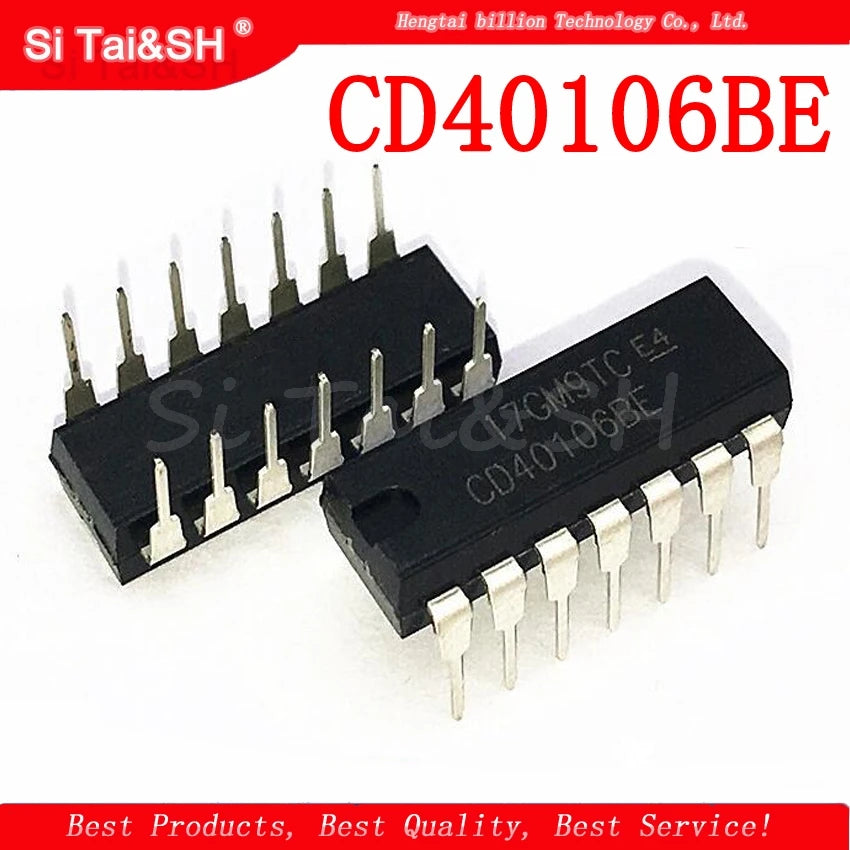
CD40106BE Hex Schmitt Trigger Inverter — DIP-14, 3–15V, CMOS, Noise Immunity (5-Pack)
CD40106BE Hex Schmitt Trigger Inverter DIP-14, 3–15V, CMOS, Noise Immunity (5-Pack)

Couldn't load pickup availability
CD40106BE Hex Schmitt Trigger Inverter — DIP-14, 3–15V CMOS, 6 Inverters (5-Pack)
The CD40106BE is a CMOS hex Schmitt-trigger inverter IC containing six independent inverters with built-in hysteresis. Operating from 3V to 15V, it is the wide-voltage-range alternative to the 74HC14 for applications requiring higher supply voltages. The Schmitt trigger hysteresis (typically 0.9V at 5V, 2.3V at 10V) makes it ideal for converting slow, noisy, or analog-like signals into clean digital logic levels, building RC oscillators, and debouncing mechanical switches.
Key Specifications
| Parameter | Value |
|---|---|
| Package | DIP-14 (through-hole) |
| Inverters per IC | 6 (independent) |
| Supply Voltage | 3V – 15V |
| Hysteresis Voltage | ~0.9V @ 5V; ~2.3V @ 10V; ~3.5V @ 15V |
| Output Current | ±0.5mA @ 5V (CMOS, lower than HC series) |
| Propagation Delay | ~60ns @ 5V (slower than 74HC14) |
| Operating Temperature | -55°C to +125°C |
| Quantity | 5 pieces |
CD40106 vs SN74HC14 — Which Should I Use?
| Feature | CD40106BE | SN74HC14N |
|---|---|---|
| Supply Voltage | 3–15V (wider range) | 2–6V |
| Hysteresis | Higher (2.3V @ 10V) | Lower (0.9V @ 5V) |
| Speed | Slower (~60ns) | Faster (~7ns) |
| Output Current | Lower (0.5mA) | Higher (25mA) |
| Best For | High-voltage, high-noise-immunity circuits | 3.3V/5V digital systems, LED drive |
Why Choose CD40106BE?
- 3–15V supply range — works with 5V, 9V, 12V, and 15V systems where 74HC14 cannot operate
- High hysteresis at 10–15V — superior noise immunity for industrial and automotive environments
- 6 independent inverters — multiple debounce or oscillator circuits in one package
- -55°C to +125°C — extended temperature range for harsh environments
- 5-pack value — sufficient for multiple circuit builds
Compatible With / Common Use Cases
- RC oscillator: Connect R from output to input, C from input to GND — frequency ≈ 1/(1.2×R×C); use at 9–12V for higher hysteresis stability
- Button debounce: Clean up mechanical switch bounce in 5–12V industrial control panels
- Slow signal squaring: Convert thermistor, photodiode, or sensor output to clean digital signal
- Crystal oscillator buffer: Buffer and square up crystal oscillator output
- Analog-to-digital threshold detector: Simple voltage threshold comparator with hysteresis
Frequently Asked Questions
Q: Can I use CD40106 at 3.3V for ESP32 or STM32 circuits?
A: Technically yes (minimum VCC is 3V), but the hysteresis and output drive at 3.3V are very low. For 3.3V systems, SN74HC14 is a better choice with higher output current (25mA vs 0.5mA) and faster switching. Use CD40106 when you need 9–15V operation or higher hysteresis.
Q: What RC values give a 1kHz oscillator with CD40106 at 5V?
A: Using f ≈ 1/(1.2×R×C): for f=1kHz, choose R=100kΩ and C=8.3nF (use 10nF standard value for ~833Hz). Adjust R or C to fine-tune. At 10V supply, hysteresis increases so the same R/C gives a slightly different frequency — recalculate for your supply voltage.
Q: Is CD40106 the same as CD4069?
A: No. CD4069 is a standard hex inverter WITHOUT Schmitt trigger hysteresis. CD40106 has Schmitt trigger inputs with hysteresis. For noise-immune and oscillator applications, always use CD40106 (or 74HC14), not CD4069.
Package Contents
- 5× CD40106BE Hex Schmitt Trigger Inverter IC (DIP-14)