

Keszoox
DIP IC Sockets — 6 to 40 Pin, Solder Type, 2.54mm Pitch, PCB Mount (5-Pack)
DIP IC Sockets 6 to 40 Pin, Solder Type, 2.54mm Pitch, PCB Mount (5-Pack)

Couldn't load pickup availability
DIP IC Sockets — 6 to 40 Pin, Solder Type, 2.54mm Pitch, PCB Mount (5-Pack)
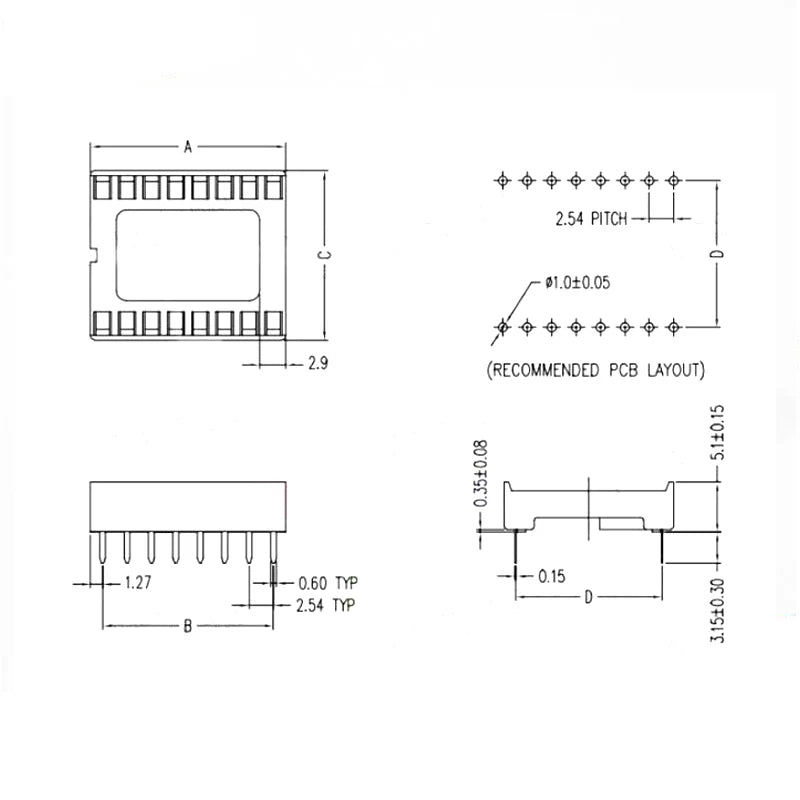
These solder-type DIP IC sockets provide a reliable, removable mounting solution for through-hole DIP integrated circuits on PCBs. With 2.54mm (0.1") pin pitch and tin-plated phosphor bronze contacts, they allow ICs to be inserted and removed without desoldering — essential for prototyping, IC programming, and field replacement of socketed microcontrollers, EEPROMs, and logic ICs.
Key Specifications
| Parameter | Value |
|---|---|
| Pin Count Options | 6, 8, 14, 16, 18, 20, 24, 28, 40 pin |
| Pin Pitch | 2.54mm (0.1") |
| Row Spacing | 7.62mm (300 mil) for ≤28 pin; 15.24mm (600 mil) for 40 pin |
| Contact Material | Phosphor bronze, tin-plated |
| Housing Material | Nylon (UL94 V-0 flame retardant) |
| Mounting Type | Through-hole, solder type |
| Operating Temperature | -40°C to +85°C |
| Quantity | 5 pieces |
Why Use DIP IC Sockets?
- No-desolder IC replacement — swap ICs instantly without heat damage to the PCB or IC
- Prototyping flexibility — test different ICs in the same circuit without resoldering
- IC programming — remove, program in a ZIF socket, and reinsert without desoldering
- Thermal protection — protects heat-sensitive ICs (EEPROM, microcontrollers) from soldering heat
- Field serviceability — enables end-user IC replacement in production equipment
Compatible With / Common Use Cases
- 8-pin: NE555, LM358, ATtiny85, 24C02 EEPROM, op-amps
- 14-pin: 74HC00, 74HC14, LM324, CD4011 logic ICs
- 16-pin: 74HC595, 74HC165, CD4017, PCF8574 logic ICs
- 28-pin: ATmega328P (Arduino UNO MCU), 24LC256 EEPROM
- 40-pin: ATmega16/32, Z80 CPU, 8051 microcontrollers
Frequently Asked Questions
Q: What is the difference between standard DIP sockets and ZIF (Zero Insertion Force) sockets?
A: Standard DIP sockets require moderate force to insert/remove ICs and are designed for permanent or semi-permanent installation on PCBs. ZIF sockets have a lever mechanism for zero-force insertion, ideal for high-cycle IC programming. Use standard sockets for PCB mounting and ZIF sockets for programming jigs.
Q: Can I use a 28-pin socket for a 28-pin narrow-body IC like ATmega328P?
A: Yes, if the socket row spacing matches the IC body width. ATmega328P (DIP-28) uses 600 mil (15.24mm) row spacing — ensure you select the correct wide-body 28-pin socket. Narrow-body 28-pin sockets (300 mil) are for ICs like 24LC256 EEPROM.
Q: Should I use turned-pin (machined) or stamped-pin sockets for critical applications?
A: Turned-pin (machined) sockets have round contacts that grip IC pins more reliably and have lower contact resistance — preferred for high-reliability and high-cycle applications. Stamped-pin sockets (this listing) are cost-effective for general prototyping and low-cycle use. For production equipment, use machined sockets.
Package Contents
- 5× DIP IC Socket (pin count as selected)