

Keszoox
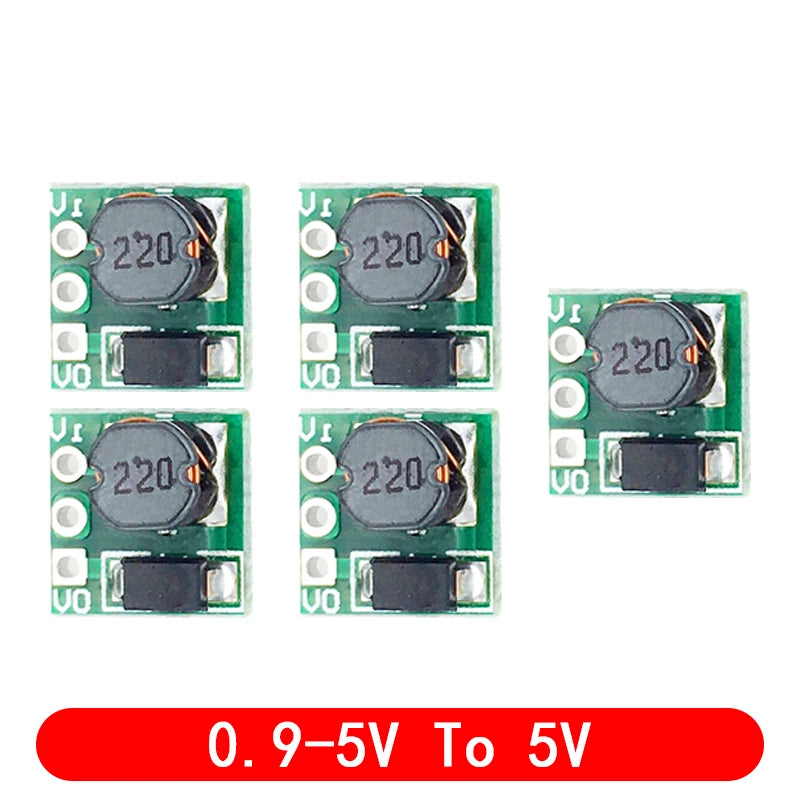
Mini DC-DC Step-Up Boost Converter — 0.9–5V to 3.3V/5V, 500mA, Arduino (2-Pack)
Mini DC-DC Step-Up Boost Converter 0.9–5V to 3.3V/5V, 500mA, Arduino (2-Pack)

Couldn't load pickup availability
Mini DC-DC Step-Up Boost Converter — 0.9–5V to 3.3V / 5V Fixed, 500mA (2-Pack)
This ultra-compact step-up (boost) converter module accepts input voltages as low as 0.9V and boosts them to a fixed 3.3V or 5V output at up to 500mA. Based on a high-efficiency switching regulator IC, it enables single-cell alkaline (1.5V), NiMH (1.2V), or Li-ion (3.7V) batteries to power 3.3V and 5V microcontroller circuits. The miniature PCB footprint makes it ideal for embedding in battery-powered Arduino, ESP8266, and sensor node projects where space is critical.
Key Specifications
| Parameter | Value |
|---|---|
| Input Voltage | 0.9V – 5V |
| Output Voltage | 3.3V or 5V (fixed, select variant) |
| Max Output Current | 500mA |
| Efficiency | Up to 96% |
| Switching Frequency | ~1MHz |
| Quantity | 2 modules |
Input Voltage vs Output Current Capability
| Input Voltage | Max Output Current (5V out) | Battery Source |
|---|---|---|
| 0.9V | ~50mA | Single depleted alkaline |
| 1.2V | ~100mA | Single NiMH cell |
| 1.5V | ~150mA | Single alkaline AA/AAA |
| 3.7V | ~400mA | Single Li-ion / LiPo cell |
| 4.2V | ~500mA | Fully charged Li-ion |
Why Choose This Boost Converter?
- 0.9V minimum input — extracts maximum energy from nearly depleted batteries
- Fixed output — stable 3.3V or 5V without adjustment, plug-and-play for MCU power
- Ultra-compact — smallest boost converter module, fits inside battery compartments
- 96% efficiency — minimal battery drain from converter losses
- 2-pack value — one for the project, one for the next build
Compatible With / Common Use Cases
- Arduino Pro Mini (3.3V): Single AA battery (1.5V) → 3.3V boost → Arduino Pro Mini 3.3V for ultra-low-power sensor node
- ESP8266 / ESP32: Single Li-ion (3.7V) → 3.3V boost for stable ESP8266 power (avoids LDO dropout issues)
- Single-cell Li-ion to 5V: 3.7V LiPo → 5V boost for USB charging or 5V Arduino from single cell
- Coin cell power: CR2032 (3V) → 3.3V boost for BLE beacon or RTC module
- Energy harvesting: Solar cell (0.9–3V) → 3.3V boost for low-power IoT sensor
Frequently Asked Questions
Q: Can this boost converter power ESP8266 from a single AA battery?
A: Yes, with limitations. A single AA (1.5V fresh, 1.0V depleted) boosts to 3.3V. At 1.5V input, output current is ~150mA. ESP8266 draws ~80mA average but peaks at ~300mA during WiFi TX. The 150mA limit may cause voltage dips during WiFi transmission. Add a 470μF capacitor at the output to buffer peak current. For reliable ESP8266 WiFi operation, use 2×AA (3V input) for ~300mA output capability.
Q: What is the difference between a boost converter and an LDO regulator?
A: An LDO (low-dropout) regulator steps voltage DOWN (e.g., 5V→3.3V) and wastes the difference as heat. A boost converter steps voltage UP (e.g., 1.5V→3.3V or 5V) with high efficiency. Use a boost converter when your battery voltage is lower than the required supply voltage. Use an LDO when your supply is higher than needed and efficiency is less critical.
Q: Can I use this module to charge a Li-ion battery?
A: No — this is a power supply module, not a battery charger. It provides a regulated output voltage for powering circuits. To charge Li-ion batteries, use a dedicated charger IC (TP4056, MCP73831). Do not connect the boost converter output to a Li-ion battery terminal.
Package Contents
- 2× Mini DC-DC Step-Up Boost Converter Module (output voltage as selected)