



Keszoox
Schottky Rectifier Power Supply Board with 6 Capacitors for DIY Speaker Amplifier
Schottky Rectifier Power Supply Board with 6 Capacitors for DIY Speaker Amplifier

Couldn't load pickup availability
Schottky Rectifier Power Supply Board — 6 Capacitors, DIY Speaker Amplifier
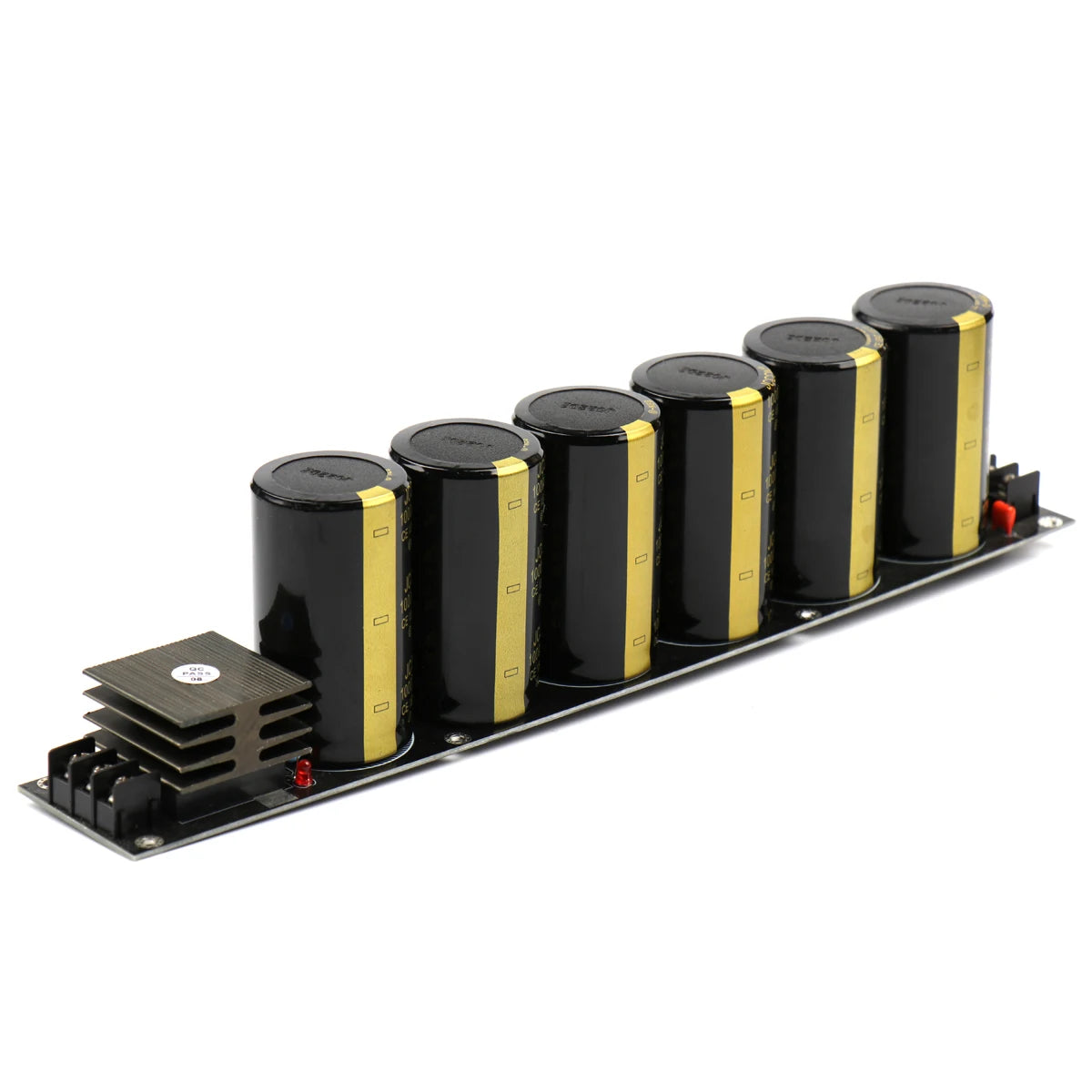
A high-performance AC-to-DC rectifier power supply board using Schottky barrier diodes and six large filter capacitors for low-noise, low-ripple dual-rail power supply construction. Designed specifically for DIY audio amplifier projects (Class AB, Class A, and valve/tube amplifier power stages) where low rectifier forward voltage drop and high capacitance filtering are essential for clean, hum-free audio output. Supports both single-rail and dual-rail (±) power supply configurations.
Technical Specifications
| Parameter | Value |
|---|---|
| Rectifier Type | Schottky barrier diode bridge (low Vf, fast recovery) |
| Filter Capacitors | 6 × electrolytic capacitors (high capacitance, low ESR) |
| Configuration | Full-wave bridge rectifier (single or dual rail) |
| Input | AC from transformer secondary (centre-tapped for dual rail) |
| Output | DC+ / GND / DC− (dual rail) or DC+ / GND (single rail) |
| Ripple Rejection | High (6-capacitor bank reduces ripple voltage) |
| PCB Material | FR4, 1.6mm, heavy copper traces |
| Certification | RoHS |
Schottky vs Standard Rectifier Diodes
| Parameter | Schottky | Standard (1N4007) |
|---|---|---|
| Forward Voltage (Vf) | 0.2–0.4V | 0.6–0.8V |
| Recovery Time | Nanoseconds (fast) | Microseconds (slow) |
| Power Loss | Lower (less heat) | Higher |
| Noise | Lower switching noise | Higher reverse recovery noise |
| Audio Suitability | Preferred for audio PSU | Acceptable for non-audio |
Typical Applications
- Class AB Amplifier Power Supply: Dual-rail (±15V to ±45V) power supply for TDA7294, LM3886, TDA2050, and discrete transistor Class AB audio amplifier boards
- Class A Amplifier: High-capacitance single-rail supply for Class A amplifiers requiring large energy reserves for low-distortion operation
- Preamplifier & Tone Control: Low-noise regulated supply input stage for op-amp preamplifiers and active tone control circuits
- Subwoofer Amplifier: High-current dual-rail supply for subwoofer plate amplifiers and bass amplifier modules
- DIY Hi-Fi Power Supply: Upgrade power supply for commercial amplifier boards (TPA3116, TPA3255) replacing switching PSU with linear rectifier supply for lower noise floor
Wiring Guide
- Connect transformer secondary AC terminals to AC input pads on the board
- For dual-rail: use a centre-tapped transformer (e.g., 2×18V AC for ±25V DC output)
- For single-rail: use a standard secondary winding (e.g., 24V AC for ~33V DC output)
- DC output: connect DC+ and DC− to amplifier board power rails; GND to amplifier ground
- Add a slow-blow fuse on the AC input for protection
FAQ
Q: What transformer do I need for a ±35V dual-rail supply?
A: For ±35V DC output, use a centre-tapped transformer with 2×25V AC secondary (25V AC × √2 − Vf ≈ 35V DC). Transformer VA rating should be at least 1.5× the amplifier output power.
Q: Can I use this board with a toroidal transformer?
A: Yes. Toroidal transformers are preferred for audio power supplies due to lower magnetic field radiation and lower no-load losses. Connect the secondary windings to the AC input pads on the board.
Package Contents
- 1 × Schottky rectifier power supply board with 6 filter capacitors



Blog posts
View all-

IC Chips & Discrete Components Express Shipping...
Shipping IC chips and discrete electronic components internationally requires more than choosing a carrier. ESD-safe packaging, correct HS codes, accurate customs declarations, and carrier selection for your destination all determine...
IC Chips & Discrete Components Express Shipping...
Shipping IC chips and discrete electronic components internationally requires more than choosing a carrier. ESD-safe packaging, correct HS codes, accurate customs declarations, and carrier selection for your destination all determine...
-

From Prototype to Mass Production — How to Scal...
Scaling from prototype to mass production is the most critical transition in a hardware product's lifecycle. The sourcing strategy that works for 10 prototype boards — cut tape, spot pricing,...
From Prototype to Mass Production — How to Scal...
Scaling from prototype to mass production is the most critical transition in a hardware product's lifecycle. The sourcing strategy that works for 10 prototype boards — cut tape, spot pricing,...
-

ISO 9001 Electronic Component Distributor — Wha...
ISO 9001:2015 certification is the most widely recognized quality management standard in the world — but what does it actually mean when an electronic component distributor claims to be ISO...
ISO 9001 Electronic Component Distributor — Wha...
ISO 9001:2015 certification is the most widely recognized quality management standard in the world — but what does it actually mean when an electronic component distributor claims to be ISO...


