



Keszoox
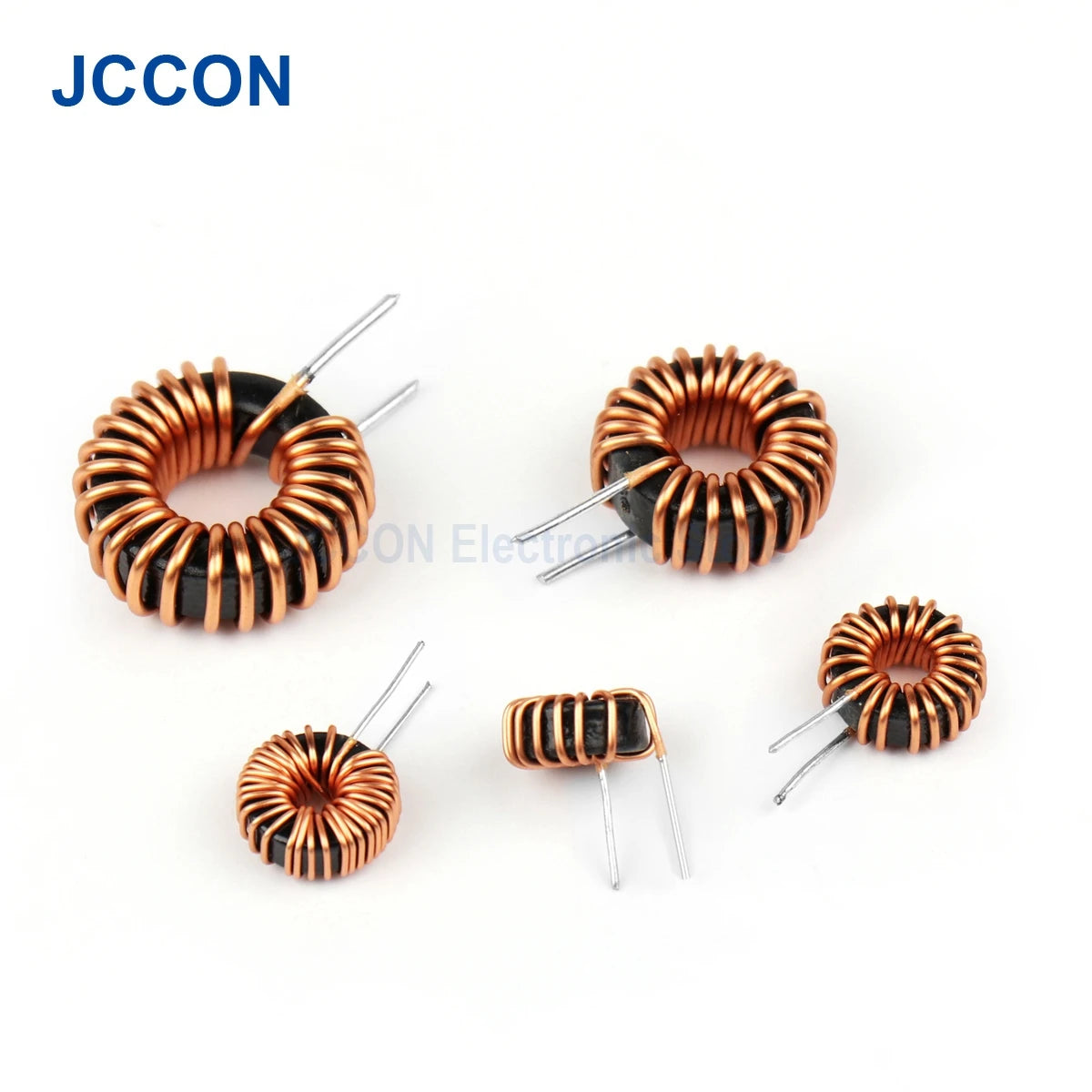
Toroid Core Inductor 10PCS 22uH–470uH 2.5A–5A Wirewound Ø13mm×5mm | Power Filter Choke
Toroid Core Inductor 10PCS 22uH–470uH 2.5A–5A Wirewound Ø13mm×5mm | Power Filter Choke

Couldn't load pickup availability
Toroid Core Wirewound Inductor — 22uH to 470uH, 2.5A–5A (10PCS)
High-quality toroidal inductors for power electronics applications requiring efficient energy storage, EMI filtering, and current smoothing. The closed toroidal core geometry minimizes magnetic flux leakage, resulting in lower EMI radiation compared to rod-core or drum-core alternatives — making these inductors the preferred choice for DC-DC converters, switching power supplies, and power factor correction circuits.
Specifications
| Core Shape | Toroid (ring core) |
| Core Dimensions | Ø13mm outer diameter × 5mm thickness |
| Wire Diameter | 0.5mm – 1.2mm (varies by inductance value) |
| Winding Technology | Wirewound |
| Inductance Range | 22uH – 470uH |
| Current Rating | 2.5A – 5A (varies by value) |
| Tolerance | ±10% |
| Quantity | 10PCS per order |
| Mounting | Through-hole (H = horizontal / V = vertical) |
| Origin | Mainland China |
Available Values & Wire Diameters
| Inductance | Wire Dia. | Orientation | Current |
|---|---|---|---|
| 10uH | 1.2mm | H / V | 5A |
| 22uH | 1.2mm / 1.0mm | H / V | 5A / 4A |
| 33uH | 1.0mm | H / V | 4A |
| 47uH | 1.0mm | H / V | 3A |
| 56uH | 1.0mm | H / V | 3A |
| 68uH | 1.0mm / 0.8mm | H / V | 3A / 2.5A |
| 100uH | 0.8mm / 0.75mm | H / V | 2.5A |
| 220uH | 0.65mm | V | 2.5A |
| 330uH | 0.65mm | V | 2.5A |
| 470uH | 0.5mm | V | 2.5A |
Why Toroid Core Inductors?
- ✅ Closed magnetic path — toroidal geometry contains flux within the core, dramatically reducing EMI radiation vs. open-core designs
- ✅ High efficiency — lower core losses at switching frequencies compared to E-core or rod-core inductors
- ✅ Compact footprint — Ø13×5mm fits tight PCB layouts
- ✅ Wide inductance range — 22uH to 470uH covers boost, buck, and flyback converter requirements
- ✅ Through-hole H/V options — choose horizontal or vertical mounting to suit your PCB layout
- ✅ 10PCS per pack — cost-effective for prototyping and small production runs
Common Applications
- Buck and boost DC-DC converter output filter inductors
- Switching power supply (SMPS) energy storage chokes
- EMI/RFI suppression filters on power lines
- Power factor correction (PFC) circuits
- Class D audio amplifier output filters
- Solar charge controller inductors
- Arduino and Raspberry Pi power supply filtering
Frequently Asked Questions
Q: What is the difference between H (horizontal) and V (vertical) mounting?
A: H (horizontal) inductors lie flat on the PCB with leads pointing down — lower profile, better for space-constrained designs. V (vertical) inductors stand upright — smaller PCB footprint but taller. Select based on your available board space.
Q: Can I use these in a 5A continuous current application?
A: Only the 10uH and 22uH (1.2mm wire) variants are rated for 5A. Higher inductance values use thinner wire and are rated 2.5A–4A. Always select the value with a current rating exceeding your application’s peak current.
Q: Are these suitable for high-frequency switching (100kHz+)?
A: Yes. Toroid core inductors perform well at switching frequencies up to several hundred kHz. Core material and saturation characteristics should be verified against your specific switching frequency and peak current requirements.
Package Contents
- 10× Toroid Core Wirewound Inductors (value as selected)



Blog posts
View all-

IC Chips & Discrete Components Express Shipping...
Shipping IC chips and discrete electronic components internationally requires more than choosing a carrier. ESD-safe packaging, correct HS codes, accurate customs declarations, and carrier selection for your destination all determine...
IC Chips & Discrete Components Express Shipping...
Shipping IC chips and discrete electronic components internationally requires more than choosing a carrier. ESD-safe packaging, correct HS codes, accurate customs declarations, and carrier selection for your destination all determine...
-

From Prototype to Mass Production — How to Scal...
Scaling from prototype to mass production is the most critical transition in a hardware product's lifecycle. The sourcing strategy that works for 10 prototype boards — cut tape, spot pricing,...
From Prototype to Mass Production — How to Scal...
Scaling from prototype to mass production is the most critical transition in a hardware product's lifecycle. The sourcing strategy that works for 10 prototype boards — cut tape, spot pricing,...
-

ISO 9001 Electronic Component Distributor — Wha...
ISO 9001:2015 certification is the most widely recognized quality management standard in the world — but what does it actually mean when an electronic component distributor claims to be ISO...
ISO 9001 Electronic Component Distributor — Wha...
ISO 9001:2015 certification is the most widely recognized quality management standard in the world — but what does it actually mean when an electronic component distributor claims to be ISO...


