

Keszoox
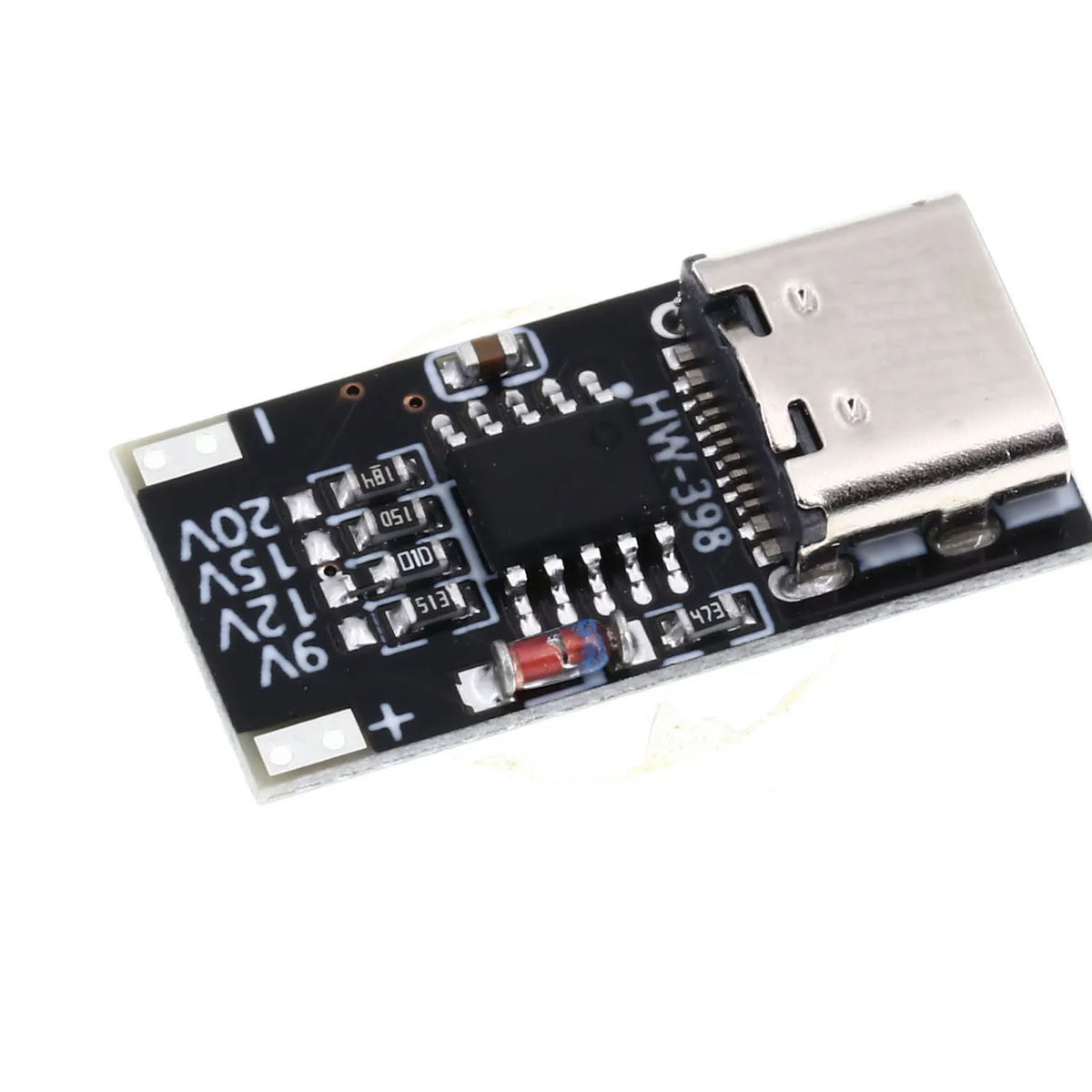
USB PD/QC Decoy Board Fast Charging Boost Module Type-C Adapter for Testing
USB PD/QC Decoy Board Fast Charging Boost Module Type-C Adapter for Testing

Couldn't load pickup availability
USB PD / QC Decoy Board — Type-C Fast Charge Voltage Trigger Module
A USB Power Delivery (PD) and Quick Charge (QC) decoy trigger board that negotiates higher voltages (9V, 12V, 15V, or 20V) from a USB-C fast charger or power bank, converting it into a stable DC power source for non-USB devices. Instead of the default 5V output, this board communicates with the charger using PD/QC protocols to request a specific voltage — enabling you to power routers, optical network terminals (ONTs), LED drivers, and other 9V–20V DC equipment directly from a USB-C fast charger.
Compact 23 × 11.5 × 4mm PCB. Voltage is set by shorting the corresponding solder pads on the board.
Supported Fast Charging Protocols
- USB PD 3.0 / 2.0: Full Power Delivery negotiation, supports fixed PDOs (5V, 9V, 12V, 15V, 20V) and PPS (Programmable Power Supply)
- PPS / QC4+: Programmable voltage in 20mV steps (3.3V–21V), up to 5A
- Qualcomm QC 3.0 / 2.0: Fixed voltage steps (5V/9V/12V/20V)
- Huawei FCP (Fast Charge Protocol): 9V/2A
- Samsung AFC (Adaptive Fast Charging): 9V/1.67A
Output Voltage Configuration
The board has four solder pads corresponding to fixed voltage levels. Short the pad for the desired output voltage:
- 9V pad: Requests 9V from charger
- 12V pad: Requests 12V from charger
- 15V pad: Requests 15V from charger
- 20V pad: Requests 20V from charger
Auto-downshift: If the charger does not support the requested voltage (e.g., you request 20V but charger only supports up to 9V), the board automatically negotiates the highest available voltage. Maximum supported output current: 5A (limited by charger capability).
Specifications
- Input: USB Type-C (from PD/QC fast charger or power bank)
- Output: DC voltage via solder pads or wire connections (9V / 12V / 15V / 20V selectable)
- Maximum Output Current: Up to 5A (charger-dependent)
- PCB Size: 23 × 11.5 × 4mm
- Protocols: PD3.0/2.0, PPS/QC4+, QC3.0/2.0, FCP, AFC
Important Requirements
- The USB-C charger or power bank must support fast charging (PD, QC, FCP, or AFC). Standard 5V chargers will only output 5V regardless of board setting.
- Verify your charger’s maximum supported voltage before setting the board — requesting a voltage higher than the charger supports triggers auto-downshift to the charger’s maximum.
- The actual output current and power are determined by the charger’s rated capability, not the board itself.
- Use appropriate wire gauge for the output current (e.g., 24AWG for ≤1A, 20AWG for ≤3A, 18AWG for ≤5A).
Typical Applications
- Router / ONT backup power: Power a 12V router or optical modem from a USB-C PD power bank during outages
- DIY DC bench supply: Use a USB-C GaN charger as a compact 9V/12V/20V lab power source
- LED driver power: Supply 12V or 20V to LED strip drivers from USB-C charger
- Laptop power via USB-C: Trigger 20V for laptops that accept USB-C PD charging
- Charger testing and validation: Verify PD/QC protocol support and voltage output of chargers
- Embedded system power: Convert USB-C charger to 9V/12V for microcontroller projects requiring higher voltage
- Dormitory power solutions: Power non-USB devices from a single USB-C power bank
Package Contents
- 1 × USB PD/QC decoy trigger board (23 × 11.5mm, Type-C input)