

Keszoox
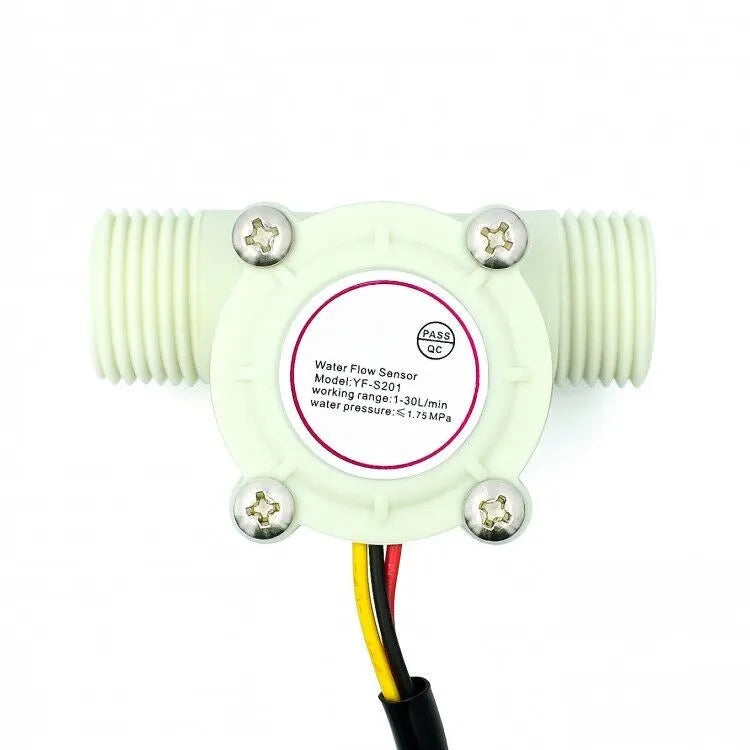
YF-S201 Hall Effect Water Flow Sensor 1–30L/min 2.0MPa | FS300A Liquid Flow Switch for Arduino
YF-S201 Hall Effect Water Flow Sensor 1–30L/min 2.0MPa | FS300A Liquid Flow Switch for Arduino

Couldn't load pickup availability
YF-S201 Hall Effect Water Flow Sensor — 1–30L/min | 2.0MPa | Arduino Compatible
The YF-S201 is the most widely used Hall effect water flow sensor in the Arduino and maker community — a compact, reliable, and affordable solution for measuring liquid flow rate in water supply systems, irrigation controllers, aquarium pumps, coffee machines, and industrial fluid monitoring. A magnetic rotor spins as water flows through the sensor body; each rotation generates a pulse from the Hall effect sensor, which your microcontroller counts to calculate flow rate and cumulative volume. The 2.0MPa pressure rating and 1–30L/min flow range cover the vast majority of domestic and light industrial water system applications.
Specifications
| Model | YF-S201 / FS300A (as selected) |
| Sensor Type | Hall effect (magnetic rotor) |
| Flow Range | 1 – 30 L/min |
| Max Working Pressure | 2.0 MPa (290 PSI) |
| Working Voltage | 5V – 24V DC |
| Output Signal | Pulse (square wave, Hall effect) |
| Pulse Rate | ~450 pulses/litre (YF-S201 typical) |
| Thread Size | G1/2" (BSP) — standard plumbing thread |
| Body Material | Plastic (food-grade compatible) |
| Wire Colours | Red (VCC), Black (GND), Yellow (Signal) |
| Operating Temperature | -25°C to +80°C |
How Hall Effect Flow Sensors Work
Inside the YF-S201, a small plastic rotor with embedded magnets spins freely in the water stream. As water flows, the rotor spins at a rate proportional to the flow velocity. Each magnet pass triggers the Hall effect sensor, generating a digital pulse on the output wire. Your microcontroller counts these pulses over time to calculate:
- Flow rate (L/min) — pulses per second ÷ pulse factor (typically 7.5 for YF-S201) = L/min
- Cumulative volume (L) — total pulse count ÷ pulse factor = total litres
The Hall effect output is a clean digital pulse — no ADC required, directly readable by any digital GPIO pin with a pull-up resistor.
YF-S201 vs. FS300A Comparison
| Property | YF-S201 | FS300A |
|---|---|---|
| Flow range | 1–30 L/min | 1–60 L/min (higher range) |
| Thread size | G1/2" | G1/2" |
| Body material | Plastic | Plastic |
| Best for | Domestic water, irrigation, Arduino projects | Higher flow rate applications |
Key Features
- ✅ Hall effect output — clean digital pulse, no ADC needed, directly readable by Arduino GPIO
- ✅ 1–30 L/min range — covers domestic water supply, irrigation, and light industrial flow monitoring
- ✅ 2.0MPa pressure rating — handles standard mains water pressure (typical mains: 0.2–0.5MPa)
- ✅ 5–24V supply voltage — compatible with 5V Arduino, 12V industrial systems, and 24V PLCs
- ✅ G1/2" thread — standard plumbing thread, fits standard pipe fittings and adapters
- ✅ Food-grade compatible body — suitable for drinking water and food processing applications
- ✅ 3-wire interface — VCC, GND, Signal — simple connection to any microcontroller
Common Applications
- Arduino water meter and flow rate monitor
- Automatic irrigation system flow measurement
- Aquarium and fish tank water flow monitoring
- Coffee machine and water dispenser flow control
- Hydroponics nutrient solution flow monitoring
- Solar water heater flow measurement
- Industrial coolant flow monitoring
- Water leak detection systems
Arduino Wiring & Code
- Connect Red wire to Arduino 5V.
- Connect Black wire to Arduino GND.
- Connect Yellow wire to Arduino digital pin 2 (interrupt-capable).
- Add a 10kΩ pull-up resistor between Yellow wire and 5V.
- Use
attachInterrupt(digitalPinToInterrupt(2), pulseCounter, RISING)to count pulses. - Calculate flow rate:
flowRate = pulseCount / 7.5(L/min, measured over 1 second).
The pulse factor (7.5) is a typical value for YF-S201. Calibrate against a known volume for precise measurements.
Frequently Asked Questions
Q: Does this sensor work with saltwater or chemicals?
A: The YF-S201 is designed for clean water. Saltwater, chemicals, and abrasive fluids will corrode the rotor and body over time. For chemical applications, use a stainless steel or PVDF body flow sensor.
Q: What is the minimum detectable flow rate?
A: The YF-S201 starts generating pulses at approximately 1 L/min. Below this threshold, the rotor may not spin reliably and readings will be inaccurate.
Q: Can I use this with a Raspberry Pi?
A: Yes. Connect the signal wire to a GPIO pin configured as input with pull-up. Use Python’s RPi.GPIO library with edge detection to count pulses.
Package Contents
- 1× YF-S201 or FS300A Hall Effect Water Flow Sensor (model as selected)